Long Live the New Flesh: A Brief History of Body Horror – Nightmare on Film Street (nofspodcast.com)
Mind & Body — The Evolution of Horror
Body horror or biological horror is a subgenre of horror that intentionally showcases grotesque or psychologically disturbing violations of the human body. These violations may manifest through aberrant sex, mutations, mutilation, zombification, gratuitous violence, disease, or unnatural movements of the body. Body horror was a description originally applied to an emerging subgenre of North American horror films, but has roots in early Gothic literature and has expanded to include other media.
A common difference in the body horror genre is that violations or distortions of the body are rarely the result of immediate or initial violence. Instead, they are generally marked by a loss of conscious control over the body through mutation, disease, or other tropes involving uncontrolled transformation.
I will look at the films of David Cronenberg
Shivers – David Cronenberg (1975)
David Cronenberg: Shivers (1975) — 3 Brothers Film
A nice little review some of the observations copied and pasted here:
Shivers is the moment David Cronenberg came into his own as a filmmaker, even though he himself said it “was the beginning of my career as a movie-maker, and the end of my career as as film-maker [sic].” Cronenberg is uncharitable to himself in this assessment. To be fair, unlike Stereo or Crimes of the Future, Shivers is not an experiment where Cronenberg is allowed free reign. It doesn’t serve entirely as an avenue for exploring esoteric concepts nor does it enjoy the limitations nor freedoms of no-budget experimental filmmaking. Instead, it is a rousing genre picture that weds Cronenberg’s cerebral obsessions with the thrills of a grindhouse B-movie. It explores the sorts of concepts you`d expect of a Cronenberg film while also satisfying the genre crowd with bloody violence and inventive thrills. In short, Shivers shows Cronenberg having his cake and eating it too, proving that he can conjure conventionally-appealing entertainment that still has the capacity to shock with its imagery and dazzle with its ideas…
We see an older man murdering a young woman in a schoolgirl outfit, disfiguring her corpse, and then committing suicide. The scene’s nudity and copious amounts of blood cue us into the B-movie bonafides of the picture. It introduces the picture’s main horror concept. We soon learn that the murderer was Dr. Hobbes, who was designing some kind of replacement organs for the Northern Hemisphere Organ Transplant Society (a Cronenbergian name if there ever was one), and that he had transplanted the girl, Annabelle, with some parasitic organ that he intended on neutralizing by murdering her. Of course, his plan doesn’t work as Annabelle had already spread the parasite to other individuals, including Nick Tudor (Alan Migicovsky), a married businessman living in the tower. The parasite begins to spread and turn the tower’s residents into sex-crazed zombies who aggressively seek to have sex with whomever is nearest them in order to pass on the parasite. In essence, Shivers is a zombie picture where the infection is transmitted through an STI parasite that turns people into rapists…
In Shivers, Cronenberg plays with the deviant nature of his imagery and explores this through the various ways that the parasite’s sexual craze manifests itself in its victims. With certain individuals, it’s as simple as making them sex-crazed profligates, like drugged-out members of an orgy during the Summer of Love as you see during the aforementioned lesbian sex scene. In other scenes, you see more aggressive forms of sexual behaviour, such as when an infected security guard tries to rape Nurse Forsythe as she ventures into the basement. The most sustained exploration of the parasite’s sexual effects on the body comes in Cronenberg’s depiction of Nick, who begins the film as an aloof philanderer and quickly becomes its chief monster as the parasite’s effect spreads…
In an early scene, Nick violently vomits and writhes in pain due to the parasites travelling throughout his skin. However, soon enough, his pain turns to pleasure; when he vomits the slug in front of his wife, he licks the blood off his lips afterwards, savouring the flavour. Later, he encourages the parasites to travel throughout his body, orgasmically relishing every movement of his flesh. All of this is best captured in a scene in front of a mirror, as Nick prods himself and watches his body change in a scene that serves as a prototype for similar scenes of self-mutilation in Videodrome and The Fly. If Nick’s behaviours haven’t made it abundantly clear, Nurse Forsythe’s words to Roger sum up Cronenberg’s disturbing thesis: “That even dying is an act of eroticism.”
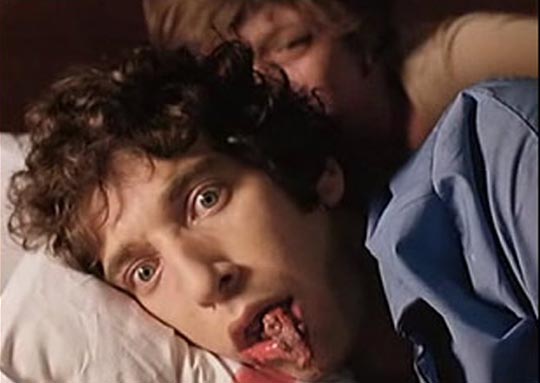

Shivers ≣ 1975 ≣ Trailer – Bing video

Rabid (1977) David Cronenberg

Rabid (1977) Review:
Rabid is, along with Shivers, one of David Cronenberg very first full-length feature horror movies. It does not feature the science-fiction aspect that will later make the success of his other films, but Cronenberg’s taste for blood and gore cannot be better illustrated than in this early masterpiece.
In many ways, this film is a classic zombie film: the infection, the thirst for blood, the virus spreading, etc. The story is relatively simple but interesting, mainly because the plastic surgery hospital background makes it kind of unusual.
Note# During this pandemic 21/02/2021; this film and its predecessor are very similar in the idea of a virus spreading and the attempt to contain it and the panic and anxiety it causes.

On his next film Cronenberg changes tack a little bit even though the film deals with body horror in the sense of rage manifesting as a brood; it is also an analysis of divorce and the psychology of abandonment and the neuroses that can develop.
The Brood is for me the first “proper” Cronenberg body horror movie.
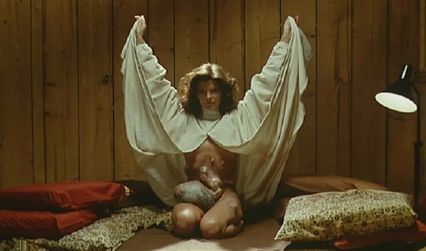
Preceding Scanners, but far more consistent on all levels, The Brood is arguably Cronenberg’s first truly great film.
Hindle plays Frank Carveth, whose estranged wife Nola (Eggar) is undergoing therapy with Dr Hal Raglan (Reed) for the psychological damage she sustained as a child. Raglan’s speciality is the field of ‘psychoplasmics’ – although somewhat murkily expressed, it seems to revolve around the idea of repressed anger and emotion becoming physically manifested – presumably to become, eventually, a separate entity to the patient. Raglan stimulates the growth through repeated role-play, taking on the persona of the various relevant figures in the patient’s life. Nola is his star patient, but when Frank collects their daughter Candice following a stay with her mother, he finds signs of physical violence. Warned by his lawyer that he cannot deny Nola contact with their child without the kind of legal battle that could cost him all access, he begins to investigate Raglan’s Somafree Clinic (a nod to Aldous Huxley there, Mr Cronenberg?) He’s aided by Jan Hartog, a disgruntled – and entertainingly bonkers – ex-patient of Raglan’s, while sharing his worries with Candice’s schoolteacher Ruth Mayer (Susan Hogan). Meanwhile, as Nola’s therapy progresses, her anger gains expression – against her mother Juliana (Nuala Fitzgerald) who physically abused her as a child, then against her father Barton (Harry Beckman) who did nothing to prevent it. And the people who’ve incurred her wrath start dying. Violently. The killers are a pack of creatures, childlike in build but with hideous, wizened faces. The ‘Brood’ are the reason why Nola is Raglan’s star patient – they are psychoplasmics’ ultimate success story, the children of her rage. And when Nola becomes angry, they become murderous…

SYNOPSIS
In a bid to boost ratings, a programmer for a trashy cable channel broadcasts a hyper-violent torture show called Videodrome. Whilst trying to uncover its origins, he goes on a hallucinatory journey into a shadow world of conspiracy, sadomasochism and bodily transformation.
LONG LIVE THE NEW FLESHVIDEODROME Film review
Russell Jones
On my latest Bluray night I introduced this cult classic to my friend who is relatively new to the movies of Cronenberg.
David Cronenberg is one of my favourite directors and many of his movies I watched in the eighties provided me with iconic images that were etched onto my retina such as exploding heads amongst other gruesome imagery.
In the beginning of the nineties Cronenberg sensibilities shifted considerably from body horror to the psychological.
Videodrome was released in 1983 just as there was a glut of video nasties flooding the market and VHS recorders were widely available making it very easy for minors to see unsuitable material.
One of those children was me who digested films such as Evil Dead, Dawn of the dead and of course the Cronenbergian ouvre.
Cronenberg was well into his career at this point and Videodrome delved into the social anxieties and paranoias concerned with videotape of this era.
Videodrome is also written by Cronenberg and follows the main character Max Renn as played by James Woods who is the president of CIVIC-TV a sleazy TV station that specialises in sleazy soft core porn and low grade violent movies (not unlike a combination of Channel 5 and Cannon movies).
Max is on the look out for something new and one of his contacts Harlan discovers a pirate signal showing what appears to be fake snuff videos.
Max is immediately interested in this imagery and in a TV interview declares that sexual violent images can be an outlet and ultimately be cathartic.
Max becomes obsessed with the Videodrome signal and even when his new girlfriend who is also aroused by sexual violent imagery goes missing at an audition for Videodrome he becomes embroiled in a conspiracy where reality and fantasy become forever blurred.
The snuff videos are indeed real and the signal is creating a tumor and hallucinations are just part of the problem.
Videodrome is prescient of the view of media and its role in society and in the age of the internet with violent or sexual images at the click of a button becomes apparent just how this can affect our mental health.
Reality shows, cyber sex, avatars, cyber bullying, false names, online porn models the internet has reeked havoc on our base primal needs bringing out the worst cases of voyeurism and exhibitionism.
Hitler used film as propaganda who knows what he would have used in this age of the internet.
Videodrome is a classic it brings up some great ideas way ahead of its time but the imagery is fantastic with overly sexualised TV’s orgasming and Max penetrating with his own head; vaginal openings with video cassettes inserted to program the individual the film is mindblowing.
Towards the end of the film you kind of give up trying to figure out what’s real and not real and take most of the imagery as a metaphor for the main characters motives which he is an assassin created to kill for corporate interests.
LONG LIVE THE NEW FLESH




https://mubi.com/films/the-fly-1986
The Fly Is Still David Cronenberg’s Masterpiece | Den of Geek
The term “body horror” has clung to David Cronenberg and his oeuvre like a terrible case of herpes that will never go away. Though many of the Canadian director’s movies have nothing to do with corporal terror such as disease, mutation and mutilation, The Fly (1986) perhaps best typifies why Cronenberg has been labeled an auteur of this subgenre of motion picture.
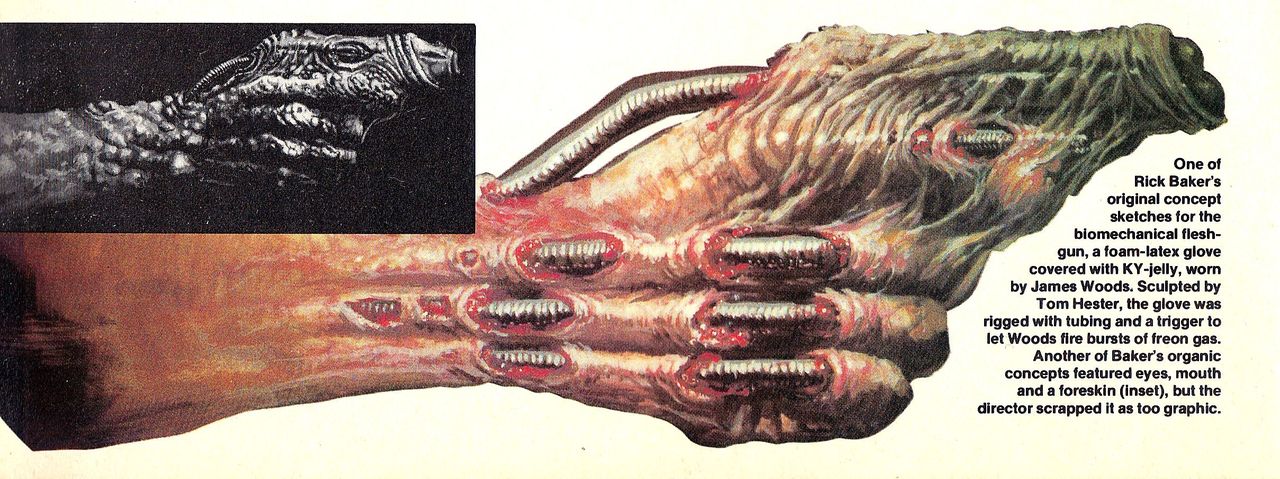
Less a remake of the 1958 film of the same name and more of an update, The Fly tells the story of brilliant scientist Seth Brundle (Jeff Goldblum) who is closing in on creating a teleportation device. Once he perfects the formula, Brundle uses himself as a test subject one evening on a drunken whim. However, a fly sneaks into the teleportation pod with Brundle and their DNA is spliced together. At first, Brundle appears normal. He feels exhilarated, as if all his senses are heightened. He craves sugar and exhibits superhuman strength. But something is wrong. Brundle begins acting in an erratic manner, his face mottled. Then his body begins to fall apart, piece by piece, as the insect mutations inside his DNA begin to take over…
[At Brundle’s lab, Veronica finds him scaling the walls]
Seth: I seem to be stricken by a disease with a purpose, wouldn’t you say? Maybe not such a bad disease after all.
Veronica: I can’t stay here.
Seth: [jumps down onto floor] No, no, no! Why not? Why can’t you?
Veronica: I can’t take it… It’s too much.
Seth: What’s there to take? The disease has just revealed its purpose. We don’t have to worry about contagion anymore, I know what the disease wants.
Veronica: What does the disease want?
Seth: It wants to…turn me into something else. That’s not too terrible, is it? Most people would give anything to be turned into something else.
Veronica: Turned into what?
Seth: What do you think, a fly? Am I becoming a hundred-and-eighty-five pound fly? No, I’m becoming something that’s never existed before. I’m becoming… Brundlefly. Don’t you think that’s worth a Nobel Prize or two?
Some critics believed The Fly to be a metaphor for AIDS as it came out right in the middle of the epidemic. Cronenberg claims that was never his intention and instead meant for the film to be an allegory of cancer or aging. Cronenberg demurred when asked about the AIDS connection and instead said he had hoped for a more universal look at life and death rather than a specific disease. Still, it isn’t difficult to see why some people drew a line between the two.
The body horror extends from Brundle to his girlfriend, Veronica (Geena Davis), a journalist. After Brundle begins to transform, Veronica realizes that she is pregnant. The terror of not knowing what is growing inside of you is a hallmark of body horror. She even has dreams of giving birth to a maggot.


https://mubi.com/films/dead-ringers
SYNOPSIS
Twin gynaecologists take full advantage of the fact that nobody can tell them apart, until their relationship begins to deteriorate over a woman.
“I’ve often thought that there should be beauty contests for the insides of bodies.”
http://cronenbergmuseum.tiff.net/collaborateurs_05-collaborators_05-eng.html


Naked Lunch (1991) | MUBI
https://mubi.com/films/naked-lunch/trailer|
SYNOPSIS
In a drug haze, a bug exterminator using his insecticide to get high believes himself to be a government agent and flees to a secret organization after accidently killing his wife.

Synopsis by Brian J. Dillard
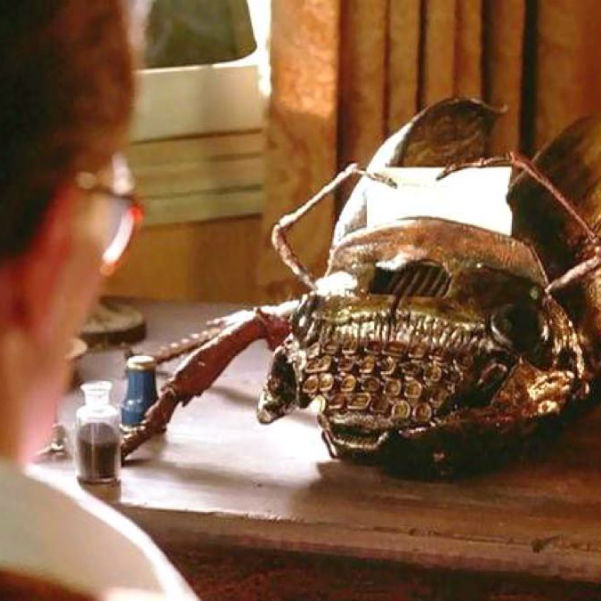
This cinematic/literary hybrid fuses motifs from Beat writer William S. Burroughs’s novel of the same name with elements of the author’s biography and plenty of the cerebral alienation and biomorphic special effects fans of creepy cult director David Cronenberg have come to expect. Bill Lee (Peter Weller) wants to write, but he exterminates bugs to pay the bills. His wife, Joan (Judy Davis), becomes addicted to Bill’s bug powder dust, and soon he joins her in a world of unorthodox hallucinogens; he visits the kindly yet sinister Dr. Benway (Roy Scheider) and walks away with his first dose of the black meat — a narcotic made from the flesh of the giant aquatic Brazilian centipede. Soon, monstrous beetles are whispering conspiracy theories in Bill’s ears and his nebbish writer friends Hank (Nicholas Campbell) and Martin (Michael Zelniker) are sleeping with Joan under his nose. When a party trick involving a liquor glass and a gun goes awry, killing Joan, Bill flees to Interzone, a Mediterranean city full of talking insectoid typewriters, double agents, offbeat aesthetes, and plots within plots. As he navigates this paranoid landscape, Bill begins ingesting another drug called mugwump jism and writes fragments that Hank and Martin soon assemble into a novel under the title Naked Lunch. As beat literature aficionados know, Interzone is based on Tangiers — the city where Burroughs wrote Naked Lunch. The incident in the film in which Hank and Martin appropriate Bill’s writing and have it published closely approximates the real-life circumstances of the novel’s publication, although it was Allen Ginsberg and Jack Kerouac who helped out the real-life Burroughs. The William Tell incident that kills Bill’s wife is also drawn from the author’s real life. “William Lee” is both Burroughs’ literary stand-in and the name under which he published his first autobiographical novel Junky. Ian Holm, who plays Joan Frost’s husband, Tom, would appear in Cronenberg’s similarly experimental eXistenZ several years later.

Synopsis
“Crash” is about the strange lure of the auto collision, provoking as it does the human fascination with death and the tendency to eroticize danger. Most motorists will slow down to stare at the scene of a collision; they may feel their pulses quickening and become aware of the fragility of their own bodies. The characters of “Crash” carry this awareness a step further, cherishing and nurturing it. For them, a car collision is a sexual turn-on, and a jolting life force they come to crave.

“After being bombarded endlessly by road-safety propaganda it was almost a relief to find myself in an actual accident.”
― J.G. Ballard, Crash
“Trying to exhaust himself, Vaughan devised an endless almanac of terrifying wounds and insane collisions: The lungs of elderly men punctured by door-handles; the chests of young women impaled on steering-columns; the cheek of handsome youths torn on the chromium latches of quarter-lights. To Vaughan, these wounds formed the key to a new sexuality, born from a perverse technology. The images of these wounds hung in the gallery of his mind, like exhibits in the museum of a slaughterhouse.”
― J.G. Ballard, Crash

eXistenZ (1999) Trailer on MUBI
SYNOPSIS
After unveiling her new virtual-reality project eXistenZ, superstar game designer Allegra is attacked by an anti-gaming group. She is rescued by Ted, and insists that they play the game to know if it has been damaged. They soon find out that their sense of reality can become dangerously distorted.
Collaborators: eXistenZ: Bioports and Pods | David Cronenberg : Virtual Exhibition (tiff.net)
Guys are always using the same lame excuses. First Ted licks Allegra’s bio-port. Then he says, “That wasn’t me–it was my game character!” Allegra is the world’s leading designer of virtual reality games. her newest game is named “eXistenZ,” and the bio-port plugs directly into the lower spine and connects to the game’s control pod via an “umbrycord.” When you’re hooked up, you can’t tell the game from reality. Not even if you designed the game.
“eXistenZ” is the new film from David Cronenberg, the Canadian director who must be a thorn in the side of the MPAA ratings board. He’s always filming activities that look like sex, but don’t employ any of the appurtenances associated with that pastime. In his previous film, “Crash (1997)”, the characters exhibited an unhealthy interest in wounds. This time it’s bio-ports. And what about those “MetaFlesh Game Pods,” input devices which combine the attributes of a joystick, a touch pad and a kidney? They pulse with a life of their own, and Allegra holds her as if it’s a baby, or a battery-powered shiatsu machine.
“eXistenZ” arrives a few weeks after “The Matrix,” another science-fiction movie about characters who find themselves inside a universe created by virtual reality. “The Matrix” is mainstream sci-fi, but “eXistenZ,” written by Cronenberg, is much stranger; it creates a world where organic and inorganic are not separate states, but kind of chummy. Consider the scene where an oil-stained grease monkey implants a bio-port in the hero, using a piece of equipment that seems designed to give a lube job to a PeterBilt.
Jennifer Jason Leigh, that fearless adventurer in extreme roles, plays Allegra, whose new game is being marketed by Antenna Research. Jude Law is Ted, the company’s marketing trainee. Allegra barely misses being killed during a demonstration of “eXistenZ,” when an assassin slips past the metal detectors at the door with a gun made of flesh and blood. Ted helps her escape, and later, when he cuts the bullet out of her shoulder, he discovers it’s not a bullet but a … hmmm, this is interesting … a human tooth. She decides Ted needs his own bio-port, and looks for a “country gas station.” When she finds one (with a sign that says Country Gas Station) we assume they’re inside the game, which is why she knows the station’s name: She wrote it, and maybe also created its owner, named Gas (Willem Dafoe).
She knows her way around this world and isn’t surprised when they’re told, “Look for a Chinese restaurant in the forest–and order the special.” The owner rattles off the chef’s daily selection, explaining that “mutant reptiles and amphibians produce previously unknown taste sensations.” But Ted insists on the daily special and gets a dish that’s really bony. No wonder. The bones click together into a gun. And soon they visit the Trout Farm, where organic game pods are grown, and come up against Kiri Vinokur (Ian Holm), who’s the owner of Cortical Systematics, a rival game firm.
Cronenberg’s film is as loaded with special effects as “The Matrix,” but they’re on a different scale. Many of his best effects are gooey, indescribable organic things, and some of the most memorable scenes involve characters eating things that surgeons handle with gloves on. He places his characters in a backwoods world that looks like it was ordered over the phone from L.L. Bean. Then he frames them with visuals where half the screen is a flat foreground that seems to push them toward us, while the other half is a diagonal sliding off alarmingly into the background.
“eXistenZ” is likely to appeal especially to computer game players, since it’s familiar with that world and speculates on its future development. Allegra explains to Ted such phenomena as “genuine game urges”– “something your game character was born to do.” She regards her programming handiwork with musings like, “I’ve devoted five of my most passionate years to this strange little creature.” At one point she’s alarmed to discover, “I’m locked outside my own $38 million game!” And without the password, it looks like neither she nor anyone else can get back inside. What? You mean she didn’t back up her disc?
Roger Ebert film review.


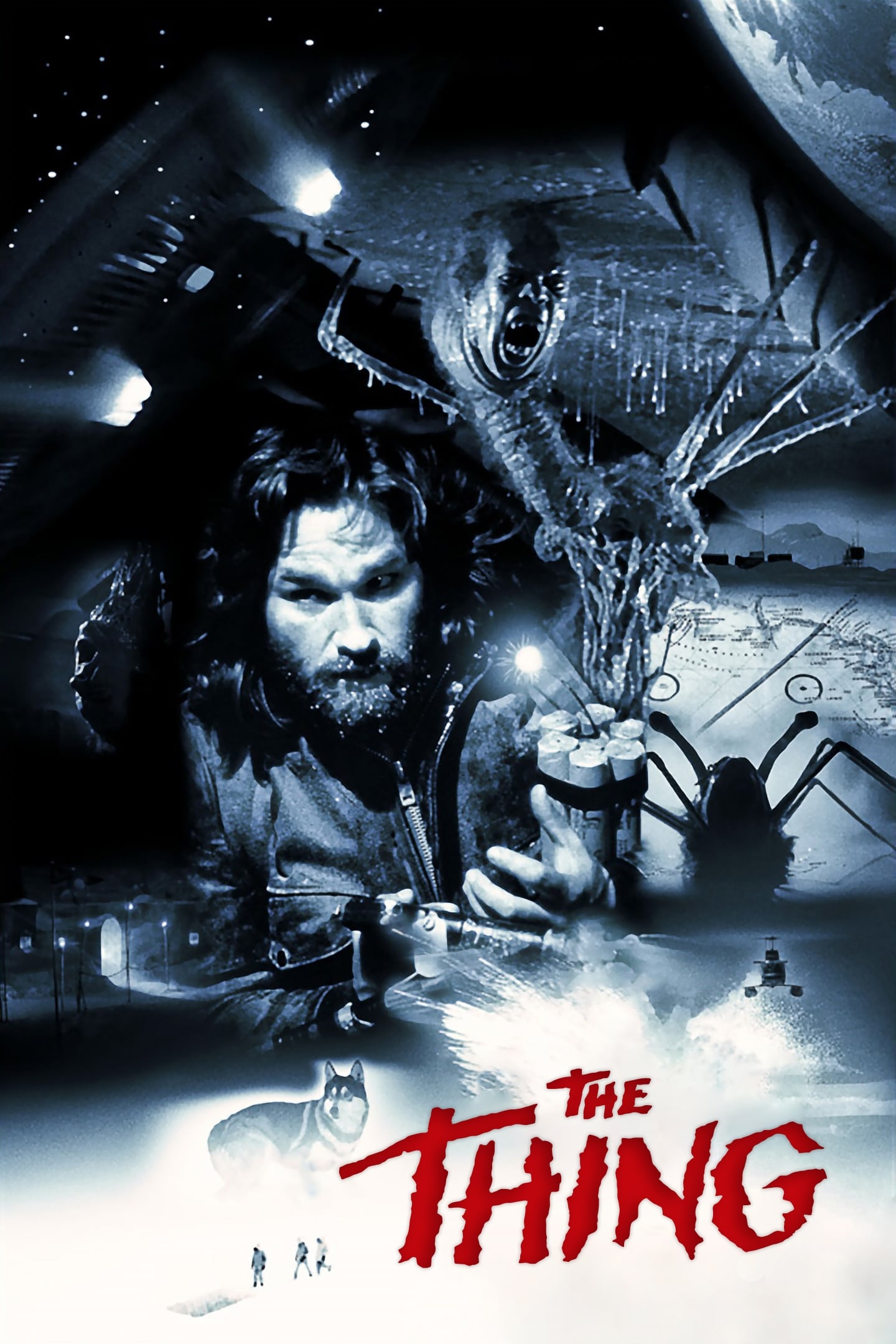
The Thing (1982) Trailer on MUBI
SYNOPSIS
A team of American scientists investigate the empty, destroyed base of their Norwegian counterparts in Antarctica, only to discover a terrifying life force that can take the form of its prey.

So what is it about The Thing, now 30 years old, that makes it worth the attention of modern audiences? Well, as we’ve already established, it’s visually and sonically fantastic, with its measured pacing and practical effects holding up surprisingly well. But the main reason The Thing is still so brilliant is because the sense of paranoia inspired by its central monster is so well handled.
The monster in The Thing reminds us of something philosophers have been writing and thinking about for centuries – that other people are essentially unknowable. Like the Pod People in Invasion Of The Body Snatchers, the Thing’s victims look and behave passably like normal people. It’s only when the beast is cornered that it reveals itself – begging the question, do the Thing’s victims know they’re an alien, since the creature seems capable of assimilating memories as well as physical shapes? And if this is the case, how would I know whether I’d been taken over by the Thing or not?
These disquieting thoughts are all lurking beneath the surface of The Thing, while its shape-shifting monster, all gooey intestines, teeth and bones, disturbs us on a more visceral, knee-jerk level, as the creature presents us with a disgusting parody of our own bodies.
Ryan lambie


An American Werewolf in London (1981) Trailer on MUBI
SYNOPSIS
While hiking though the English moors, American students David and Jack are attacked by a strange beast that kills Jack and wounds David. David discovers that he is doomed to become a werewolf at the next full moon…
An American Werewolf in London Is Still the Best Horror Reimagining | Den of Geek

My favourite scene from Robocop it is truly disgusting a guy has toxic waste poured all over his body and the results are frightening.
10 Morbid Sculptures Brimming with Death and Body Horror – Scene360
Fábio Magalhães | Arte Contemporânea (fabiomagalhaes.com.br)

Hellraiser (1987) | MUBI
Hellraiser (1987) Trailer on MUBI
SYNOPSIS
Clive Barker’s feature directing debut graphically depicts the tale of a man and wife who move into an old house and discover a hideous creature — the man’s half-brother, who is also the woman’s former lover — hiding upstairs.
Teratoma Tumors
Tumors are already terrifying as it is. A runaway mass of mutated cell production, tumors are at best uncomfortable and unsightly growths in or on the body, and at worst, destroy the body from the inside. But Teratoma Tumors really take this to the next level. From the Greek for “Monster Tumor,” Teratomas can develop their own bone, muscle, hair, teeth, eyes, and more bodily tissue. Teratomas are born of rogue “germ cells,” typically found in the ovaries or testes, which can give rise to multiple forms of tissue. When a cell that can produce a number of different tissues snowballs into a large tumescent mass, “demonic” looking tumors can result. Imagine cutting into a tumor and having eyeballs and teeth staring back at you. Except you don’t have to imagine it, you can google it (except…I wouldn’t). Fortunately, most teratoma tumors are actually benign. Plus, studies of teratomas have given rise to groundbreaking stem cell science and other breakthroughs in scientific research. Despite their freakishness, teratomas have an important place in the legacy of medical science.
 Rusty'sArtWerk