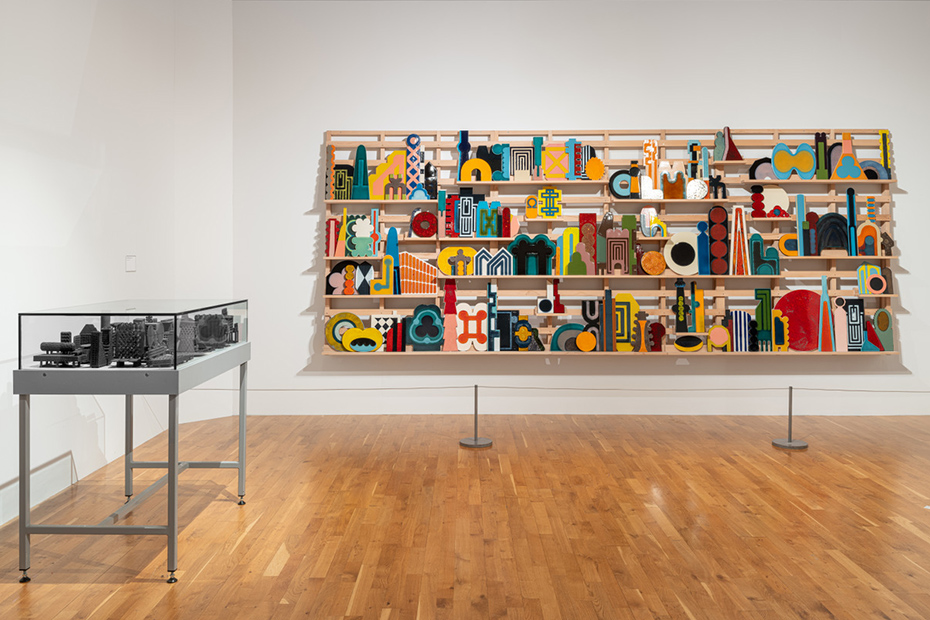
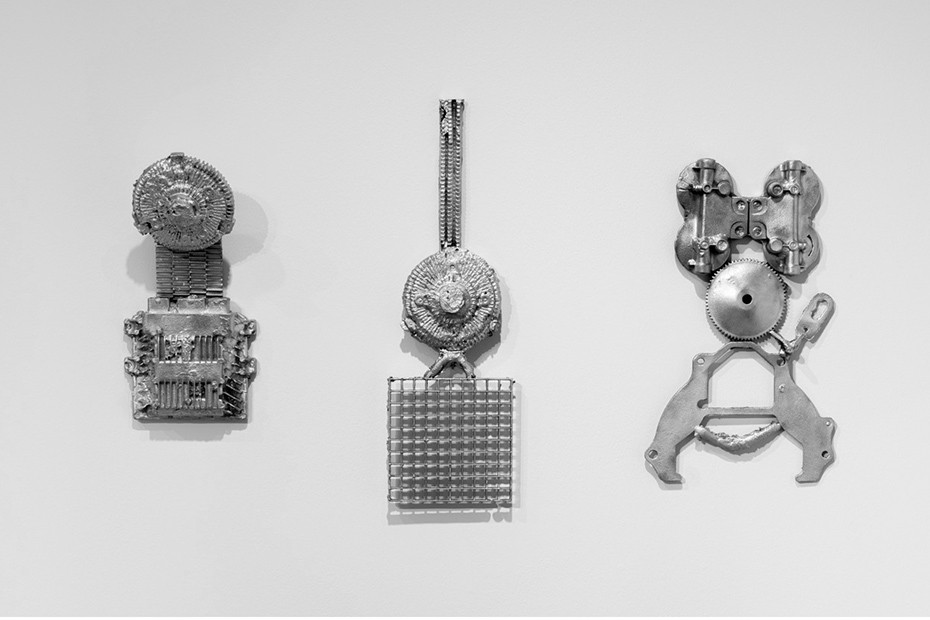
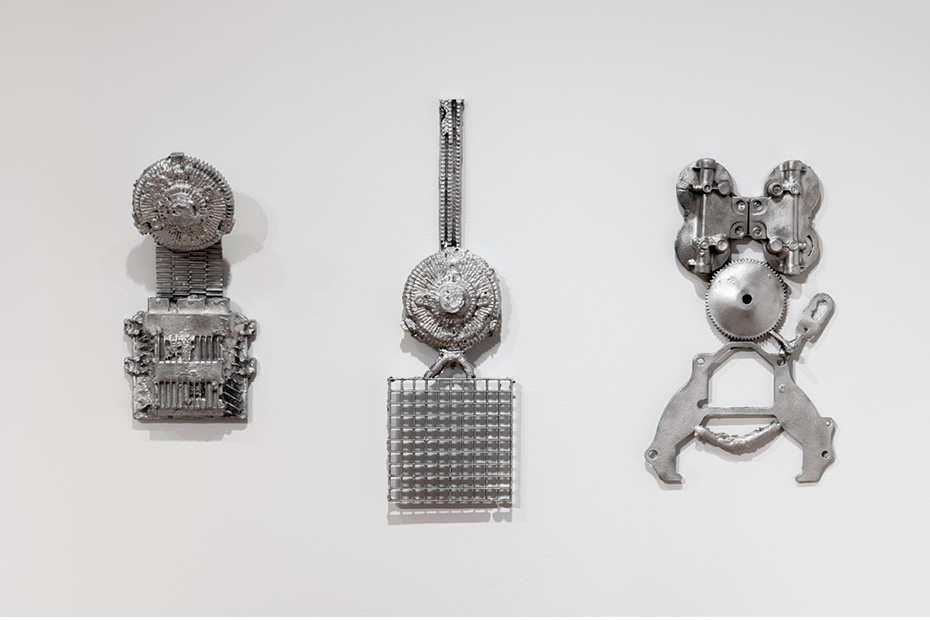
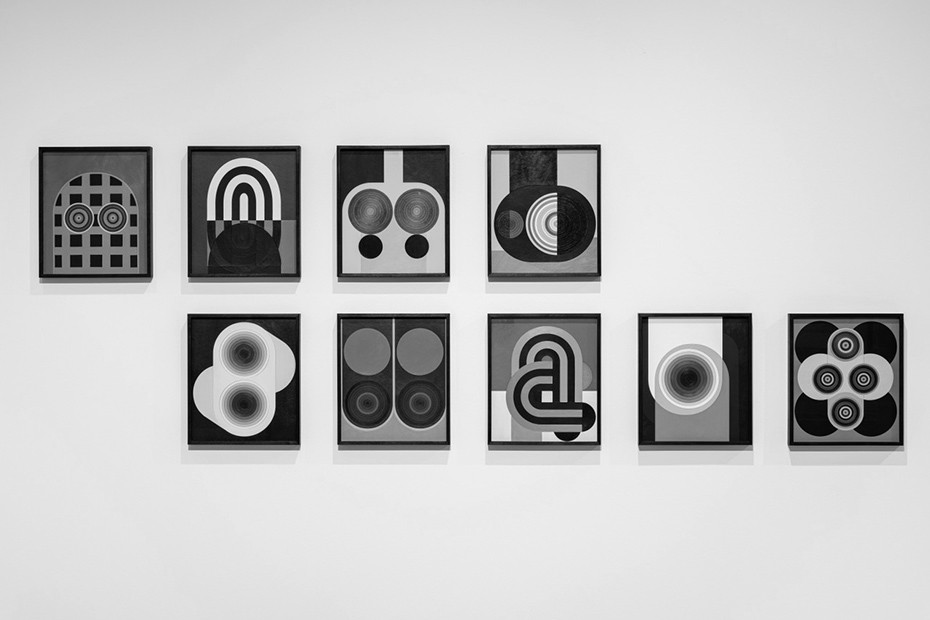
Lubna Chowdhary’s bold, hybrid creations deftly explore the interconnectivity of objects in the material world, across wide-ranging cultural contexts.
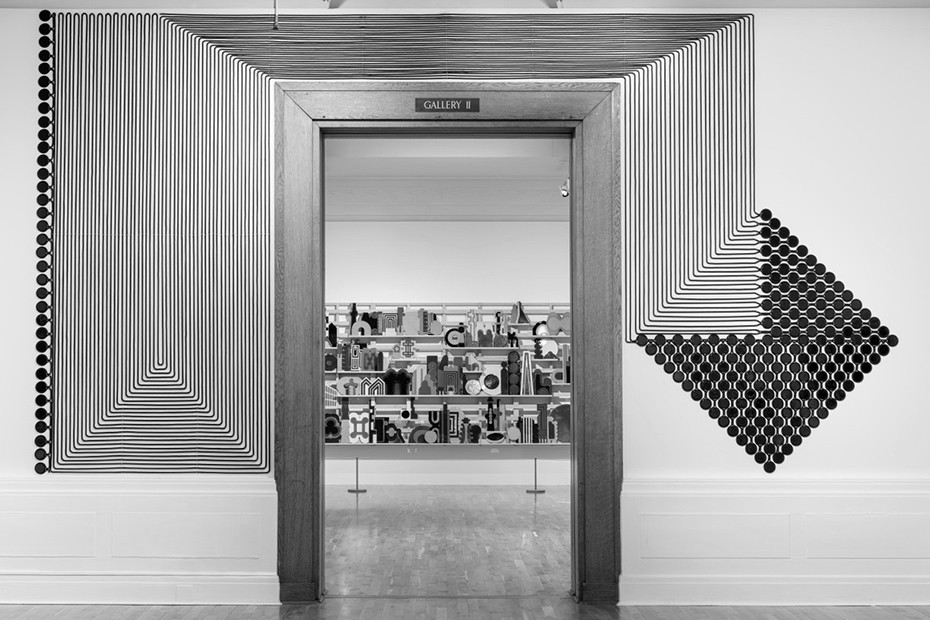
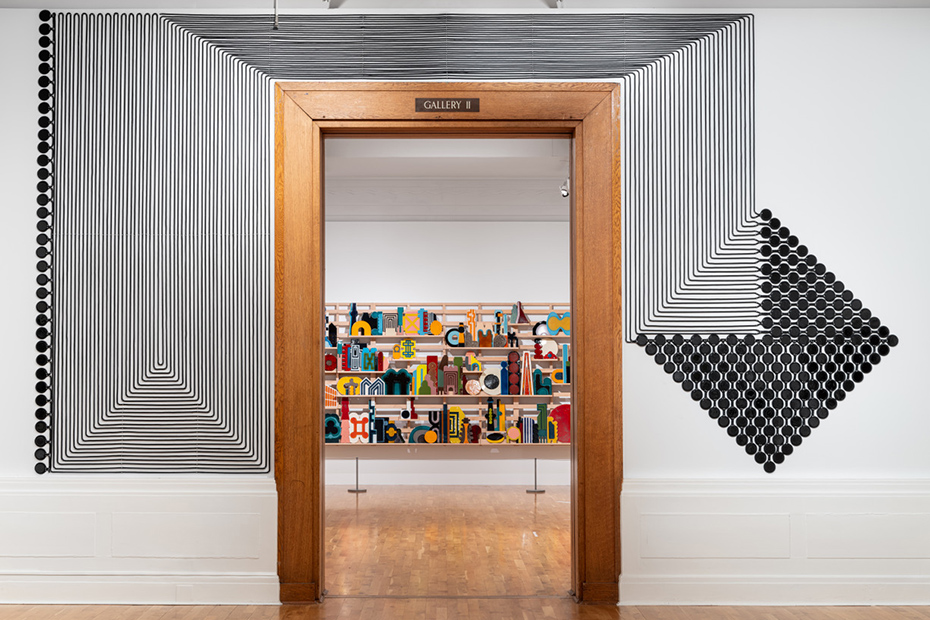
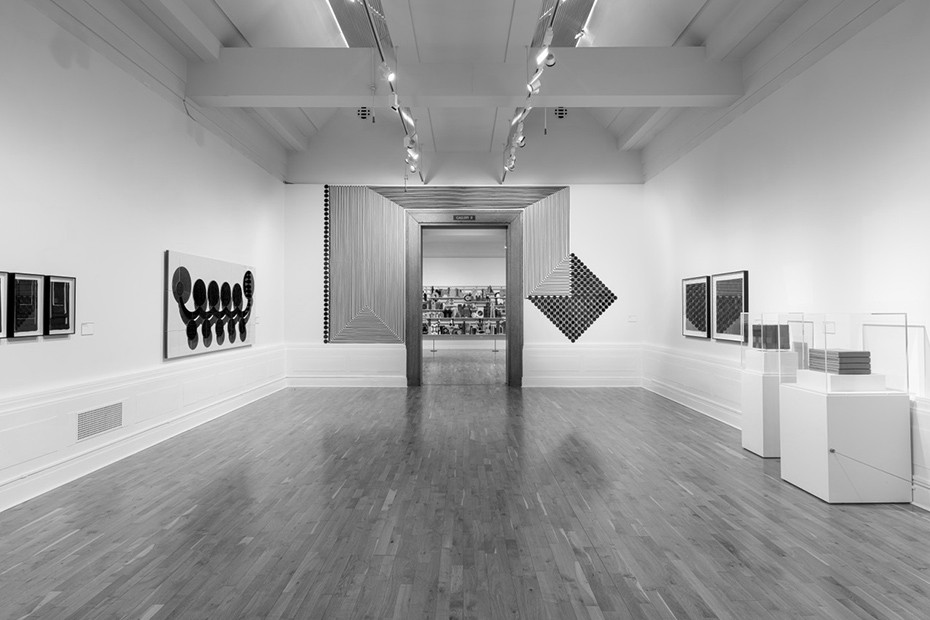
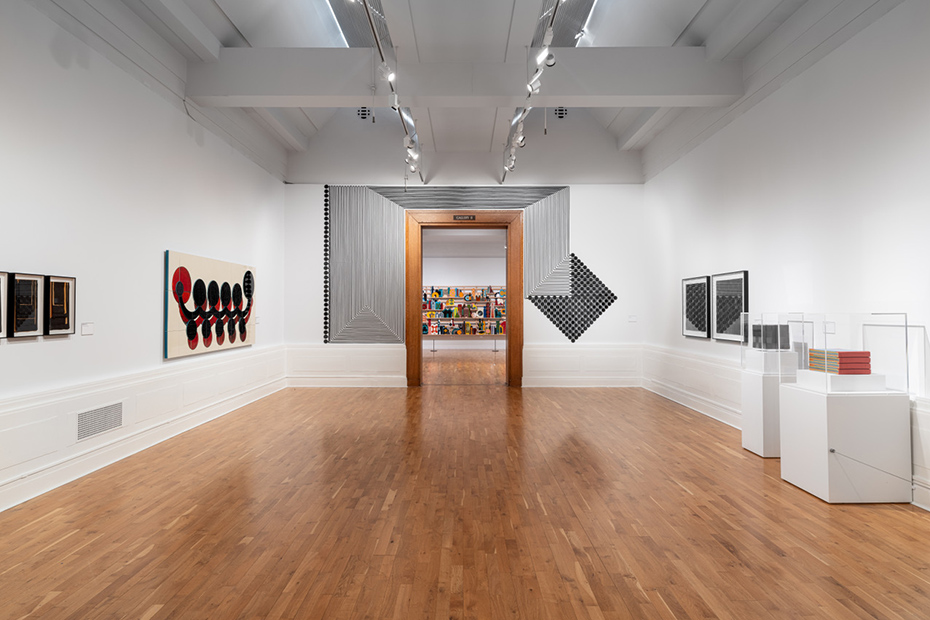
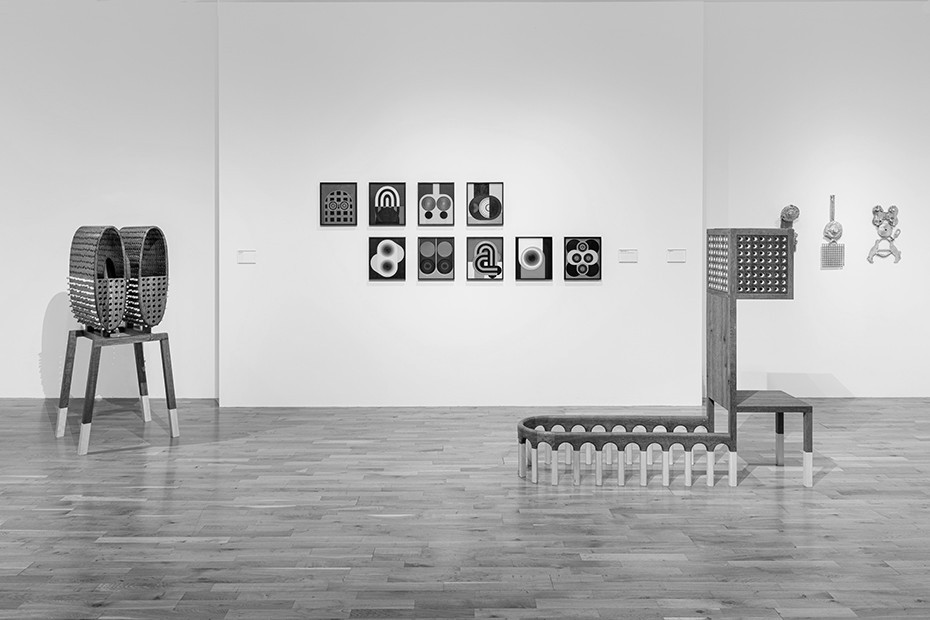
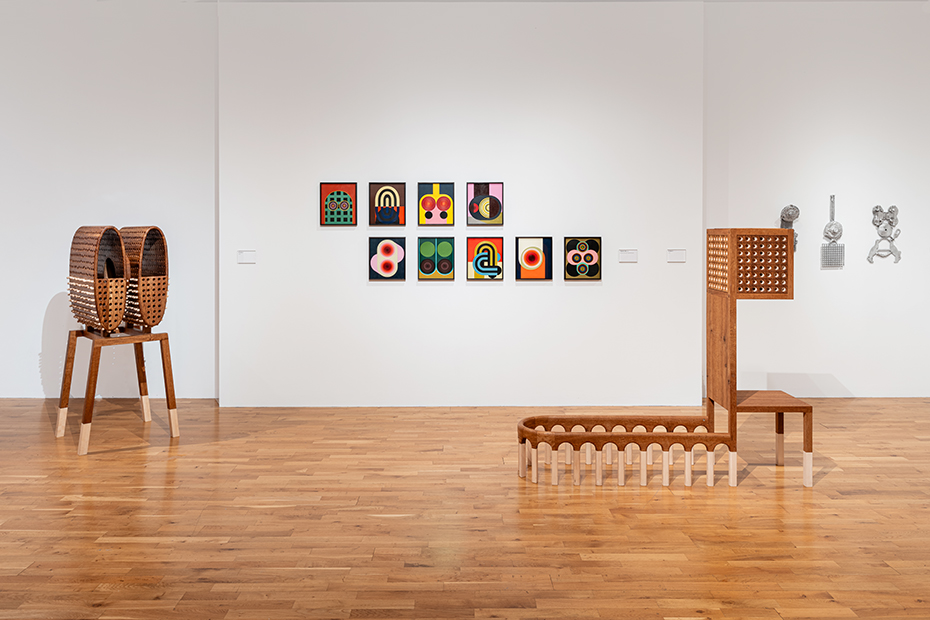
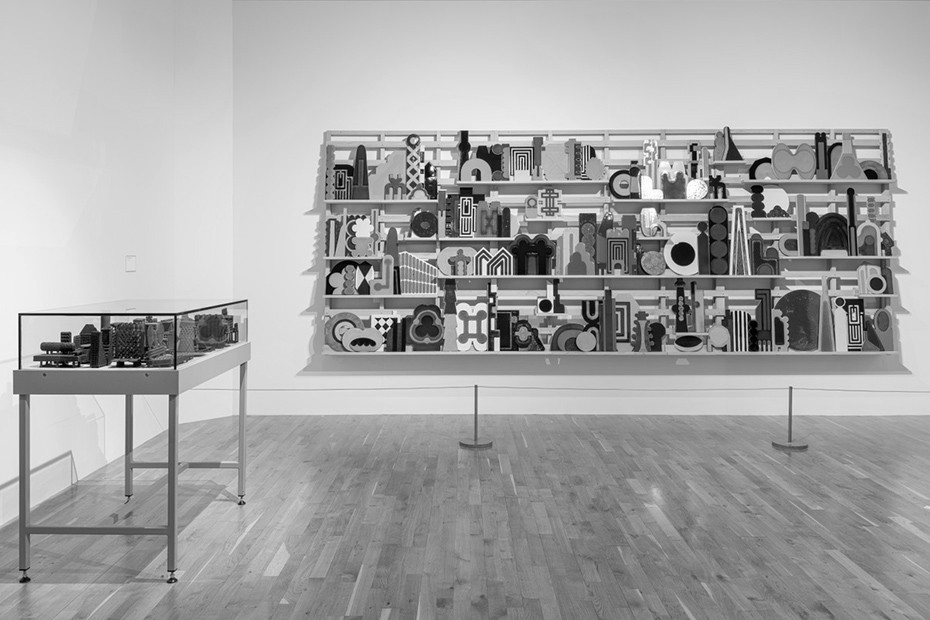
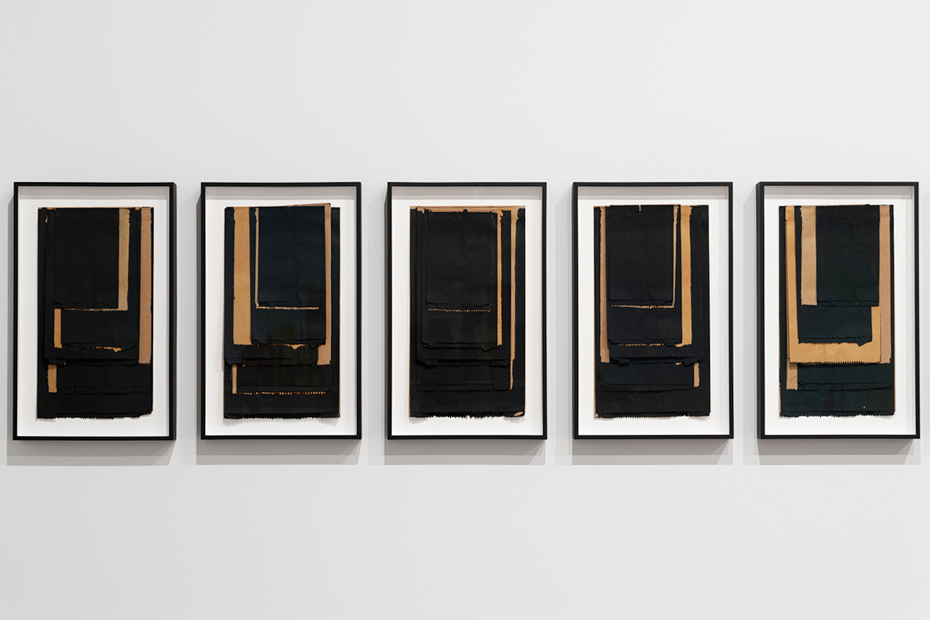
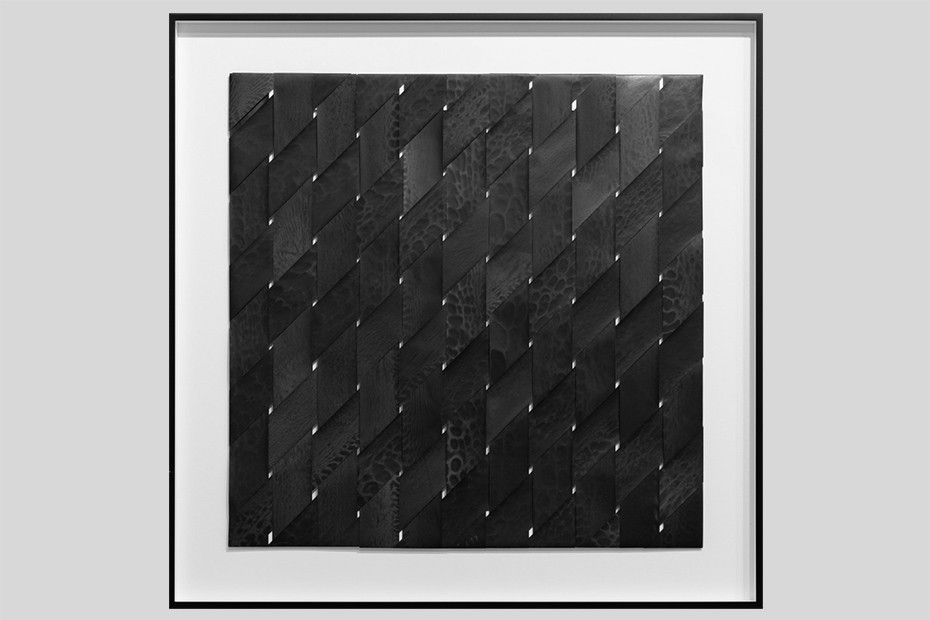
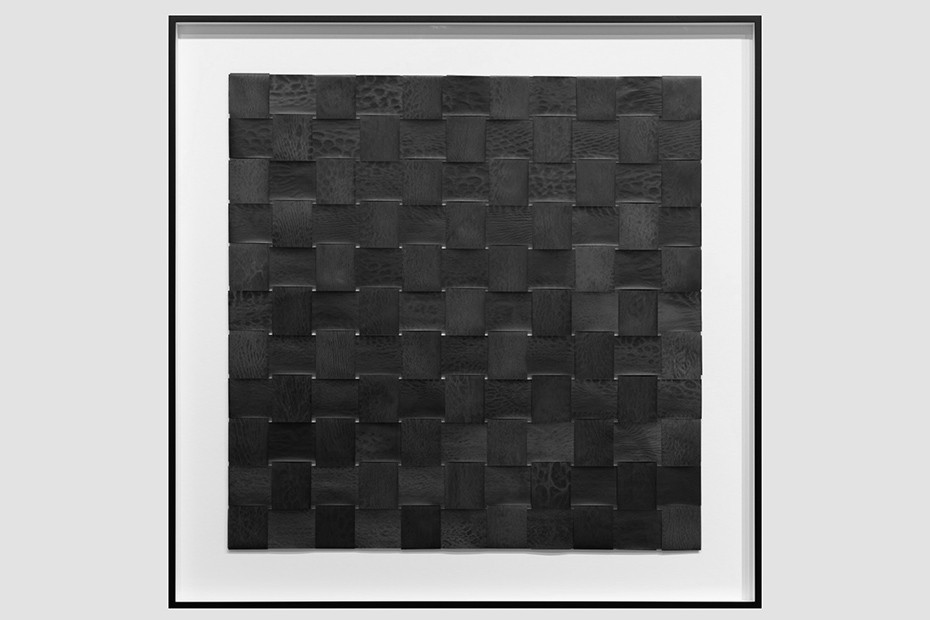
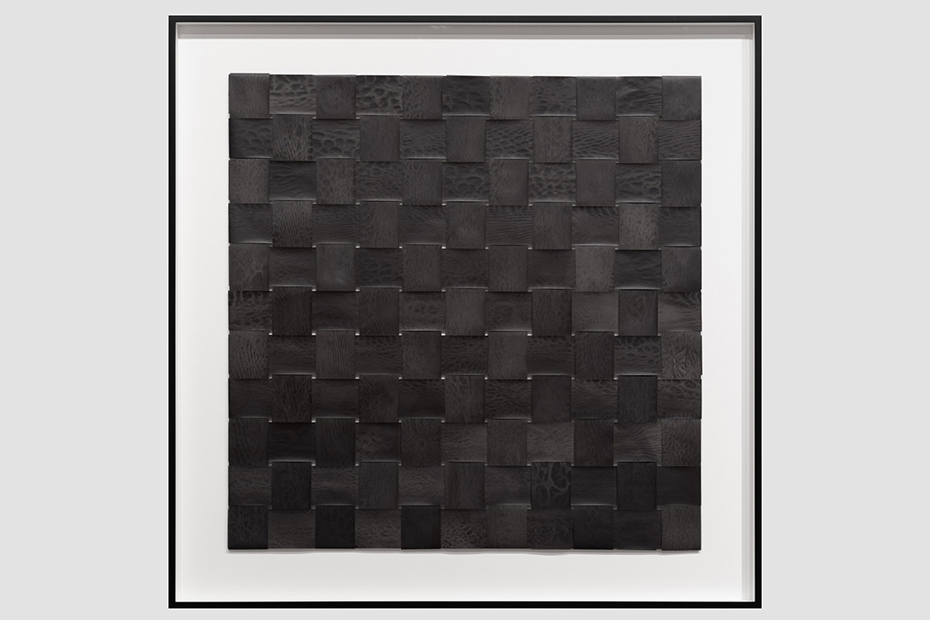
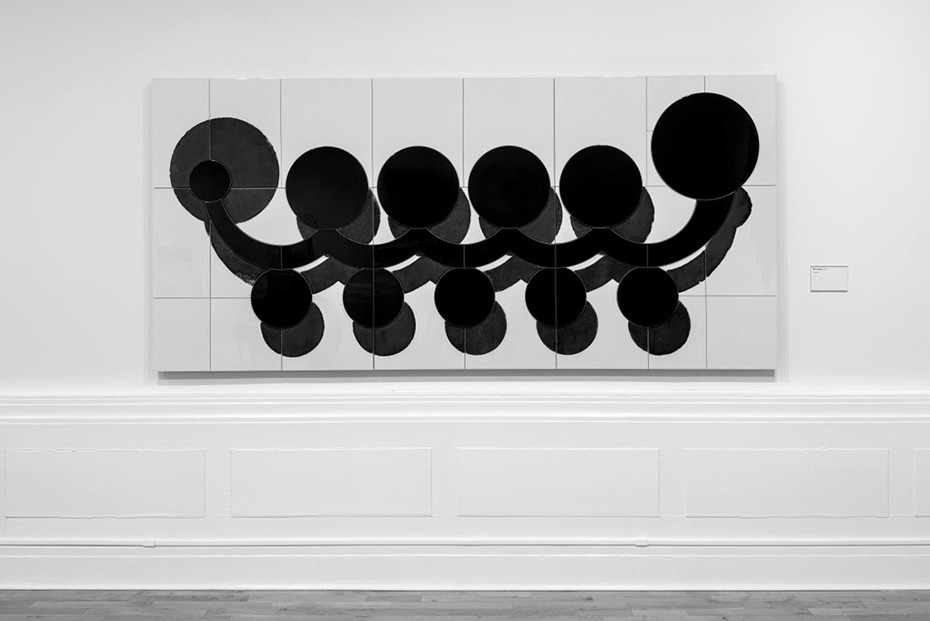
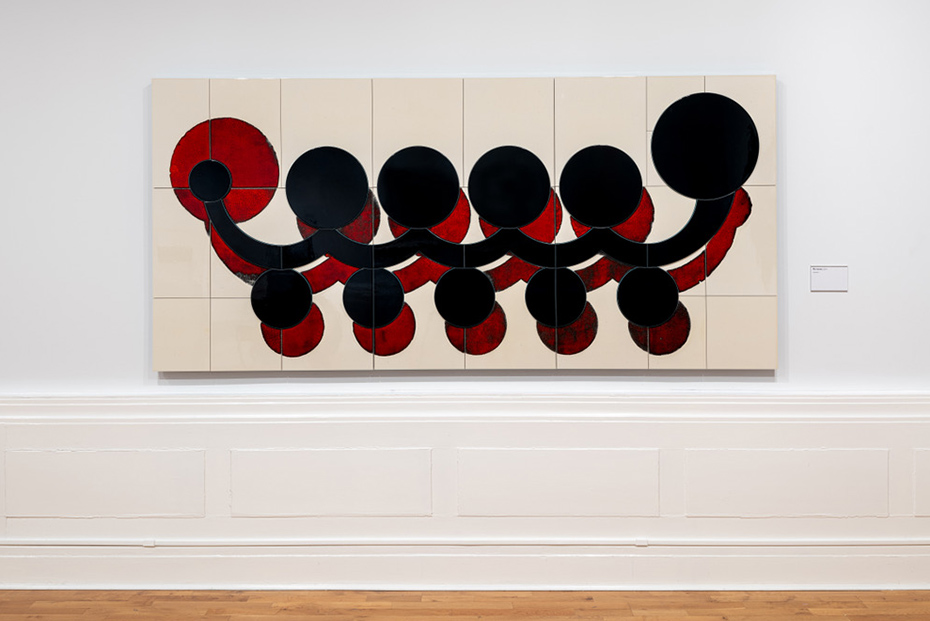
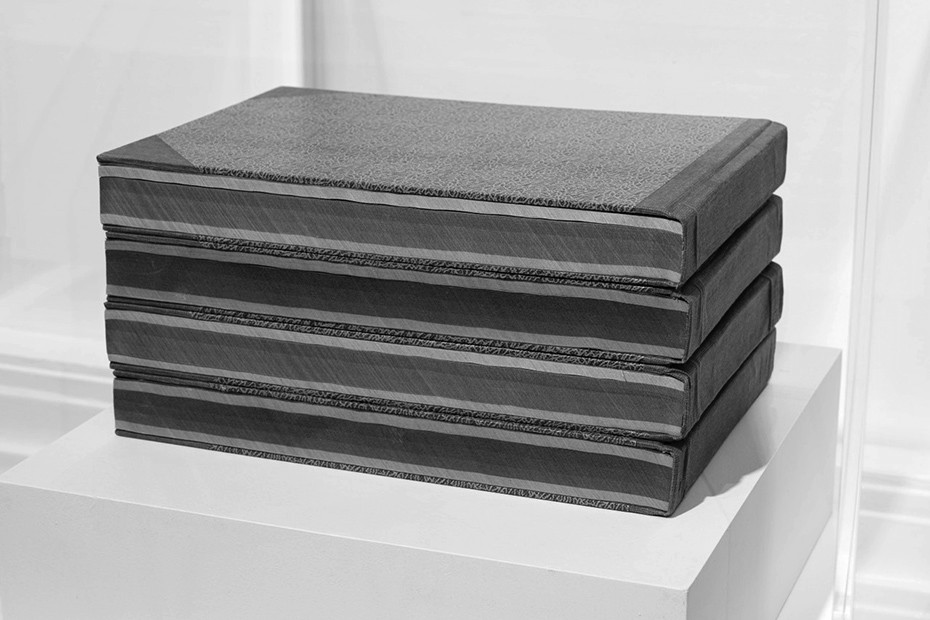
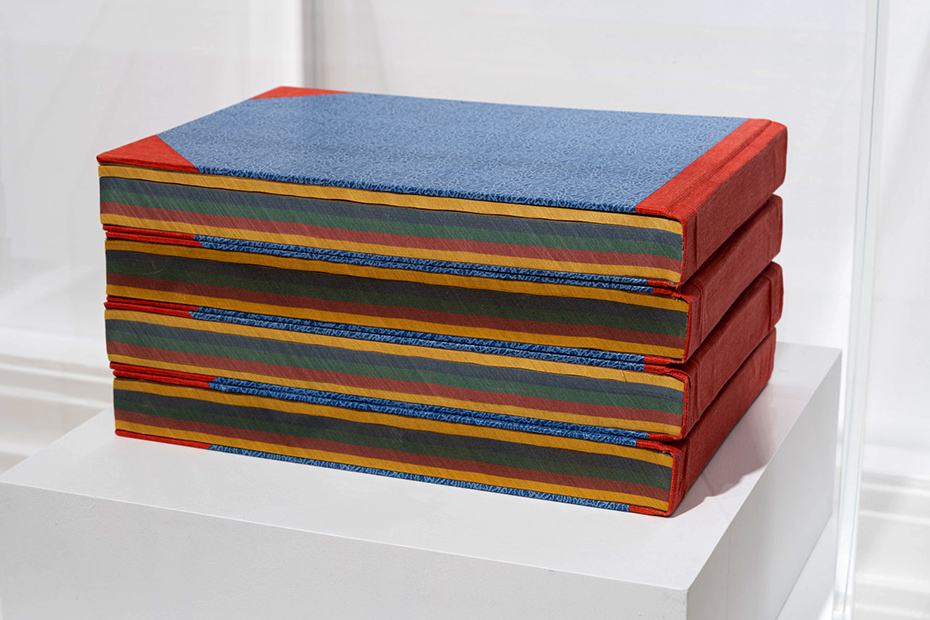
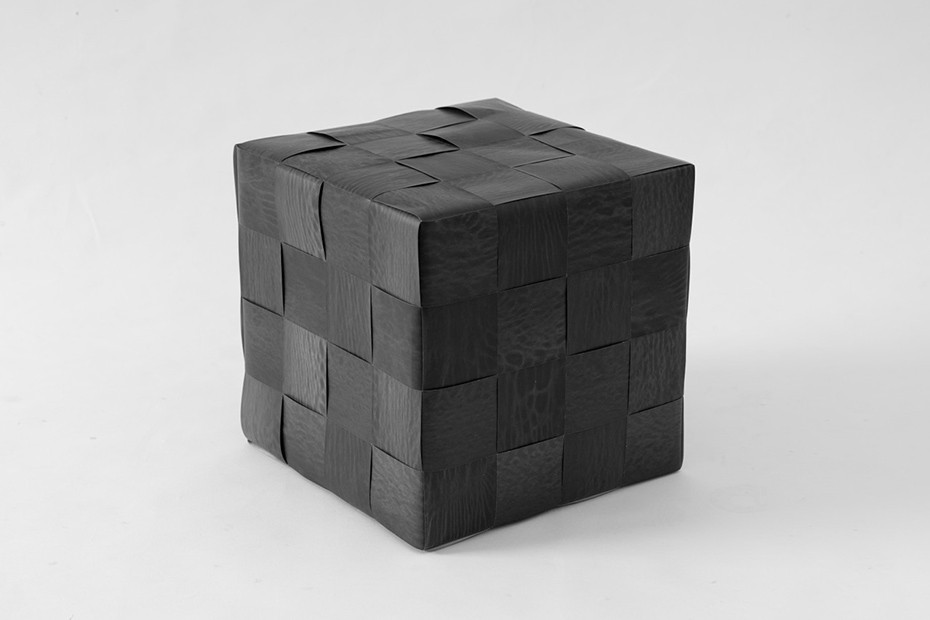
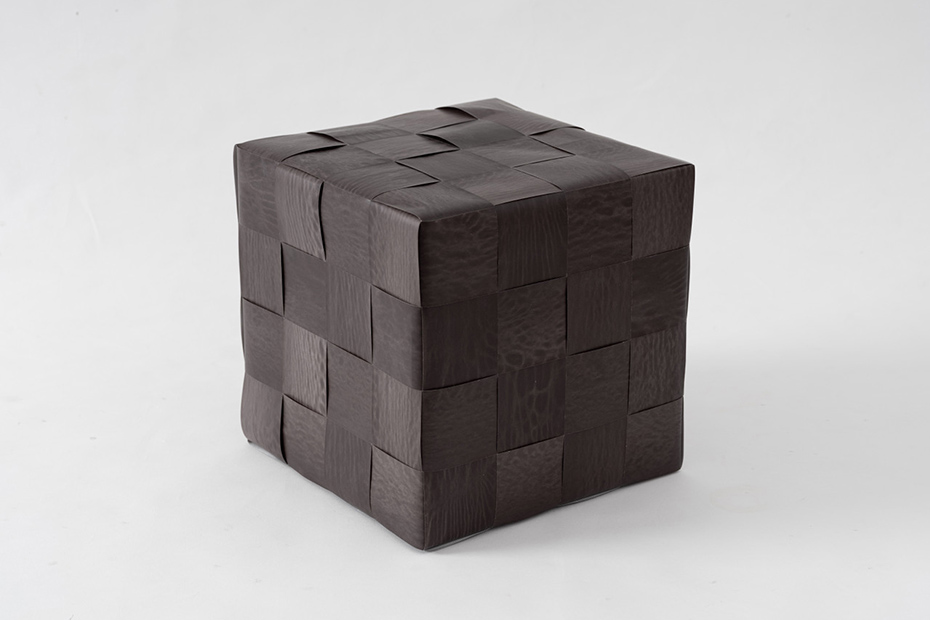
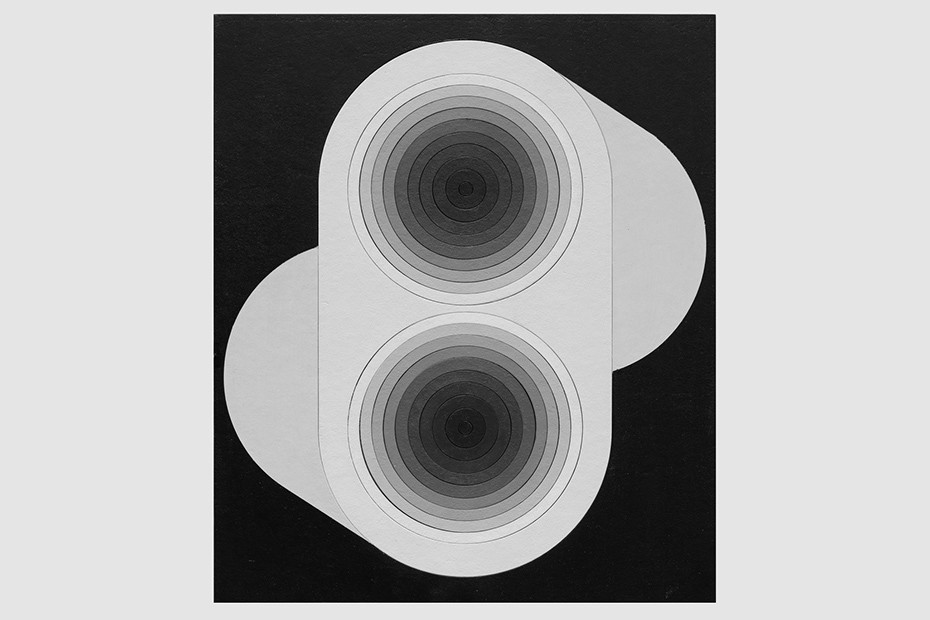
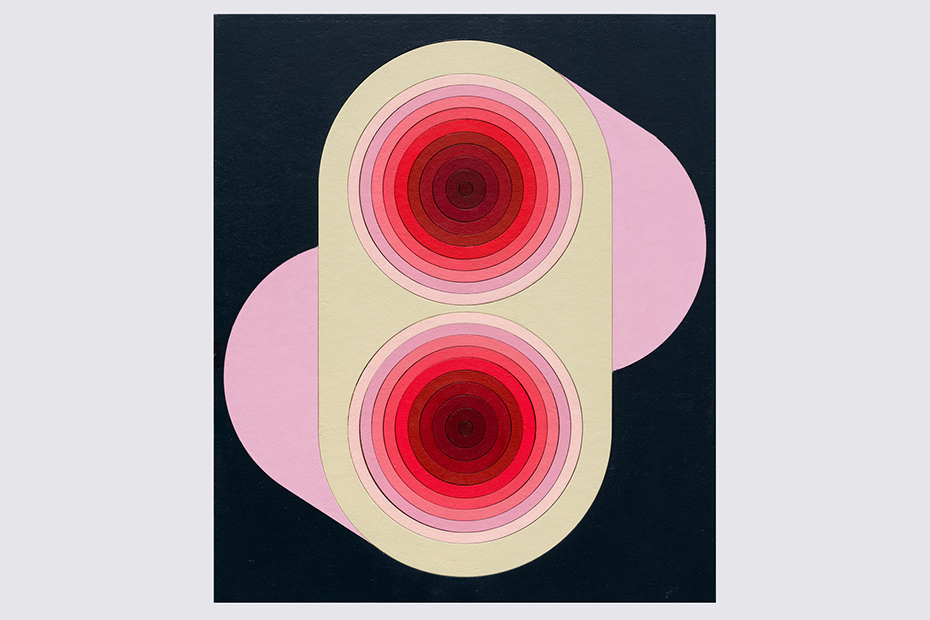
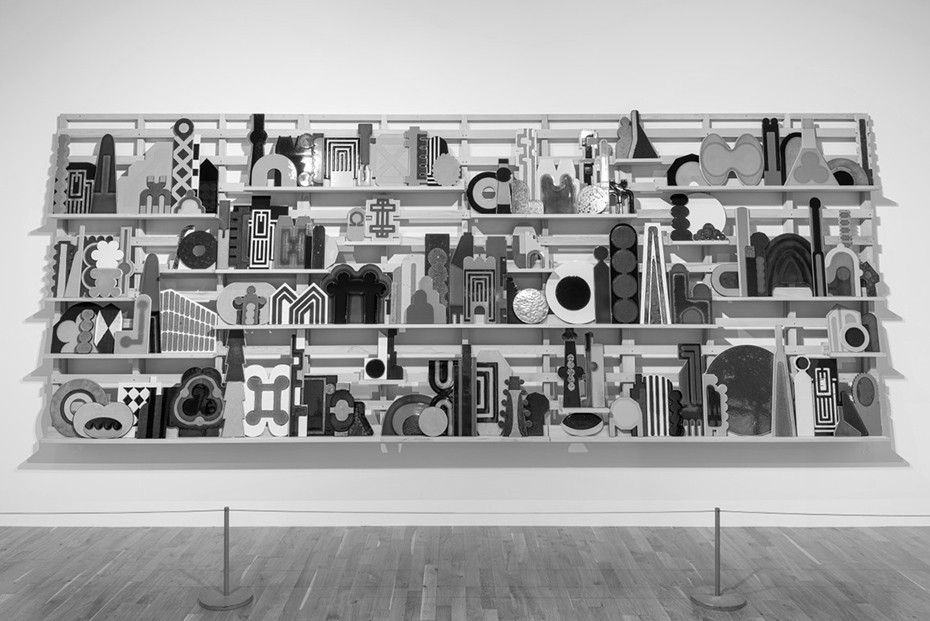
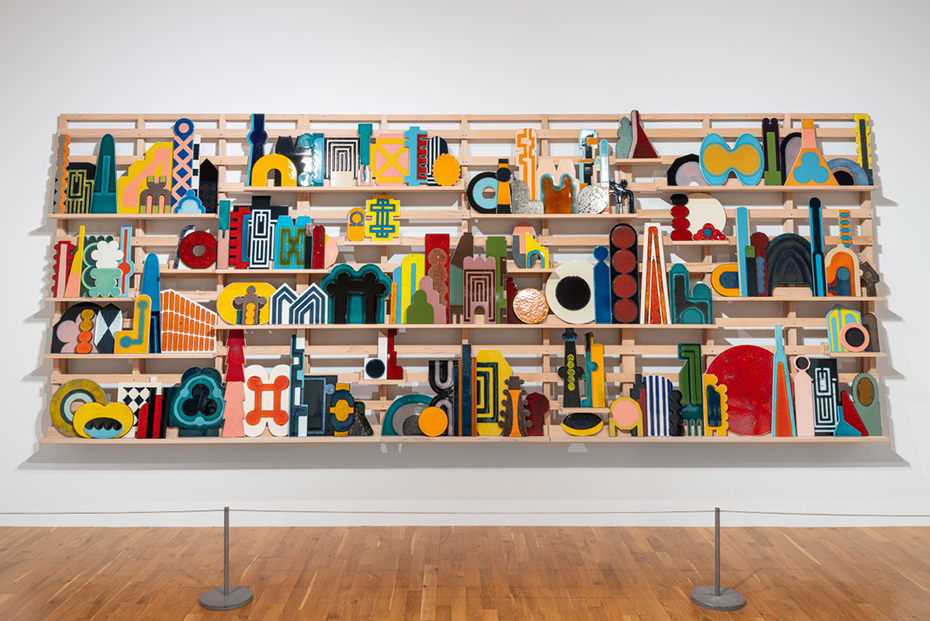
PLURIVERSE presents Chowdhary’s most recent work, including new drawings and sculptures developed during residencies in India and Italy earlier this year. Encompassing the disciplines of sculpture, architecture and craft, these works examine the relationships between diverse visual languages, materials and processes.
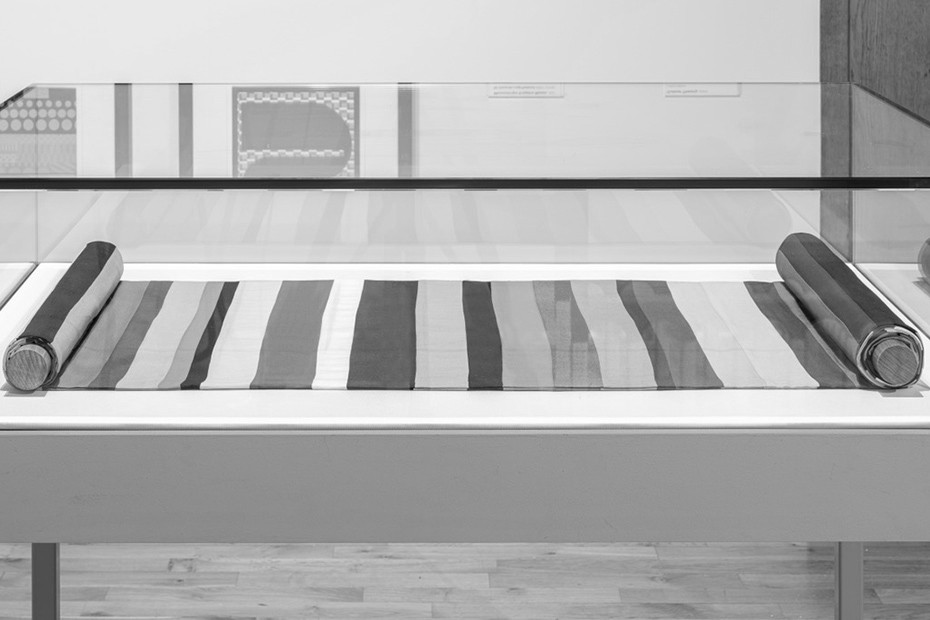
In a solo exhibition at Graves Gallery Sheffield Museums, Lubna Chowdhary presents recent work, including work developed during residencies at Mahler Lewitt Studios Italy and in India.¶ Pluriverse also sees her working with Sheffield Museum’s visual art collection, in particular the city’s holding of Indian miniatures and Eduardo Paolozzi prints.
Very impressive display and exhibition even if it’s not really in my realm of interest.
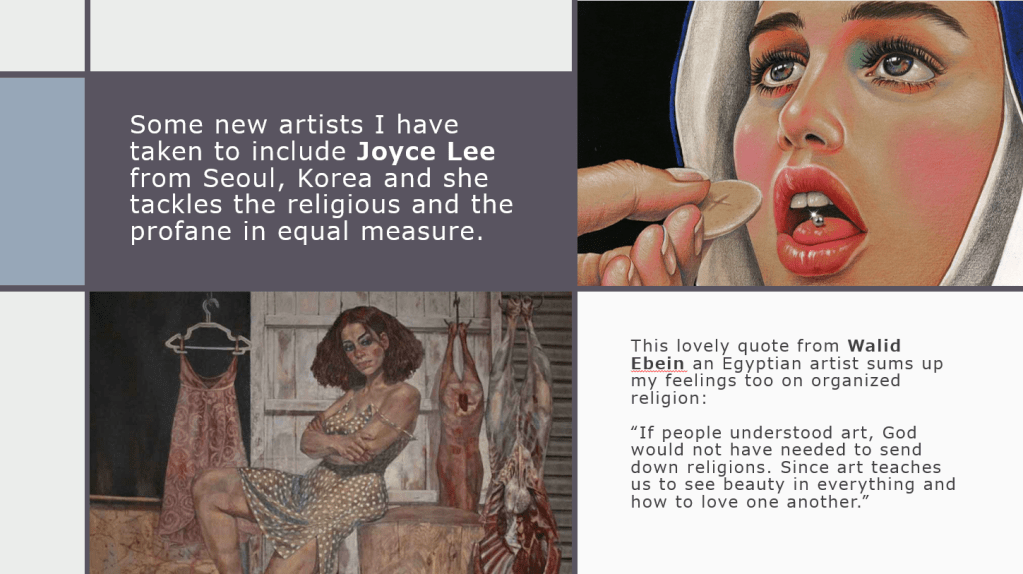
Joyce Lee is a native of Seoul, Korea. She majored in English literature & language at university and worked for airlines for several years before deciding to follow her true passion as an artist and return to art school. She got BFA degree at “Seoul National University”. Joyce prefers to work with watercolors, acrylic and pencils and she enjoys exploring the humanistic (and sometimes humorous) aspects of love and relationship through the symbolism of the human body.
Joyce Lee (@joyceartworks), our Artist in Focus, spins tales of acceptance, love, and rebellion with her surrealistic strokes. She tells provocative stories through the human body, exploring themes of gender, identity, and empowerment. Her masterpiece, “Prayer III,” is an exquisite portrayal of a nun’s silent rebellion, where restraint and freedom dance in harmony.
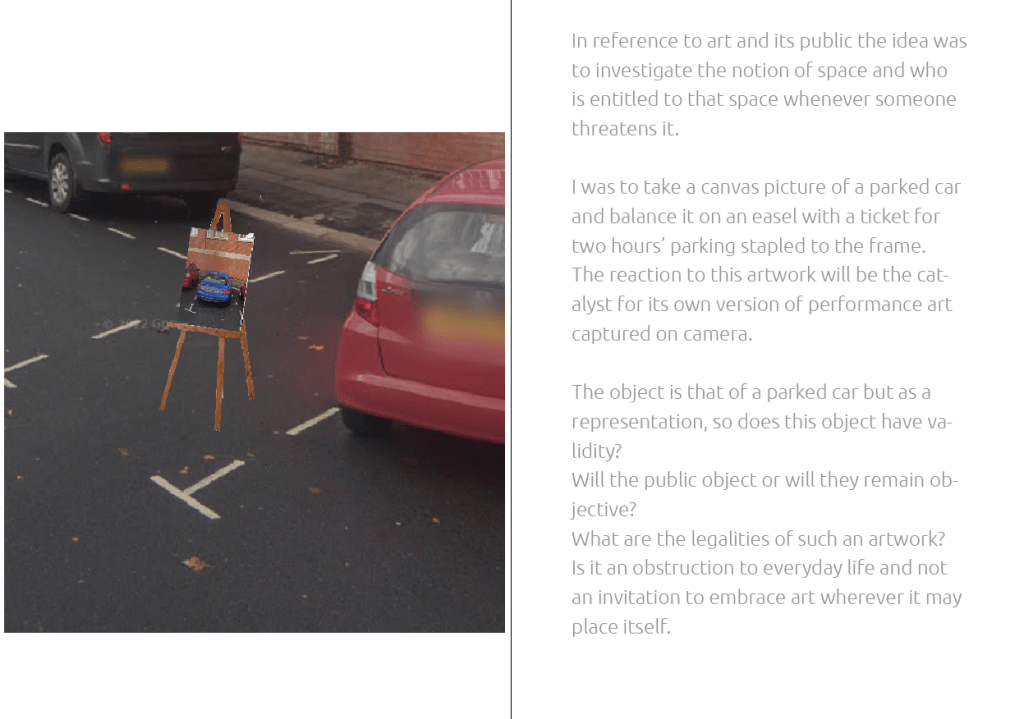
Pecha Kucha October 1st in Aspect Court with other students and our tutor. I spoke in detail about the content on the slides, however it was the parked car performance art that garnered the most interest.
“I is another. If the brass wakes the trumpet, it’s not its fault. That’s obvious to me: I witness the unfolding of my own thought: I watch it, I hear it: I make a stroke with the bow: the symphony begins in the depths, or springs with a bound onto the stage.”
― Arthur Rimbaud
It started with a series of little cuts, lines in serial, to test the flesh and prove a point: you can take it, there is meaning in willing yourself to overcome pain. You wonder out of the front door, leaving the party behind, closing it behind you, pulling back on the handle with one arm, to be undisturbed, to be left alone. in the other hand you hold onto a serrated kitchen knife after a few moments of indecision: the wrist; torso; mental hesitation marks, you carve a star five ways into your left shoulder, it’s mostly skin, it bleeds a lot, you place the knife onto the ground and go to the toilet to find a bundle of tissue,hoping it won’t soak through. You wear a T-shirt all summer, refusing to take it off even when the sun is at its highest, changing plasters every few days. It leaves a mark. People still ask you about it, you don’t know what to say, it was a long time ago, it all happened to someone else.
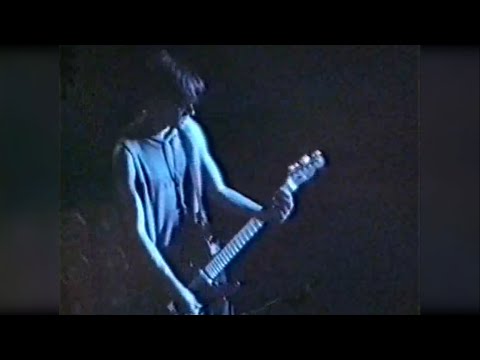
In 1991 Richey Edwards carved ‘4 REAL’ into his arm and posed for a notorious NME photo—exposing a very private and personal act, unleashed as a performative and sensational gesture. A response to journalist Steve Lamacq questioning the sincerity of Manic Street Preachers, it signaled a downward trajectory where Edwards pushed further against the grain to assert control of the mind over the body in a chaotic universe that would gradually overwhelm him. Your heart leapt, not at the voyeuristic image or the visible depth of the garish razor wounds, but at the brutal commitment of the act. Arriving a few short years later, the lyric: “Scratch my leg, with a rusty nail, sadly it heals.” from ‘The Holy Bible’s ‘Die In The Summertime’ speaks to a sense of history, outside of time and beyond the flesh.
The first Manic Street Preachers album I bought on release was 1998’s ‘This Is My Truth Tell Me Yours’. Only four years apart, I quickly discovered ‘The Holy Bible’ album, its excoriating power, politicized outrage and nihilistic introspection marked it as the work of a different band—rejecting notions of commercial potential and critical approval. In a mixture gesture of affectation and teenage isolationism I was one of a generation who absorbed the uncompromising vision of ‘The Holy Bible’. Seeing only conflict, cruelty and suffering in the world around him Richey Edwards’ unyielding gaze dominated the record as he internalized the damaged bloodline of the 20th century into a personal crisis. With penetrating insight Edwards and Nicky Wire delivered a relentless staccato of racing thoughts where righteous anger, depression and self-loathing went hand-in-hand. Projecting a state of continued existential dread, akin to life under a nuclear cloud, this became a condemnation of the chattering, helpless masses, as the closing chant from ‘Of ‘Walking Abortion’ becomes a mantra against a life of bliss ignorance: “who’s responsible? You-fuck-ing-are!”
—
—
This dark streak of moral outrage chimed with one of my earliest memories of television, watching news reports at the start of the Bosnian War in 1992: faceless buildings with their windows blown out, snaking crowds of refugees funneled through streets of rubble before the next assault on an already ruined town. Throughout Bosnia and Herzegovinia heinous human rights abuses were committed, largely by Bosnian Serbs seeking to exterminate Muslims and Croats, through rape, concentration camps and mass executions.
Across the 90s the white tanks and blue helmets of UN troops stood out against military camouflage, just as Manics drummer Sean Moore would sport a UN beret for many of ‘The Holy Bible’ photoshoots. UN forces seemed ubiquitous rolling in and out of troubled ‘conflict’ zones on peacekeeping missions as situations of total war accelerated into ethnic-cleansing and mass displacement.
‘IfWhiteAmericaToldTheTruthForOneDayItsWorldWouldFallApart’ aligns American protectionism as another form of imperialism, reeling off a litany of flawed interventions: “Granada, Haiti, Poland, Nicaragua”. The fallout of post-Communist decline highlighted the fragmentation of the political spectrum and exposed the inner weakness of Western Democratic states and the NATO coalition as a bulwark against tyranny. Enter Francis Fukuyama’s now notorious statement about ‘the end of history’ in 1992, where he prematurely argued for a post-war world, incidentally predicting the rise of neoliberalism. Instead we would see humanity repeating its mistakes, hounded by returning echoes of Edwards’ threat for the incoming “horrors of World War Five”.
The Holocaust is a dominant theme across ‘The Holy Bible’. The decadent death drive of “She Is Suffering”, a rejection of beauty doomed to fade, and the elegiac body horror of “4st 7lbs”; express the dilemma of Richey’s anorexia, mirrored in images of holocaust victims forced into starvation. The author David Evans noted: “Like Sylvia Plath, Richey runs together personal traumas and world-historic tragedies, often in the same lyric.” where she used the image of a “Nazi lampshade” (made of human skin) in her poem Lady Lazarus, Edwards employed lyrics of barking SS men: “Raus raus, fila fila” and sampled of 1945 Nuremberg Trial on ‘Intense Humming Of Evil’, meant to serve as testimonials against Nazi spectacle, they verge on exploitation.
—
—
The album serves the populist view that places the high death toll of Nazi atrocities as the arbiter of evil, where emphasis on the Jewish tragedy which birthed the slogan ‘never again’ threatens to lose perspective and neglect contemporary genocides of the present. A student of politics, Edwards would lament a 90s pop-culture that seemed to have forgotten the Holocaust, relegating it to the past, while people indulged the emergent views of academic Holocaust-deniers who sought to cast doubt on the concept of extermination camps.
Nicky Wire noted a streak of contrarian extremism in Edwards’ lyrics, shifting from right-wing conservatism before leaning into vicious Libertarian satire.The heavy metaphor of music- industry-as-prostitution in ‘Yes’ twists into a tirade against the corruption of forced gender politics with parents choosing their child by design: “He’s a boy/You want a girl so tear off his cock.” ‘PCP’ riots against censorship, political correctness and moral hypocrisy, mocking ineffectual P.C. plods while making a conservative call for the good old days of ‘bobbies on the beat’.
—
—
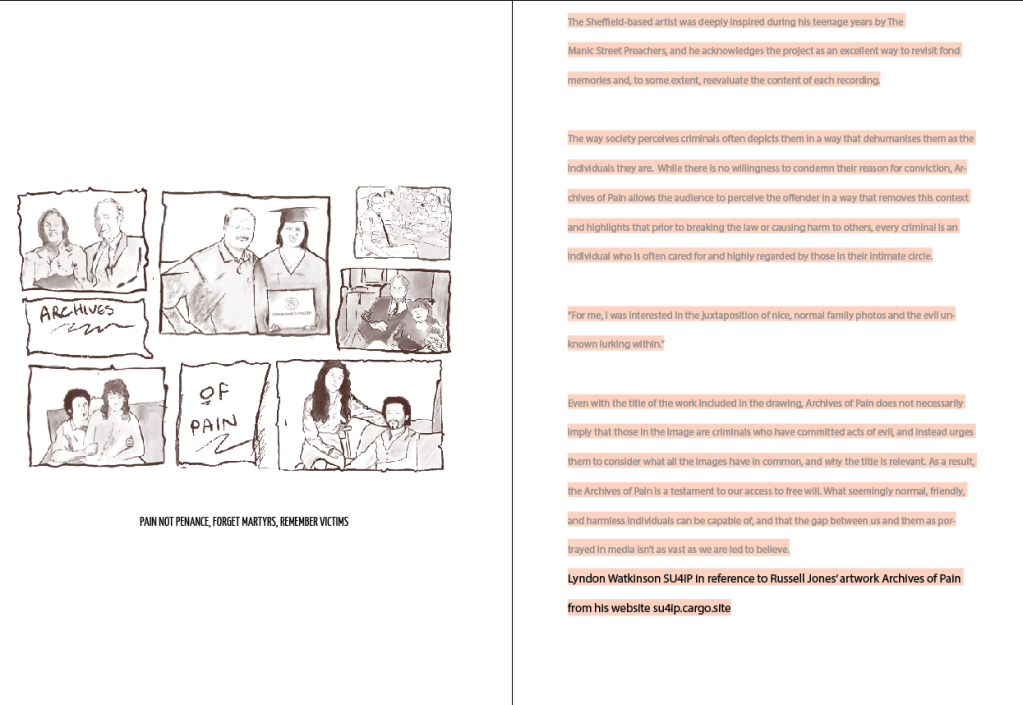
On ‘Archives Of Pain’ Edwards vents his frustration at the celebrity treatment of death and murderers in the ironic work of the Young British Artists, who turned serial killers such as Hindley and Brady and Peter Sutcliffe into post-modern icons, while the Manics would realise its antithesis in ‘The Holy Bible’s cover art Strategy (South Face / Front Face / North Face) by Jenny Saville. Edwards condemned the lenient sentencing given to murderers and rapists; a new inequality that seemed to place the rights of criminals above their victims. Instead, he called for punishments that fit the crime: citing execution of criminals pulled apart by horses and forced sterilization. This feeds into the album’s attacks upon liberal elitism; a moral relativity I was growing into as a teenager, reading about Chomsky and ideas of a redistributive society.
Edwards referred to ‘The Holy Bible’ as a work of truth compared to the hypocrisy of organized religions’ sacred texts, he stated the alternative: “to walk around with a plastic bag over my head”. Being too awake to the wider toxicity of man’s inhumanity to man easily became inverted into violence against the self—where the manifestation of physical and mental illness seem an appropriate reaction to the horrors of the world. Photographs from 1994 show Edwards, exhausted and statuesque, his own St Sebastian, fragile but resolute in his beliefs. In a late interview Caitlin Moran finds Edwards doe-eyed with nicotine stained teeth, “beautiful in spite of himself” it returns us to his favored image of the purity of the child’s eye corrupted by life.
A very serious form of growing pains, my version of ‘rightness’ became a blinkered outlook of hopelessness. Slipping into “the realm of the unwell” and the peculiar stillness of depression: you make non-choices and things happen to you—becoming a spectator in your own life. The poet Dan Duggan, himself sectioned for many years at Beckenham Hospital, referred to this austere position as “the luxury of the dispossessed”, feeling intensely but held at a distance, as if everything is happening to you.
For me, not eating became a revolt against the work done of chewing and swallowing, where force-feeding yourself exposed the functionality of living. You don’t eat because you feel sick; you feel sick because you don’t eat—it was hard to admit to such broken logic—your body draws breath; you sigh in response. Drinking more, I empathized with Kurt Cobain who told himself his heroin addiction was a necessary cure for an undiagnosed stomach complaint. I too, self-medicated: Rennie’s, Pepto-bismol, kaolin and morphine mixture, fluoxetine, citalopram, cocodamol; anything to numb the angry stomach and smother that nagging feeling. You burn, bleed and scream without noise; the mirror dances—tell yourself it’s not a pose—there is meaning in control, witness the pained self-regard of ‘4st 7lbs’: “I eat too much to die, not enough to live. I’m just waiting”. Overturning the idea of illness as metaphor, these self-inflicted wounds paint you into a corner, to be a source of worry, talked about in the third-person—we circle the problem like a spider washed about a sinkhole. There is a famous photo of Edwards by Tom Sheehan. Wearing a boiler suit with the prologue to Rimbaud’s A Season In Hell scrawled on the back: “Once, if I remember rightly, my life was a feast where all hearts opened, and all wines flowed […]” Edwards added his own final line: “One who mutilates himself is surely damned, isn’t he?”
Troubled moods fuel suicidal ideation—to dream the final freedom of death—the big nothing. Co-host of the Backlisted podcast, Andy Miller noted the twin escapism in Nicky Wire’s 1996 song lyric ‘Australia’. written in the wake of Richey’s disappearance, Wire himself retreated to the other side of the world as a form of recovery. It speaks to Edwards’ own version of gradual exile; to opt-out from the pain of life. You half-smile, now, at the surreal image in ‘Yes’: “Just an ambulance/At the bottom of a cliff”, an anti-Catcher In The Rye riff, which highlights the difficulty of supporting people with mental health issues, for some it always arrives too little, too late.
—
—
Nicky Wire’s lyrics to ‘This Is Yesterday’ return to Manic themes of emergent memory, sounding old before his time, it marks disappearing reflections of childhood slips further away. At recent gigs it has become a tribute to Edwards and the raw brilliance of youth, while trying to resist the temptation to keep looking back when forced into a position between nostalgia and regret, flipping the philosophical paradigm between existence and emptiness: “why do anything/when you can forget everything?” The bombastic guitar solo arrives both ridiculous and sublime, but it cures my dry throat from the verse: “houses as ruins/and gardens as weeds/ I repent/I’m sorry, everything is falling apart”, it becomes a moment to pause and an invitation to breathe.
You wanted college to be the place where things came together, but in reality only some things changed for the better. The Manics’ shameless intellectualism encouraged me to study philosophy at sixth-form and later at university. I embraced the burn-bright precociousness of ‘The Holy Bible’, particularly the rapid-fire name-checking of ‘Faster’, a machine-gun syllabus which balanced high and low culture against ‘Revol’ and its roll call exposing the private lives of politicians and dictators.
I was inspired by the immortal line of “Libraries gave us power” from 1996’s ‘Design For Life’ adapted from a 1984-esque stone engraving in Newport library (“Knowledge Is Power”), it also overturned the slogan from the gates of Auschwitz: “arbeit macht frei”, used in the lyrics to ‘The Intense Humming Of Evil’, with stark irony: “then work came and made us free”. Reverberating throughout stadiums and young minds, bedroom-bound in claustrophobic, small towns, the Manics were always about lifting up working class listeners, never beating them down further. Despite my atheistic household, I really connected with religious philosophy, where questioning the existence of God was really a search for meaning. This was brought into further relief reading Albert Camus’ The Rebel, where the gears of pure reason seemed to stall against the banality of cruelty.
—
—
In interviews Richey Edwards—sexy, dangerous and vital—praised the almost-Poet Laureate, Philip Larkin for living “a great life”. From his self-loathing domesticity, Larkin saw through the veneer of home, which “stays as it was left” and lamented the twin mediocrity in leaving his home town of Coventry for the adopted city of Hull. Perhaps it was the comfortable security of a respected writer that Edwards admired, a kind of happiness you felt could never be yours, where contentment, “some kind of nothingness”, was for other people.
In his final TV interview in 1994 I watched and re-watched as Richey struggles to answer the last question about next plans, with a depthless sigh: “the future—that’s a big, nasty word, isn’t it”. A heavy statement of foreshadowing, this manifested in his refusal to accept life in the world as it is, with all of its necessary contradictions and compromises: indulging the bad to eclipse the good. Referred to by one BBC critic as “a triumph of art over logic”, I see ‘The Holy Bible’ as a work of wounded genius, with all of its flaws making it seem all the more human, revealing the tragedy of brutal sincerity witnessed in ‘Faster’: “I’ve been too honest with myself/I should have lied, just like everybody else.”
Joyce Lee has become one of Instagram’s most prolific painters. Her portraits depicting everything from the female nude to surrealist fish have garnered thousands of likes on her Instagram page. Lee now has a social-first fan base so strong that she’s eschewed gallery representation for a direct-to-consumer model in which she holds seasonal drops of her work.
Born in Cairo, Egypt, in 1970, Walid Ebeid spent his early childhood in Yemen. The precocious artist recalls, fondly, connecting with nature and using oil paints at an age when other children were still using crayons or markers—with the encouragement of his father, who supported his art. As a young man, Ebeid was raised to respect women, whom he was surrounded by, and describes it as a rude awakening when he grew up to see how badly women were treated by society, outside his loving family environment.
Back home in Egypt, the prolific artist wasted no time in establishing himself. Shortly after graduating from art school, fortuitously, Ebeid secured the support of Farouk Hosny, the minister of culture at the time. Hosny, an artist himself, immediately spotted Ebeid’s talent and helped the promising young artist arrange his first solo exhibit, People You May Know (a career-establishing event that might have taken a recent graduate nearly a decade to achieve on their own).
Ebeid continued to actively take part in the local arts scene, going on to exhibit internationally. His primary artistic influences, as he was developing his style, were Gustav Klimt and ancient Egyptian art. It was a happy coincidence and source of pride for Ebeid when he discovered that his Austrian hero, Klimt, was also influenced by ancient Egyptian art, so that Ebeid felt he had come full circle: distilling inspiration of his rich heritage through the filter of a European master.
A self-described “risk-taker,” Ebeid found his artistic calling as a voice of the people or, more specifically, an advocate for the downtrodden. Not one to shy away from controversial subjects, even dark and disturbing realities, he went on to explore taboo issues in his work, such as domestic abuse, forced marriages and child brides, government torture, the Egyptian revolution and its miscarriages, immigration, poverty, hunger . . . Ebeid’s figurative art, which he describes as “realistic-expressionism,” is often dramatic, symbolic, accusatory. His confrontational work demands an emotional response from the viewer, as if to say: Look at our suffering, the one you’re complicit in. If we choose to defy your double standards, don’t you dare condemn us.
Like his formative influence, Klimt, the female body is central to Ebeid’s art, as muse and allegory but also as site of protest and battleground. Aware of his power, both as an artist and a male in a patriarchal society, Ebeid seeks to redress an imbalance by sharing his platform with society’s scapegoat: women. Blamed for men’s desires and frustrations, the artist recognizes the paradoxical role women occupy in his embattled culture: at once humiliated underdogs and revered life-givers. The women in Ebeid’s art tend to fall into one of two categories, either defeated and demeaned at the hands of weak and vicious men or unabashedly sensual, goddesses, luxuriating in their skin and bluntly erotic. “Definitely a male gaze happening here,” balked an American acquaintance of mine, on social media, when I shared his art online. Well, Ebeid is a male, gazing adoringly at women, reveling in themselves. What might appear louche, scandalous, or sexist to some could have more to do with the viewer than the artist who only seeks to hold up a mirror to society and his complicated subjects.
Allowed Meat is a complex painting by Ebeid that has it both ways. The scantily clad, barefoot heroine poses seductively in an unglamorous surrounding, a butcher shop, flanked by animal carcasses. Her ashen skin is rendered as unsentimentally as the animal flesh around her, à la Lucian Freud by way of Francis Bacon. Is the dress on the coat hanger a metaphor for the fiery redhead, dangling on a hook, offering her wares? Is that a come-hither look she wears, or is she lost in reverie or regret? Is the voluptuous female seated on the cutting block availing herself to be ravaged, consensually, by a lover or resigned awaiting a customer? What is allowed in this meat shop: only raw carnal desire? What about Love? Is this a portrait of empowerment, defilement, or both?
While Ebeid does not identify as a feminist—calling himself a “humanist” instead—of course, one need not be a feminist in order to recognize gender equality as a basic human right, critical for the health of any society. Yet even a cursory glance at Ebeid’s body of work reveals to what extent he is a champion of women’s issues/rights, intimately identifying with their plight while seeking to amplify their voices and celebrate them. In one interview, he puts it this way: “I myself cannot fathom the reason I hold all this empathy towards women—as if women were the reason for me being an artist.”
Yet despite being a sensitive soul and soft-spoken, in an Arabic language interview he gave on an Egyptian TV show, Ebeid knows what he’s doing and is unafraid to contradict expectations. When his admiring female interlocutor assures him that no offense should be taken by his compassionate work, since he intends no harm, Ebeid differs, politely, but firmly. “My paintings are meant to hurt,” he corrects her. “Really?” she stammers. Yes, he confirms; they hurt those who have done wrong, whom the paintings are accusing.
This is the artist as witness, activist, public scold, and collective conscience, all rolled into one. In this sense, Ebeid’s manner of painting, which can veer into a sort of hallucinatory realism, as well as his concerns, echo those of another Arab artist, Kuwaiti-Syrian Shurooq Amin, a self-confessed “creative thorn in their sides.” Like Ebeid, Amin is a natural-born provocateur and fearless in addressing sexual politics through her arresting canvases, which typically mirror sociopolitical ills and hypocrisies, focusing on female oppression.
Unlike Amin, however, Ebeid’s work has not been labeled “pornographic” and “anti-Islamic” but instead warmly embraced. In fact, Ebeid enjoys a largely female following, and when I posted some of his paintings on Facebook, two Egyptian friends, both women and academics, let me know they admired his work (one gushing: “He’s my favorite for years, now”) and that his exhibits were well attended back home. What’s more, women often reach out to Ebeid and recommend topics for him to tackle. To render their stories faithfully, the artist listens, attentively, so that in his words he can “paint not just their bodies but also their souls.”
His painting The Immigrant is a kind of shock art, intended to shake us out of complacency.
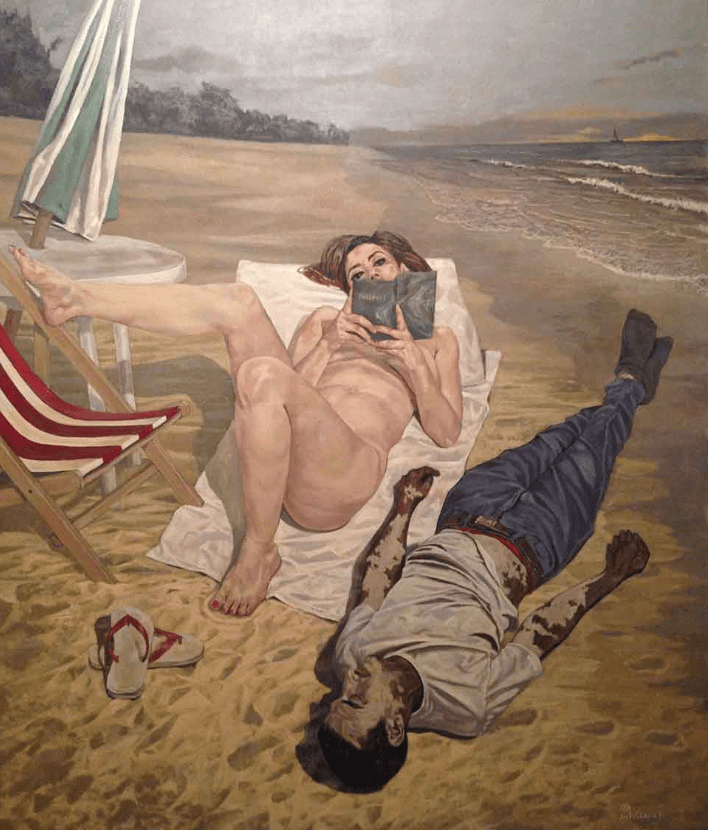
Addressing one of the great moral issues of our time, the refugee crisis in which tens of thousands of unfortunate souls drowned in the Mediterranean, Ebeid commented: “People who feel like strangers in their own countries seeking for a better life in other places where they will realize that they are more strange.” His painting The Immigrant is a kind of shock art, intended to shake us out of complacency. Reversing roles, and expectations, it depicts a fully clothed man (washed up onshore?) lying next to a naked woman at the beach. He is lifeless and discolored, she pale and languid. One of the nudist’s legs is raised, idly—like a cat’s tail twitching on a lazy summer day. It appears that the woman is reading a book, but upon closer inspection, it turns out to be a passport. This is angry, indignant art, laced with defiance and a strange eroticism. But the true obscenity that such a challenging painting suggests is indifference to the pain of Others.
By association, I think of the sardonic lyrics of a song by English musical artist Morrissey titled “Lazy Sunbathers.” There are not enough words or paintings to address the magnitude of this ongoing immigration catastrophe, but for those who wish to explore it further, I highly recommend a powerful poem by Sherman Alexie, “Autopsy,” which opens with these damning words:
Last night, I dreamed that my passport bled. I dreamed that my passport was a tombstone For our United States, recently dead.
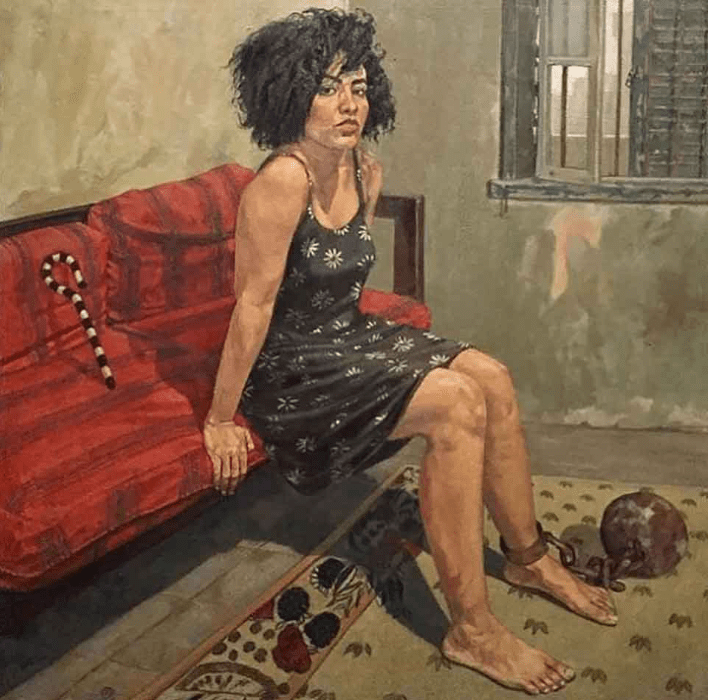
The opposite of freedom features prominently in the parable-paintings of Ebeid, in the form of blindfolds, bars, handcuffs, chains, and, generally, circumstances that bind. A student of Egypt’s illustrious history, one of his works is titled Nefertari, Once Again. Ebeid’s rendering of the great Egyptian queen is a far cry from her typically lavish depiction. This modern Nefertari has fallen on hard times, sitting uneasily on the edge of a sofa, in squalid surroundings. Her royal staff, like her, is diminished and rests like a futile child’s toy on the worn cushions next to her. To underscore her appalling condition, there is a ball and chain fixed to her left ankle. The fallen monarch stares directly at the viewer, reproachfully. What have you learned from our past, she might ask. Where is our ancient wisdom?
Ebeid passionately believes in the edifying capacity of art and its inherent morality, going so far as to say (somewhat provocatively), “If people understood art, God would not have needed to send down religions. Since art teaches us to see beauty in everything and how to love one another.”
Judging by the harsh verdict found in his canvases and the tumultuous affairs of our world, as a species, we have not understood very much of art and religion. So, we turn to his paintings to see our naked, sometimes ugly reflections, in hopes that we remember who we can become.
Egyptians are a funny lot. They’re tolerant, until they’re not. When I recently discovered the bold work of Ebeid, I admit, I was concerned for his safety. I feared an example might be made of him the way it was of another Egyptian artist, Ahmed Naji, whose byline now reads: writer, journalist, art critic, and criminal. After an Egyptian man claimed that an excerpt from Naji’s second novel, Using Life, had made his blood pressure spike and given him a mild heart attack, the young novelist was accused of “offending public morals and promoting obscenity.” This might be faintly amusing had it not ended terribly for Naji, setting a precedent for being the first author in modern Egypt imprisoned for a work of literature.
In the harrowing account of his experience behind bars, translated in The Believer (February, 2021), the unfortunate writer makes this poignant realization:
The regime’s guards fed on humiliation. If their eyes fell upon you for some reason and they took a dislike to a movement you made or the way you looked, they could make an example of you in front of everyone, and when that happened, you had to submit, because any hint of resistance was a provocation. Your resistance signaled there was something inside you that wasn’t broken yet, and their job was to break it.
There are three red lines, he emphasized, that an artist cannot cross in Egypt.
The chastened novelist revisited this heartrending territory in a videotaped presentation that Naji delivered at Apexart, NYC: “Rotten Evidence: Reading and Writing in Prison.” There are three red lines, he emphasized, that an artist cannot cross in Egypt today: frank depictions of sex, mocking national identity or mythology, and questioning religion.
Yet despite flirting with those three prohibited red lines, Ebeid has mercifully escaped becoming another cautionary tale while continuing to offer provocative resistance through his art. A decade and a half older than Naji, Ebeid knows all too well about the brokenness that Naji alludes to in what can, sometimes, seem like a country-wide prison. But instead of being cowed, Ebeid throws the crushed spirits he rescues in paint right back in the face of their oppressors. This lamentable lot might be unfree in their homes and workplace, the painter suggests, but the jailer is never free. That’s the greater spiritual truth that I believe emboldens Ebeid and his gallery of wounded souls. As Arab American poet-activist Suheir Hammad puts it: “Do not fear what has blown up. If you must, fear the unexploded.”
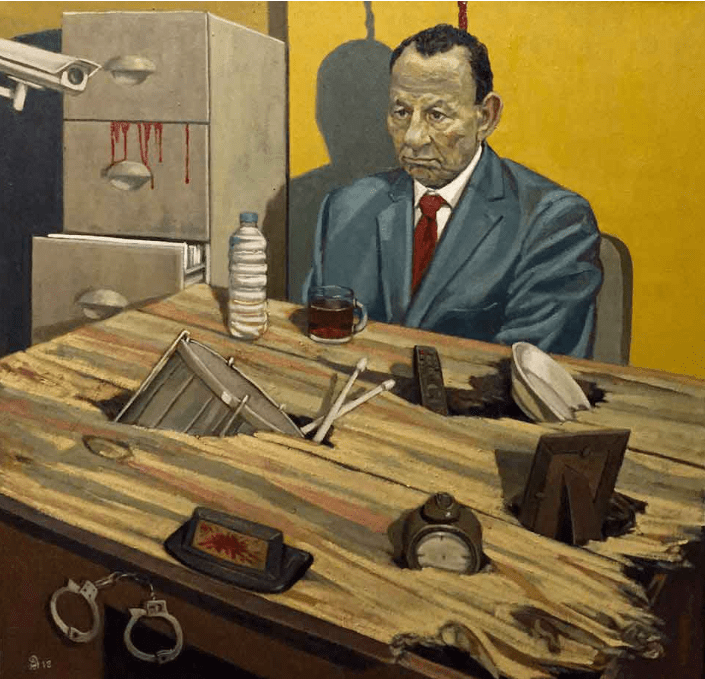
An unsettling example of one systematically broken and barely unexploded is Ebeid’s Settled Citizen. If the vacant, extinguished look in the eyes of this citizen were not enough to betray his condition, his bomb-site of an office hints at a lifetime of disappointments that surround him like shrapnel. While his teacup and water bottle sit upright as he does, his suit and tie are more vibrant than the hollow man inside them. All the symbols of what might sustain, entertain, and distract him crash through the splintered wood of his tomb-desk: a soup bowl, a picture frame, a drum kit, remote control, and clock. To add insult to injury, a surveillance camera makes public his private humiliation. The handcuffs that hang from his desk do not appear to be needed. Is the blood dripping from the filing cabinet his own, sapped by this office? And does his shadow betray a noose around his neck? The so-called settled citizen reminds one of Melville’s miniature masterpiece, “Bartleby the Scrivener,” an ode to the patron saint of civil servants, the dispirited automatons of an absurd workplace. In Eliot’s “Prufrock,” these are all who “measure out their lives in coffee spoons” in demoralizing circumstances, performing tedious tasks that they would prefer not to.
“You’ve been beaten, and it’s been deliberate. The whole society has decided to make you nothing. And they don’t even know they’re doing it,” another artist/activist spelled it out. That’s James Baldwin, laying his heart bare in a 1984 Paris Review interview. Baldwin is describing his desperate state of mind after his best friend jumped off a bridge in the US. “My luck was running out,” he elaborates. “I was going to go to jail, I was going to kill somebody or be killed.” With forty dollars in his pocket and a one-way ticket, Baldwin takes the sanity-restoring and life-saving leap to France.
As I write this appreciation of Walid Ebeid’s quietly devastating art, with the ten-year anniversary of our Egyptian revolution come and gone, I find myself meditating upon this small poem by Peter Meister:
Beloved homeland, how did we let you steer us so far away from Home?
I wonder, is Home the Egypt I grew up in, which I revisit with constricted breath in Ebeid’s occasionally claustrophobic work, or is it the embattled United States where I have been attempting to make a new life for the past decade and a half? Sometimes borders blur, colors bleed, and I’m not sure where I landed, as if the Egypt I fled trailed me―stealthy as a shadow, shapeshifting along the way. Plus ça change . . .
Ebeid’s hard-hitting work demonstrates how it is possible to be a lover and a fighter; perhaps—even necessary―when the beloved is slipping away, a lover becomes a fighter. Naji, too, and other art-ivists who fiercely critique their homelands recognize that nations can be like families: difficult to forgive from time to time but also impossible to abandon. If we hold them to a higher standard, demanding more of them, it’s because we know what they’re capable of, and it’s out of frustrated love that we remind them of their ideals.
Ebeid’s hard-hitting work demonstrates how it is possible to be a lover and a fighter.
Baldwin understood this exquisite tension and its price, profoundly: “I think that it is a spiritual disaster to pretend that one doesn’t love one’s country. You may disapprove of it, you may be forced to leave it, you may live your whole life as a battle, yet I don’t think you can escape it.”
In closing, permit me one final echo as well as a brief remembrance of a fallen hero, familiar with this tricky terrain of the heart. This Valentine’s Day, revered Palestinian poet Mourid Barghouti passed away, joining his beloved wife, novelist Radwa Ashour. At the age of seventy-six, Barghouti, a poet of lifelong exile, was four years older than the state of Israel and wrote movingly about the twin sins of occupation and oppression. In his acclaimed autobiographical novel, I Saw Ramallah, the national treasure describes returning to his beloved Palestine, for the first time in three decades, this way:
The homeland does not leave the body until the last moment, the moment of death. The fish, Even in the fisherman’s net, Still carries The smell of the sea.


















 Rusty'sArtWerk