Scratch my leg with a rusty nail, sadly it heals Colour my hair but the dye grows out I can’t seem to stay a fixed ideal Childhood pictures redeem, clean and so serene See myself without ruining lines Whole days throwing sticks into streams
I have crawled so far sideways I recognise dim traces of creation I wanna die, die in the summertime I wanna die
The hole in my life even stains the soil My heart shrinks to barely a pulse A tiny animal curled into a quarter circle If you really care, wash the feet of a beggar
I have crawled so far sideways I recognise dim traces of creation I wanna die, die in the summertime I wanna die
I have crawled so far sideways I recognise dim traces of creation I wanna die, die in the summertime I wanna die
Andy Johnson sums it up succinctly in this article found on this site manic street preachers a critical discography https://manicsdiscog.wordpress.com/2013/03/04/t72-die-in-the-summertime/ I will say this about the song I find it the hardest track on the album because it is so personal and concerns itself with suicidal ideation and that events are always better in the past and there is no future to look forward to. The veil of innocence whether regarding the self or external events has been lifted and can never be reversed. I have been in dark places like this and known people to have taken their lives and thinking this was how Richey was feeling at the time makes the song difficult.
Here is Andy Johnson’s summation:
“The Holy Bible is often thought of as a particularly political Manics LP, but as should have become clear by now there is a rich vein of the personal running through the album. It is this trend which makes the record slightly less of a radical shift from Gold Against the Soul than it is often made out to be, and ‘Die in the Summertime’ is one of the songs which most clearly expresses it. Along with ‘4st 7lb’, this is one of the songs which Wire felt was most influenced by Edwards’ state of mind.
Like ‘La Tristesse Durera’ before it, the song is partly concerned with the process of ageing, which in Edwards’ view tends to make people find little value in the memories of their adult lives and instead retreat into idealised recollections of their childhood. Appropriately given the line “childhood pictures redeem / clean and so serene”, photographs of the band members when they were children were printed inside the Holy Bible booklet next to the lyrics to the song. The first verse of the song covers slightly different ground, detailing a figure’s attempts to stave off or prevent the inevitability of change, of which ageing forms a part. The title comes from the wishes of the character about whom Edwards was writing, an old man who wants to literally “die in the summertime” because it is that season that reminds him of his long-departed youth. All of this is clearly quite bound up in the theme of regret, which is quite a key element of The Holy Bible in general.
‘Die in the Summertime’ is one of the more musically conventional tracks on the album, and but for the menacing guitar tones it might have sat quite comfortably on Gold Against the Soul, given its deceptively buoyant melody and a particularly anthemic chorus. A demo of the song was released with the album’s tenth anniversary edition, but it isn’t particularly notable – it adds some probably unwise echo to Bradfield’s vocals and comes to an even more surprisingly abrupt stop.”
Choice Lyric “I have crawled so far sideways I / recognise dim traces of creation”
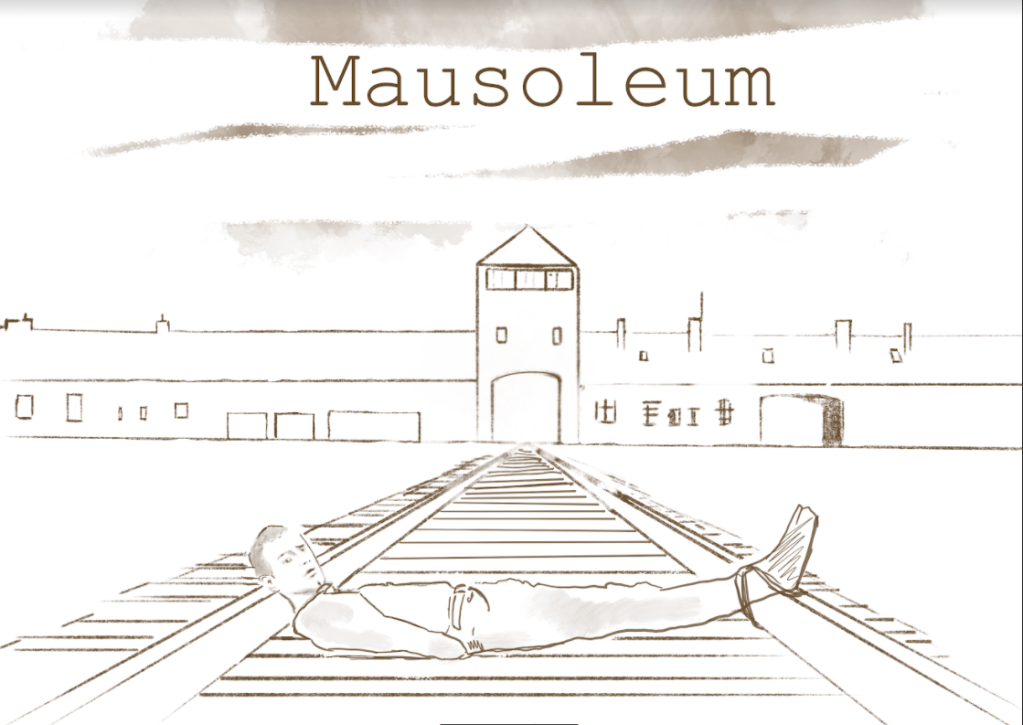
Mausoleum is the eighth track on The Holy Bible and like the penultimate track The intense humming of evil concerns itself with the holocaust inspired by their visits to Dachau and hiroshima Peace museum as a band.
Dachau is such an evil, quiet place. There’s no grass, and you don’t even see a worm, let alone any birds. All you can hear is this humming of nothing.
Nicky Wire
Includes the quote: “I wanted to rub the human face in its own vomit… and force it to look in the mirror.” – British author J.G. Ballard (1930 – 2009) explaining in an interview his motivations in writing the novel Crash (1973).
Wherever you go I will be carcass Whatever you see will be rotting flesh Humanity recovered glittering etiquette Answers her crimes with Mausoleum rent
Regained your self-control And regained your self-esteem And blind your success inspires And analyse, despise and scrutinise Never knowing what you hoped for And safe and warm but life is so silent For the victims who have no speech In their shapeless guilty remorse Obliterates your meaning Obliterates your meaning Obliterates your meaning Your meaning, your meaning
No birds, no birds The sky is swollen black No birds, no birds Holy mass of dead insect
Come and walk down memory lane No one sees a thing but they can pretend Life eternal scorched grass and trees For your love nature has hemorrhaged
Regained your self-control And regained your self-esteem And blind your success inspires And analyse, despise and scrutinise Never knowing what you hoped for And safe and warm but life is so silent For the victims who have no speech In their shapeless guilty remorse Obliterates your meaning Obliterates your meaning Obliterates your meaning Your meaning, your meaning
No birds, no birds The sky is swollen black No birds, no birds Holy mass of dead insect
And life can be as important as death But so mediocre when there’s no air, no light and no hope Prejudice burns brighter when it’s all we have to burn The world lances youth’s lamblike winter, winter
“The court has come. The court of the Nations. And into the courtroom will come the martyrs of Majdanek, and Oswiecim. From the ditch of Kerch, the dead will rise. They will arise from the graves, they will arise from flames bringing with them the acrid smoke and the deathly odour of scorched and martyred Europe. And the children, they too will come, stern and merciless. The butchers had no pity on them; now the victims will judge the butchers. Today the tear of the child is the judge. The grief of the mother is the prosecutor.“ The sample comes from a 1947 Soviet-made English language documentary on the Nuremberg Trials, where leaders in the Nazi Party or individuals responsible for the Holocaust were tried for their war crimes and genocide. https://archive.org/details/Nuremberg_Trials
You were what you were Clean cut, and unbecoming Recreation for the masses You always mistook fists for flowers
Welcome welcome soldier smiling Funeral march for agony’s last edge
6 Million screaming souls Maybe misery – maybe nothing at all Lives that wouldn’t have changed a thing Never counted – never mattered – never be
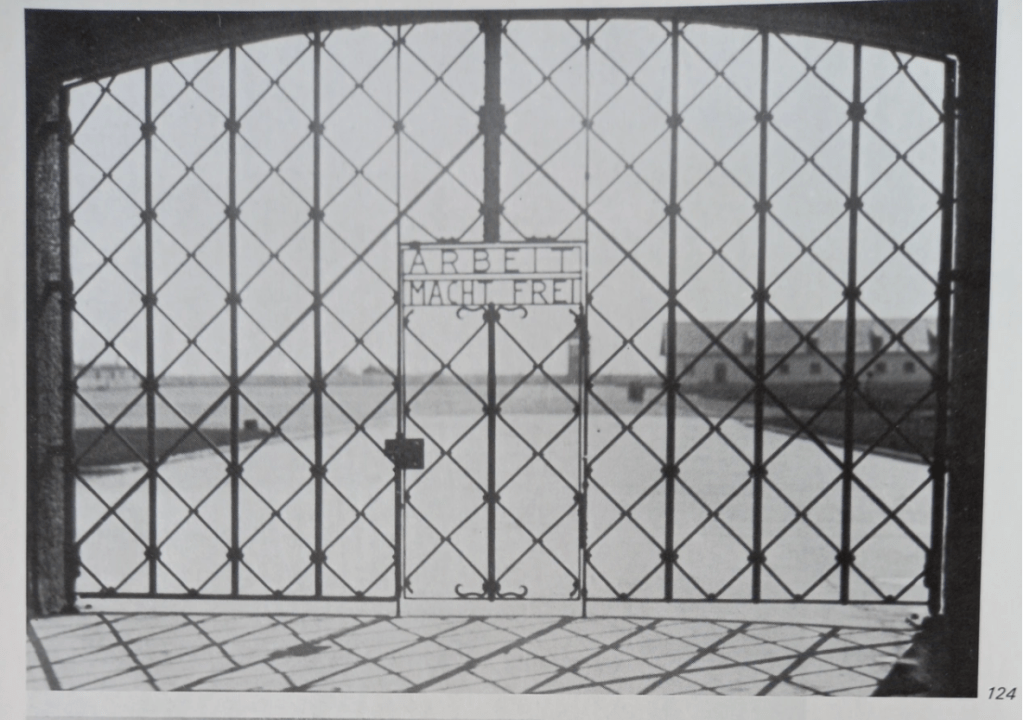
Arbeit macht frei Transports of invalids Hartheim Castle breathes us in In block 5 we worship malaria Lagerstrasse, poplar trees Beauty lost, dignity gone Rascher surveys us butcher bacteria
Welcome welcome soldier smiling Funeral march for agony’s last edge
6 Million screaming souls Maybe misery – maybe nothing at all Lives that wouldn’t have changed a thing Never counted – never mattered – never be
Drink it away, every tear is false Churchill no different Wished the workers bled to a machine
It was inevitable that a song explicitly and very obviously based on the band’s trips to a pair of Nazi concentration camps would end up becoming the darkest and most difficult listen in the entire discography. It isn’t just a question of subject matter: the Manics’ experiences in those places impacted enormously on the musical composition of the (fantastically titled) ‘The Intense Humming of Evil’. It isn’t anger, confusion or madness that drips from every drum beat and guitar figure in the song: it is pure horror. Portraying horror in music is something that few bands seriously attempt, and that fewer still can actually pull off. ‘The Intense Humming of Evil’ was never exactly single material, but it is devastatingly effective at what it aims to do.
A surprisingly large part of the atmosphere comes from the very long opening quote, which comes from the English-language Soviet documentary film – not a news report – about the Nuremberg Trials which took place between 1945 and 1949 at the Palace of Justice in the German city of Nuremberg. The quote uses the Russian name for Auschwitz (“osventsim”) instead of the more commonly heard German one. The unusual ringing, metallic sound which repeats throughout much of the song alongside Moore’s drums is also a key part of the deeply disturbing atmosphere. The outro is also noteworthy – it sputters to a stop like a failing engine, or a life ending. It is harrowing stuff.
‘The Intense Humming of Evil’ is significant in a more subtle way than its sheer darkness – in being neither a rock song nor an acoustic piece, it is a very early example of a Manics track which is primarily about atmosphere and creating a particular feel. This type of approach would become much more prominent on later records, although of course the band would never record anything quite like this track again.
The song is also one of the only ones about which a bit of internal dissent over lyrics has been recorded: it is said that Bradfield requested that changes be made to be words to make them more judgemental (“you can’t be ambivalent about the Holocaust”). Given his own comments about the song, it is possible that Edwards intended it to be partly about Holocaust denialism, which he described as “one of the few examples where even truth is being questioned” and which has continued to pop up in the media occasionally since 1994. The final lines also criticise Winston Churchill, usually thought of as a hero of the United Kingdom. The line “Churchill no different / wished the workers bled to a machine” is probably a reference to his fierce opposition to and determination to destroy Bolshevism (and by extension, leftist politics in general).
Choice Lyric “in Block Five we worship malaria”
References Arbeit macht frei – German for “work brings freedom” or “work makes you free”. Inscribed over the gates of Auschwitz.
Transport of invalids – an official Nazi euphemism for the transports used to take people to the death camps.
Hartheim Castle – a castle near Linz, Austria used as one of several euthanasia centres during the Nazi era. Around 18,000 physically and mentally disabled people were murdered there under the “Aktion T4” programme.
Block Five – a specific block at Dachau camp used for medical experimentation, including deliberately infecting prisoners with malaria.
Malaria – an often deadly infectious disease carried by mosquitoes and widespread in tropical and subtropical regions.
Lagerstrasse – German for “camp street”. Used to refer to the main avenues in concentration camps.
Rascher – Sigmund Rascher (1909 – 1945), German SS doctor known for various barbaric and deadly experiments at Dachau. Executed in 1945 by the Nazis after his attempts to please Heinrich Himmler backfired spectacularly.
Churchill – Winston Churchill (1874 – 1965), Prime Minister of the UK during WWII and again from 1951 to 1955.
My own thoughts on the songs are they are bleak and are obsessed with the horror of the holocaust, I was introduced to new words and phrases such as Arbeit Macht Frei which the irony of having that emblazoned above a concentration camp will never lose me.
Detail from Concentration Camp Dachau 1933-1945. A cropped version of the image of the main gate at Dachau accompanies the lyrics to ‘The Intense Humming of Evil’.
Neues folk
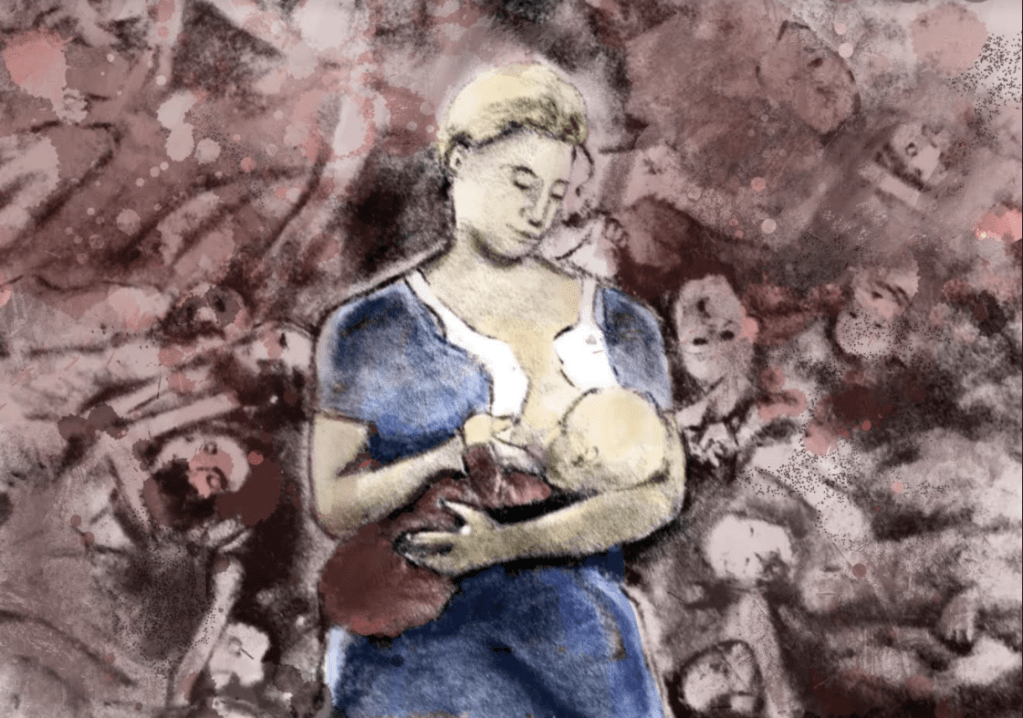
Above is my own obsession with the holocaust with my image of an Aryan woman breastfeeding whilst oblivious to the horror that surrounds her. This image features a lot in my artwork and reappears in different forms.
The intense humming of evil adapted from neues folk pastel pencil ideal size A4 via procreate.
Released on: The Holy Bible (Album #3) Epic Records, 29 August 1994 Track: 8
In contrast to the singularly gruelling experience of preceding track [T69] ‘4st 7lb’, ‘Mausoleum’ largely consists of more straightforwardly rocking music, accelerating to its devastating conclusion more in the style of [T68] ‘Archives of Pain’. As with so much of The Holy Bible it has Bradfield deliver in spades in the beautifully sinister guitar department, particularly in the memorable intro. The demo version of the song – one of only two to ever be released from The Holy Bible, on the tenth anniversary edition – makes clear that this effect took some effort to achieve, as the early version was very crude by comparison. The really curious thing about the demo is that it contains two very different vocal interpretations of the song’s excellent, protracted bridge – the second rendition is absolutely hopeless…
Track 6 off the album The Holy Bible and the second single from that album. A fast post-punk song which I love but apparently James Dean Bradfield doesn’t; I have heard this song performed twice so I’m happy.
Mr. Lenin – awaken the boy Mr. Stalin – bi-sexual epoch Kruschev – self love in his mirrors Brezhnev – married into group sex Gorbachev – celibate self importance Yeltsin – failure is his own impotence
Napoleon – childhood sweethearts Chamberlain – you see God in you Trotsky – honeymoon – serenade the naked Che Guevara – you’re all target now Pol Pot – withdrawn traces bye bye Farrakhan – alimony alimony
Revol is a palindrome and means lover backwards and since the lyrics concern themselves with sexual habits of world leaders and their potency it is a fitting title. The chorus differs from using fascist terms which to me insinuates power dynamics can change for the worse in politics or at least be perverted.
References Lenin – Vladimir Lenin (1870 – 1924), leader of the Russian Soviet Federalist Republic from 1917 to his death and premier of the Soviet Union from 1922.
Stalin – Joseph Stalin (1878 – 1953), de-factor Soviet leader from the mid 1920s until his death. Founder of Stalinism.
Khrushchev – Nikita Khrushchev (1894 – 1971), Stalin’s successor as Soviet Premier and responsible for undoing significant parts of his legacy in the country.
Brezhnev – Leonid Brezhnev (1906 – 1982) Soviet leader criticised for his failure to reform the Soviet economy leading to its stagnation in the 1970s.
Gorbachev – Mikhail Gorbachev (1931 -) former Soviet statesman and reformer who pioneered the Glasnost and Perestroika restructuring programmes in the 1980s. Winner of the Nobel Peace Prize in 1990.
Yeltsin – Boris Yeltsin (1931 – 2007), first president of the Russian Federation from 1991 to 1999, at which point he resigned with extremely low popularity ratings. Spearheaded “shock therapy” and the extremely rapid economic liberalisation which led to concentration of wealth in the hands of oligarchs and criminals.
Lebensraum – German for “living space”. A component of Nazi German ideology used to justify territorial expansionism.
Kulturkampf – German for “culture struggle”. Term used to refer to efforts by Prussian Prime Minister Otto von Bismarck to suppress Catholicism in Germany through legislation in the 1870s.
Raus – German for “out”. The shout of “raus raus” was one of the first heard by many concentration camp inmates as they were herded out of trains by German troops.
Fila – Italian for “form a line” or “line up”. A similar WWII-era camp command.
Napoleon – Napoleon Bonaparte, Emperor of the French from 1804 to 1815. Eventually decisively defeated by other European powers in the Napoleonic Wars.
Chamberlain – Neville Chamberlain (1869 – 1940), British Prime Minister and exponent of the appeasement policy who signed the Munich Agreement with Adolf Hitler in 1938.
Trotsky – Leon Trotsky (1879 – 1940), Russian revolutionary and founder of Red Army. Assassinated by agents sent by Joseph Stalin in Mexico City in 1940.
Che Guevara – Ernesto “Che” Guevara (1928 – 1967), Argentine revolutionary and global countercultural symbol. Murdered during his disastrous campaign to inspire revolution in Bolivia in 1967, with the support of the CIA.
Pol Pot – leader of the genocidal Khmer Rouge faction in Cambodia
Farrakhan – Louis Farrakhan (1933 – ) leader of the largely African-American religious group the Nation of Islam.
As you can see the list of names in this song are in the majority Russian leaders but other world leaders are in there too.
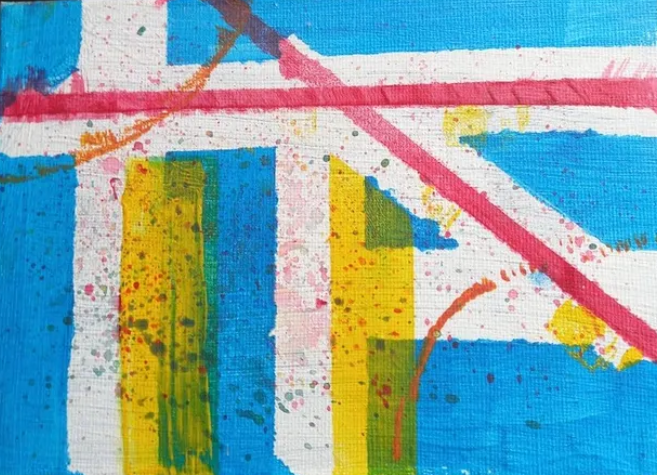
With the current crisis in Ukraine and the zeal and adulation President Zelensky has received for standing up to the Russian invasion inspires this abstract piece which utilises Ukrainian colours. The title The humanitarian corridor is a type of temporary demilitarized zone intended to allow the safe transit of humanitarian aid in, and/or refugees out of a crisis region. The colours hint at instability and the use of red as danger or a sniper light indicates the danger lurking.
Released on: Revol (Single #14) Epic Records, 1 August 1994 Peak UK Chart Position: #22 Band Ranking: #39 Also on: The Holy Bible (Album #3) Epic Records, 29 August 1994 Track: 6
he second single used to promote The Holy Bible is, within the album context, probably the song with the lightest theme and lightest touch – making its release as a single unsurprising. ‘Revol’ is “lover” backwards and is another of Edwards’ pieces on the subject of love as a concept. The lyricist had minimal experience of relationships and struggled to make them work, but they were a recurrent interest of his which crops up multiple times in his work.
The lyric juxtaposes the names of various political figures with sexual hangups, predilections and related phrases – all of the leaders mentioned in the first verse are the heads of the Communist Party of the Soviet Union (CPSU), listed…
Track 5 on The holy Bible and what a track; an indictment of our glorification of serial killers and an open plea for the use of the death penalty. With a dark bassline and the frenetic naming of killers plus a soundbite from a victim this song is relentless in its fury.
Fan made video of Archives of pain
Archives of pain lyrics:
“I wonder who you think you are. You damn well think you’re God or something? God give life, God taketh it away, not you. I think you are the Devil itself.” Irene MacDonald
If hospitals cure Then prisons must bring their pain Don’t be ashamed to slaughter The centre of humanity is cruelty There is never redemption Any fool can regret yesterday Nail it to the House of Lords You will be buried in the same box as a killer, as a killer, as a killer
A drained white body hanging from the gallows Is more righteous than Hindley’s crotchet lectures Pain not penance, forget martyrs, remember victims The weak die young and right now we crouch to make them strong
Kill Yeltsin, who’s saying? Zhirinovsky, Le Pen Hindley and Brady, Ireland, Allit, Sutcliffe Dahmer, Nielson, Yoshinori Ueda Blanche and Pickles, Amin, Milosovic Give them respect they deserve Give them the respect they deserve Give them the respect they deserve Give them the respect they deserve
Execution needed A bloody vessel for your peace If man makes death then death makes man Tear the torso with horses and chains Killers view themselves like they view the world They pick at the holes Not punish less, rise the pain Sterilise rapists, all I preach is extinction
Kill Yeltsin, who’s saying? Zhirinovsky, Le Pen Hindley and Brady, Ireland, Allit, Sutcliffe Dahmer, Nielson, Yoshinori Ueda Blanche and Pickles, Amin, Milosovic Give them respect they deserve Give them the respect they deserve Give them the respect they deserve Give them the respect they deserve
The song starts with a quote from one of the victims mothers admonishing the killer of her daughter which is taken from this interview:
This link will take you to Yusuf Sayed’s essay on this song which is far more in depth then what I will delve into.
The title of the song and much of its contents were inspired by the writings of French structuralist philosopher and historian Michel Foucault. He wrote on the emergence of disciplinary society through devices such as psychiatry and prisons. https://literariness.org/2017/03/28/key-theories-of-michel-foucault/ Richey claims Foucault advocated for a return to medieval (or “savage”) forms of punishment. His reading is controversial to say the least. Foucault actually compares medieval, classical and modern forms of punishment, criticising the idea that the changes are product of some sort of social evolution or civilising process. Prisons can be as wrong as public executions, even if they are less graphic. Pain not penance, forget martyrs, remember victims is a lyric that is blunt in its message to kill those that are guilty of murder and heinous crimes and to remember the victims who we often sideline to focus on the killers motives and mindset.
Kill Yeltsin, who’s saying Zhirinovsky, Le Pen Hindley and Brady, Ireland, Allitt, Sutcliffe Dahmer, Nilsen, Yoshinori Ueda Blanche and Pickles, Amin and Milosevic Give them respect they deserve I give them the respect they deserve
Yeltsin – Boris Yeltsin (1931 – 2007), first president of the Russian Federation from 1991 to 1999, at which point he resigned with extremely low popularity ratings. Spearheaded “shock therapy” and the extremely rapid economic liberalisation which led to concentration of wealth in the hands of oligarchs and criminals.
Zhirinovsky – Vladimir Zhirinovsky (1946 -) rightist Russian politician and activist.
Le Pen – Jean-Marie Le Pen (1928 -), French far-right politician and longtime leader of the National Front (now led by his youngest daughter Marine).
Hindley and Brady – Myra Hindley (1942 – 2002) and Ian Brady (1938 -) also known as the “Moors murderers” for the killing of five children in Greater Manchester, UK between 1963 and 1965.
Ireland – Colin Ireland (1954 – 2012), known as the “Gay Slayer” for his murder of five homosexual men in London in 1993. Obsessed with becoming a serial killer and thereby attaining fame, he died in prison.
Allitt – Beverley Allitt (1968 -) murdered four children and attacked several others while working as a student nurse in 1991. Currently imprisoned.
Sutcliffe – Peter Sutcliffe (1946 -) also known as the “Yorkshire Ripper”. Convicted in 1971 of murdering thirteen women and attempting to murder seven others. Currently imprisoned.
Dahmer – Jeffrey Dahmer (1960 – 1994), infamous American serial killer who preyed on young men and practised rape, cannibalism, dismemberment, etc. Was himself murdered in prison in 1994.
Nilsen – Dennis Andrew Nilsen (1945 -) British serial killer who murdered fifteen men between 1978 and 1983. Known as the “Muswell Hill murderer” or the “Kindly Killer”, the latter due to what Nilsen believed was his “humane” methods of killing. Currently imprisoned.
Yoshinori Ueda – (?) Japanese man believed to have killed five people using overdoses of muscle relaxants in the early 1990s. Apparently released after pleading insanity.
Blanche – Eugene Terre’Blanche (1941 – 2010), South African politician and white supremacist. Murdered at his farm in 2010.
Pickles – Judge James Pickles (1925 – 2010), British judge who became famed for his controversial decisions and statements, such as claiming that rape victims were “asking for it”. Subsequently became a writer.
Amin – Idi Amin (mid-1920s – 2003) Ugandan soldier in the British colonial army there and subsequently brutal dictator of that country during the 1970s. Fled to Libya and then Saudi Arabia, where he died, after war with Tanzania forced him from Uganda.
Milosevic – Slobodan Milosevic (1941 – 2006), Serbian and Yugoslav politician charged with war crimes during the Yugoslav Wars that followed the breakup of Yugoslavia. Died in the UN war crimes detention centre in the Hague, Netherlands.
Allusions Nail it to the House of Lords – this is probably an allusion to German monk Martin Luther, who in 1517 nailed his Ninety-Five Theses, a document opposing the spectacular wealth of the Catholic church and the sale of indulgences, to the door of the All Saints’ Church in Wittenberg.
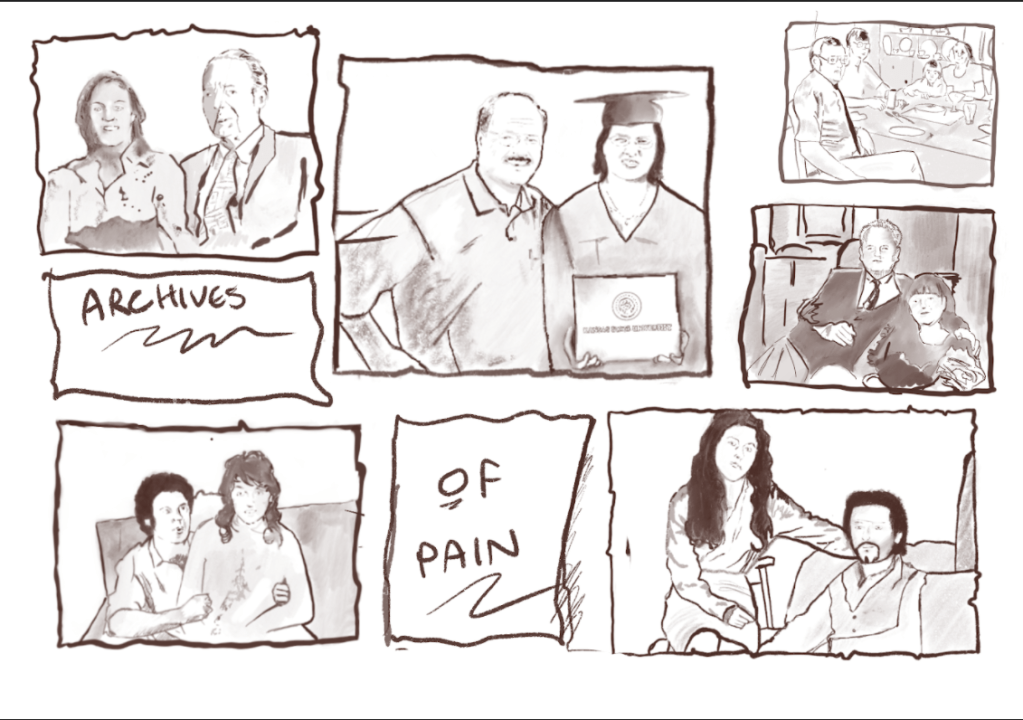
I drew pictures of killers and their family lives posing with wives to illustrate how evil has an everyday face; could be your neighbour, your friend, your husband or wife or even your leaders.
I came up with the idea to film Liam Priestley a friend of mine who was getting involved in a charity boxing match and convinced my nephew to direct whilst I held the sound boom.
I was involved in my nephew Wes’ short film where I play a zombie filmed on Chancet wood field.
The Holy bible art/music presentation
Video I appeared in from Hope Schofield- Clear and Void
Adam Moore, who sometimes works under the alias of Adam East London, is a British-Saint Lucian artist who dances and works with dance. Born, living, and working in the regenerated east end of London, he is interested in sustainability.
Kaleidoscopic and sensitive, collaborative, socially engaged, and transdisciplinary, his practice engages embodied processes across various mediums, examining notions of multiculturalism, unity, and resilience, inviting others into new ways of synthesising material, sensory, and spiritual dimensions through dance performance, installation, moving image, sculpture, sound, writing, and teaching.
He designs spaces to perform in that establish and reciprocate care, intimacy, and abundance.
Dancing with people, life forms, materials, and structures in the places he lives and the spaces he moves through, he explores exchanges across fragmented dimensions that touch himself and others deeply, softening hardened institutions, helping life to thrive more fully.
Taken from Adam’s site.
Adam Moore started his talk with a performative dance and discussed his practice and influences which I have linked above.
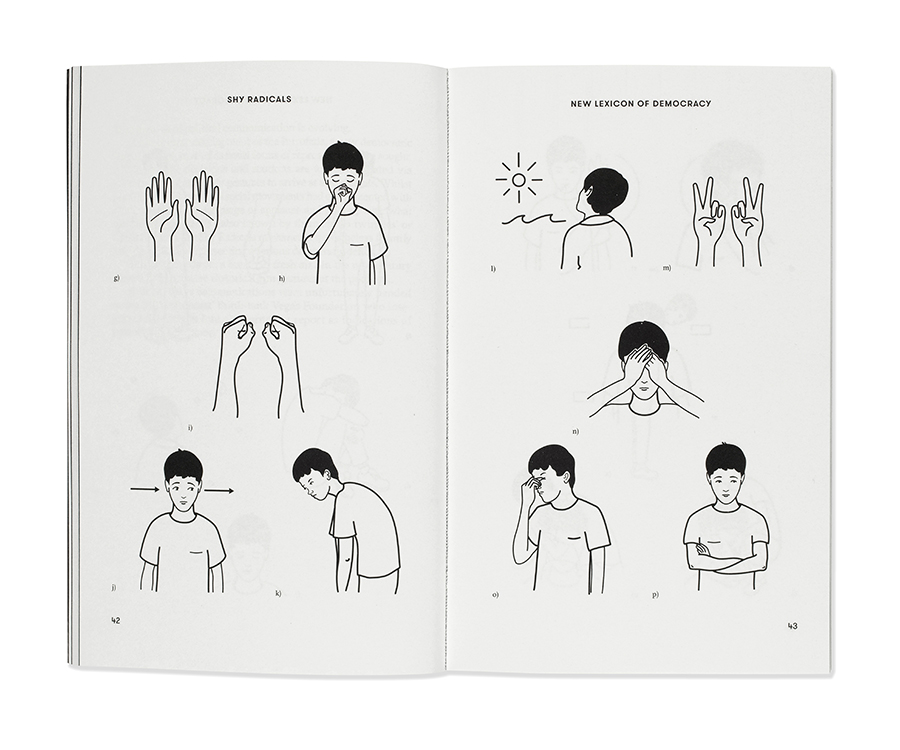
Today’s guest speaker is Hamja Ahsan an artist, writer, curator and activist. A multi-disciplinary artist, his practice has involved conceptual writing, building archives, performance, video, sound and making zines. Key reoccurring themes revolving in his work has been explorations around state crime, contemporary Islamophobia, repression of civil liberties under the so-called War on Terror, and prison solidarity. Hamja is the author of Shy Radicals: The Antisystemic Politics of the Militant Introvert https://shadesofnoir.org.uk/a-decolonial-introvert-revolution-interview-with-hamja-ahsan/
Hamja talks about Arlo parks cover of Creep by Radiohead which he uses in the Shy Radicals film and how the lyrics change dramatically when Arlo sings them. Hamja talks about diyzinebank a nomadic zine library collected by Hanja Ahsan over 25 years.
Hamja talks about solitary confinement and about the Angola 3 case which I knew nothing about and also their involvement with Free Talha movement which is better explained in this link: https://freetalha.org/about/ http://freetalha.org/ Talha Ahsan is a British-born poet, translator and human rights campaigner with Asperger syndrome who was extradited to the US on 5th October 2012 after over 6 years of detention without charge, trial or prima-facie evidence.
He had never set foot on US soil prior to his extradition… Hamja fights tirelessly for his brothers release.
Herman’s house was mentioned https://www.amdoc.org/watch/hermanshouse/ Herman Wallace may be the longest-serving prisoner in solitary confinement in the United States — he’s spent more than 40 years in a 6-by-9-foot cell in Louisiana. Imprisoned in 1967 for a robbery he admits, he was subsequently sentenced to life for a killing he vehemently denies. Herman’s House is a moving account of the remarkable expression his struggle found in an unusual project proposed by artist Jackie Sumell. Imagining Wallace’s “dream home” began as a game and became an interrogation of justice and punishment in America. The film takes us inside the duo’s unlikely 12-year friendship, revealing the transformative power of art.
Hamja Ahsan, Shy Radicals: The Anti-Systemic Politics of the Militant Introvert , 2017. Courtesy: Book Works
“A wave of withdrawal is reshaping the political landscape … Tremors can be felt from the global Shy Underground… From the boardroom to the bedroom.’ As doors close during the lockdown, shuttered exhibitions, theatres, cinemas and clubs have left culture in a lurch. It’s time, then, to rethink the nature of that cultural experience itself.
In a way, the world is catching up with the vision of artist Hamja Ahsan’s manifesto, Shy Radicals (2017). Ahsan’s book called for a ‘pan-Shyistic’ society of introverts, the asocial and the reclusive. Challenging what he calls ‘extrovert supremacy’, Ahsan proposes a speculative Walden pond for our moment of hyper-visibility, livestreams and influencers. This state would ensure its citizens ‘freedom from small talk; freedom from coercive visual distraction; freedom from enforced jollity’. Its constitution proclaims: ‘No one shall be required to attend or perform at social gatherings.’
Hamja Ahsan, Shy Radicals: The Anti-Systemic Politics of the Militant Introvert, 2017. Courtesy: Book Works
When Ahsan published Shy Radicals, it was intended as serious satire. But, seen today, it gets at something larger: that this moment of ‘enforced extroversion’, which privileges those who speak loudly at meetings and those who beam themselves on screens, may only exacerbate existing disparities. And, as some galleries shut forever while others will reopen, we’re seeing how those same disparities have long marked cultural production, a realm in which visibility itself is monetized.” BY PABLO LARIOS IN OPINION | 07 APR 20
Hamja is then answering questions about his practice and mentions Manic Street Preachers which I then immediately have a conversation with him about as I have a fellow obsession. I find Hamja to be an erudite, intelligent artist who is inspiring so much that I have ordered his book and communicated directly through Instagram.
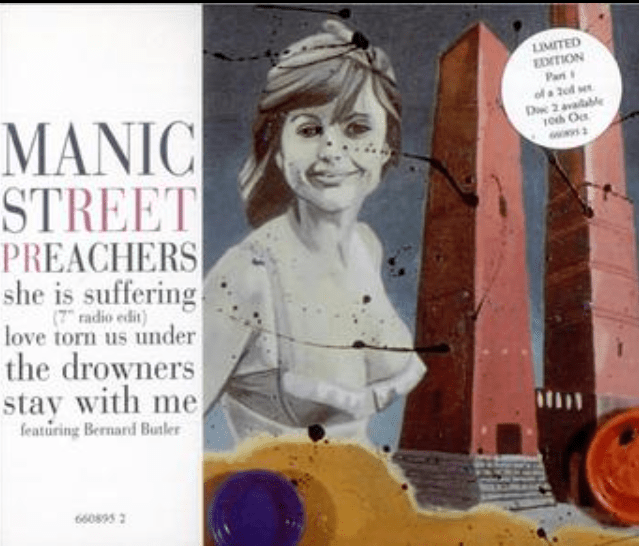
She is suffering single cover by martin kippenberger
The third and final single from The Holy Bible is a bit of a respite from the first three tracks which deal with prostitution, colonialism and abortion but this song is still dark and concerns itself with female suffering and the shedding of desire to become something purer. These themes also resonate in 4st 7lb. I can barely remember the music video but it’s interesting to see Richey Edwards in his last video before his disappearance on the 1st of February 1995.
Here are the lyrics to this song:
Beauty finds refuge in herself Lovers wrapped inside each others lies Beauty is such a terrible thing
She is suffering yet more than death She is suffering She sucks you deeper in She is suffering You exist within her shadow
Beauty she is scarred into man’s soul A flower attracting lust, vice and sin A vine that can strangle life from a tree. Carrion, surrounding, picking on leaves
She is suffering She sucks you deeper in She is suffering You exist within her shadow
Beauty she poisons unfaithful all Stifled, her touch is leprous and pale The less she gives the more you need her No thoughts to forget when we were children
She is suffering She sucks you deeper in She is suffering Nature’s luke-warm pleasure.
I get from the reading of these lyrics and in context of the album title that lust poisons the mind and destroys beautiful souls especially those possessing the beauty who get exploited like in the song Yes which appears first on the holy bible album. Nature’s lukewarm pleasure refers to sex but I get the feeling it is sex that is bought for and used as a transaction.
Anna Nicole Smith is someone I always think of as a beautiful person who was exploited and made famous from her looks. People tried to take her money and accuse her of being a gold digger. She suffered and died an early death https://www.biography.com/personality/anna-nicole-smith
In January 1995, a 22-year-old Quek, using the name Annabel Chong starred in an adult film called World’s Biggest Gang Bang. Over the course of 10 hours, she had sex with about 70 men a total of 251 timeshttps://www.vice.com/en/article/jgqqd8/what-happened-to-annabel-chong this story always makes me think of the line a flower that attracts lust, vice and sin.
Manic Street preachers were instrumental in shaping how I looked at women and their femininity and how men can exploit that and destroy it like any other commodity in the world and how that bleak outlook could affect a tragic soul like Richey Edwards.
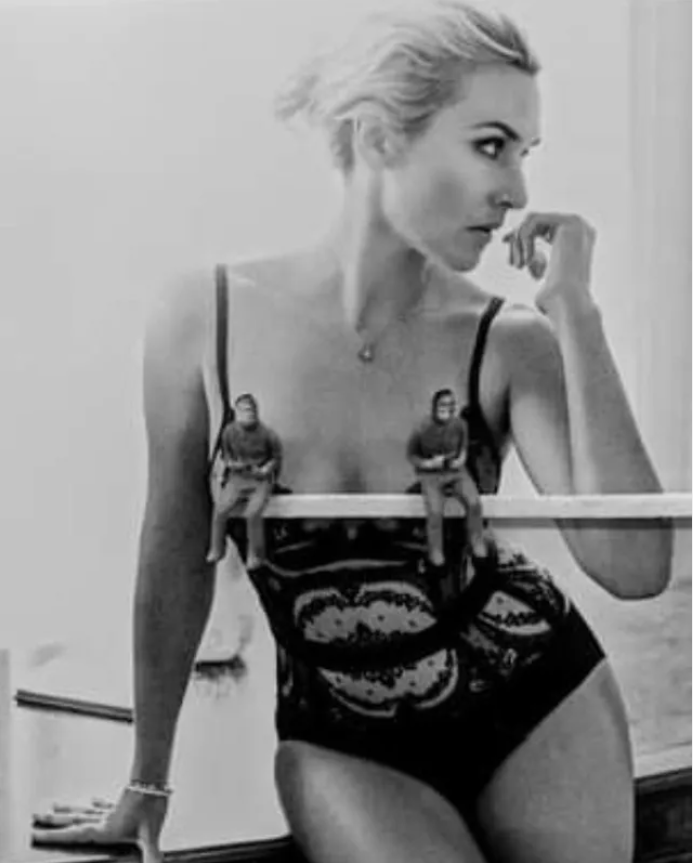
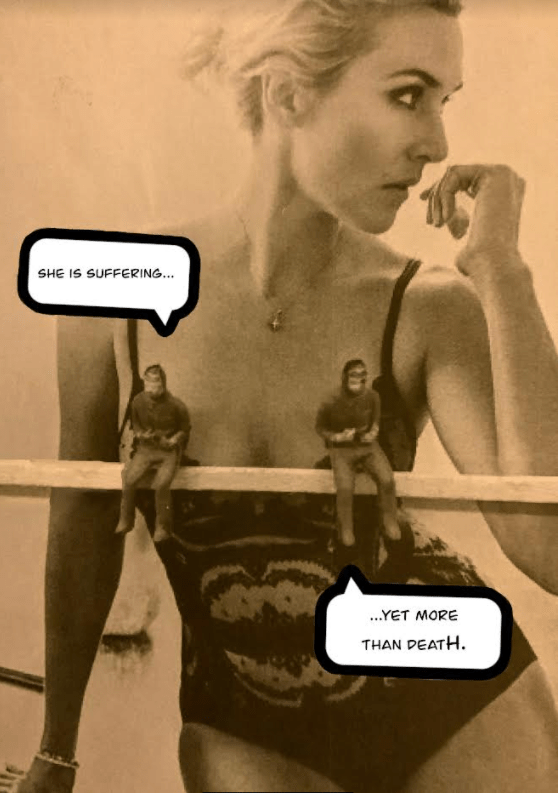
A picture from a magazine, two micro sized men and a matchstick create a billboard size scale. Really enjoyed coming up with this. Hillsborough college.White Lion pub quiz scraperboard
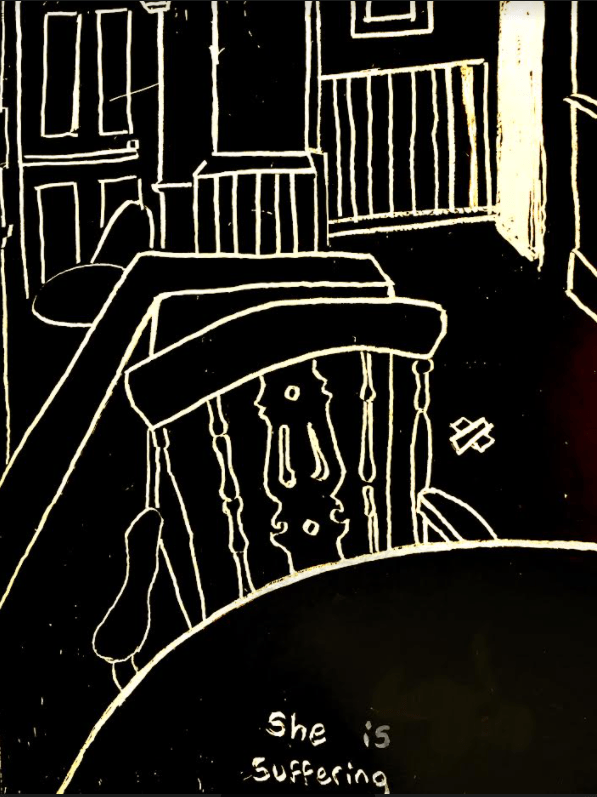
She is suffering scraperboard
She is suffering/ photo collage with matchstick men digitally manipulated via procreate








 Rusty'sArtWerk