Little baby nothing

Little baby nothing by Manic Street preachers

https://www.youtube.com/embed/wM3N54avEQc?version=3&rel=1&showsearch=0&showinfo=1&iv_load_policy=1&fs=1&hl=en&autohide=2&wmode=transparentLittle baby nothing- Manic street Preachers

Today I am going to talk about the fantastic single by Manic Street Preachers Little baby nothing that was released in November 1992 off their debut album.

Littlebabynothing.jpg
Single cover

Little baby nothing features vocals by Traci lords a former pornographic actress who lied on her birth certificate by two years and was actually performing films underage which led to prosecutions and the films that she starred in were pulled as child pornography.
Shocking stuff but Traci was ideal to feature in this song about sexual exploitation.
Bradfield said: “we needed somebody, a symbol, a person that could actually symbolize the lyrics and justify them to a certain degree. Traci was more than happy to do it. She saw the lyrics, and she had an immediate affinity with them. It was definitely easy to incorporate her personality into the lyrics. We just wanted a symbol for it, and I think she was a great symbol.”

The Manics tackle issues regarding female sexuality and their vulnerability often you will see it in songs like She is suffering and 4st 7lb for instance.

Their first choice for the single was Kylie Minogue who due to commitments couldn’t be involved.

These are the lyrics for little baby nothing:

No one likes looking at you
Your lack of ego offends male mentality
They need your innocence
To steal vacant love and to destroy
Your beauty and virginity used like toys

My mind is dead, everybody loves me
Wants a slice of me
Hopelessly passive and compatible
Need to belong, oh the roads are scary
So hold me in your arms
I wanna be your only possession

Used, used, used by men

All they leave behind is money
Paper made out of broken twisted trees
Your pretty face offends
Because it’s something real that I can’t touch
Eyes, skin, bone, contour, language as a flower

No god reached me, faded films and loving books
Black and white TV
All the world does not exist for me
If I’m starving, you can feed me lollipops
Your diet will crush me
My life just an old man’s memory

Little baby nothing
Loveless slavery, lips kissing empty
Dress your life in loathing
Breaking your mind with Barbie Doll futility

Little baby nothing
Sexually free, made-up to breakup
Assassinated beauty
Moths broken up, quenched at last
The vermin allowed a thought to pass them by

You are pure, you are snow
We are the useless sluts that they mould
Rock ‘n’ roll is our epiphany
Culture, alienation, boredom and despair

You are pure, you are snow
We are the useless sluts that they mould
Rock ‘n’ roll is our epiphany
Culture, alienation, boredom and despair

Great lyrics and even more appropriate than ever with women selling themselves online in front of a webcam for OnlyFans etc.

Looking through the comments on YouTube everyone agrees how attractive James Dean Bradfield is and let’s face it that image did not detract from their popularity.
Lots of feminist style slogans going on here, He-man being put into a blender (I wept at that), women divided into cuts like chattel. The lady with lipstick on her legs Read my lips and the lipstick on John Wayne was a nice touch too.
W H I T E M E N A R E S E X U A L L Y I N F E R I O R written on the backdrop too. I love Richey James and his use of slogans just to get a reaction a lot of the time.

That’s what I loved about Manic Street Preachers they married art, literature, music, philosophy and a rock n’ roll image into this debauched symbolic act of defiance with a touch of politics.
They aren’t afraid of intellectualism which is something to be cherished in the world of mass entertainment.
Names like Orwell, Bukowski and Valerie Solanos all appeared on my cultural radar.

Sculpture of man

A B-Side from the double A-Side “Faster/P.C.P.” single taken from The Holy Bible released in 1994.
I remember owning this way back in 1994.
Here’s the front cover for that single:

FasterPCP.jpg

Lyrics:
War censored, no blood on TV
Cheap entertainment sold like a new deodorant
World War Three, a Sega dreamland
I’d take a whore to the funeral

Sculpture of man
Sculpture of man
Sculpture of man
Sculpture of man

Jesus descends, Dachau his father
Flanders is a corpse under flowers
There’s more art in Burger King
Than the British museum today

Sculpture of man
Sculpture of man
Sculpture of man
Sculpture of man

Wills and Harry, dressed in drag
Standing over the sodomised body of their mother
Would make a beautiful poster in Athena

Sculpture of man
Sculpture of man
Sculpture of man
Sculpture of man

With Richey in the band their lyrics are incendiary and far from the conservative image the band has in 2021. Akin to the other singles “Faster/P.C.P.” which feature on The Holy Bible Sculpture of man is a vibrant punky frenetic song clocking in at 1:55 with some provocative lyrics.

“There’s more art in Burger King
Than the British museum today.”

“Wills and Harry, dressed in drag
Standing over the sodomised body of their mother
Would make a beautiful poster in Athena.”

Wills and Harry are of course the sons of the late Princess Diana which this track precedes her death in 1997.
Athena being the company who brought us posters that were on every bedroom wall such as the tennis player revealing her buttock.
Another nod to consumerism is mentioned in the line “War censored, no blood on TV
Cheap entertainment sold like a new deodorant.”

It’s a difficult song to pin down by the vague lyrics but I sense an anger at the consumerism of art, war, entertainment with brand names being used such as Sega, Athena and the British museum to convey how strong branding is in a world full of atrocity.

Research on Manic Street preachers

The Holy Bible

I have always been a Manics fan especially of the Richey Edwards era which culminated in their finest piece of work The Holy Bible.
Released in 1994 The Holy Bible is a scabrous, nihilistic monument to the decline of civilisation in regards to religion specifically the ten commandments.
I decided to focus on this album as it has pertinent themes that still resonate today like the influence of religion (good or bad), western powers and colonialism, Anorexia, holocaust, death penalty and censorship.
Not the cheeriest album then but certainly one with tangents to explore as well as the political dimensions there are the dimensions of fandom and the personal;
Richey’s declining mental health and his own issues with Anorexia.
The literary citations and the visual imagery conjured from lyrics such as “Mussolini hangs from a butcher’s hook ” excite me so I am interested in what works I will produce with some a rich source.
The band introduced me to Jenny Savile whose artwork adorns the front page of The Holy Bible and it’s follow-up The Plague of lovers.
A lot of artists I have discovered through this band such as the photographer Vivian Meier, Kevin Carter et al.
before I delve into the album a bit more let’s look into their history preceding the album.

Manic Street Preacher’s history

I assume that whoever may be reading this might not know who the Manic Street Preachers which is unlikely or why I have chosen that band amongst others. Here is an insight into the band:

Manic Street Preachers are a Welsh rock band formed in Blackwood in 1986. The band in their current incarnation consists of cousins James Dean Bradfield (lead vocals, lead guitar) and Sean Moore (drums) and Nicky Wire (bass guitar, lyrics). They are often colloquially known as “the Manics”.

Following the release of their debut single “Suicide Alley”, Manic Street Preachers were joined by Richey Edwards as co-lyricist and rhythm guitarist. The band’s early albums were in a punk vein, eventually broadening to a greater alternative rock sound, whilst retaining a leftist political outlook. Their early combination of androgynous glam imagery and lyrics about “culture, alienation, boredom and despair” gained them a loyal following.

Manic Street Preachers released their debut album, Generation Terrorists, in February 1992, followed by Gold Against The Soul in 1993 and The Holy Bible in 1994. Edwards disappeared in February 1995 and was legally presumed dead in 2008.

This is the era I am most concerned with I remember these incidents as I was reading kerrang! at the time. These were pre-digital days and information was scarce when it came to your favourite bands.
Kurt Cobain had took his life in April 1994 so it felt like all my musical heroes were coming to an end.
I left school in 1994 so the world seemed a colder and more uncertain place with the news that these musicians lives were so fragile and whom I held so dear.

The year is 2021 and I am 43 soon to be 44 and music has been an important aspect of my life whether I am relating to millennial angst through Radiohead or analysing my fragility through the music of Nine Inch Nails or even God forbid it having a good time dancing to The Smiths.

The Manics were another band that got me to really look at the world through an artistic lens and although they never recovered totally from the loss of Richey Edwards and their albums became more conservative I still have a fondness of them in my heart.

https://www.bbc.co.uk/iplayer/episode/p09s4qds/radio-2-live-2021-manic-street-preachers


Lecture 2

https://www.tate.org.uk/whats-on/tate-britain/exhibition/lynette-yiadom-boakye

Lynette Yiadom-Boakye: Fly in the league with the night
Life of an Artwork: Belshazzar’s Feast, the Writing on Your Wall by Susan Hiller

Second lecture was talking about exactly what our criteria is and examples of critical thinking and writing.

some references given:

Édouard Glissant, Poetics of Relation, trans. Betsy Wing, (University of Michigan Press, 1997)
https://shifter-magazine.com/wp-content/uploads/2015/10/Glissant_For_Opacity.pdf
Laura Mulvey, ‘Visual Pleasure in Narrative Cinema’, in Lux Online,
https://www.luxonline.org.uk/articles/visual_pleasure_and_narrative_cinema(printversion).html
Soviet Montage, in Movements in Film https://www.movementsinfilm.com/soviet-montage
Isabelle Graw et al, Thinking Through Painting: Reflexivity and Agency beyond the Canvas, (Sternberg Press 2012)

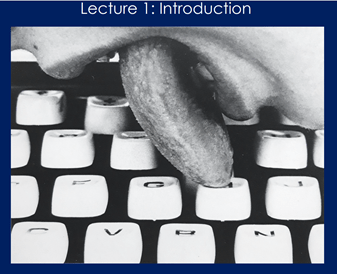
Lecture 1 Introduction

Leonora de Barros, from the Poema series, 1979

The word metaphor is made up from two parts: meta (over, across), and pherein (to carry, or to bear). Metaphor, ‘a transfer, especially of the sense of the transfer of meaning from one word to a different word, literally a carrying over’.

‘Hope’ is the thing with feathers / That perches in the soul / And sings the tune without the words / And never stops – at all.

Emily Dickinson

Using metaphor to translate our ideas concerning art when it is a visual medium; examples are above.

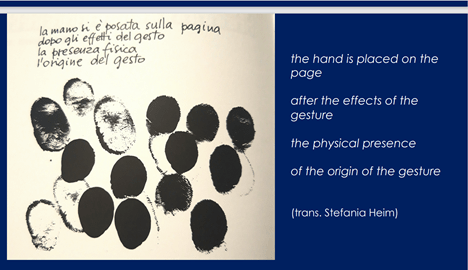
Detail from In rapport a (in relation to), handwriting
and fingerprints on paper, Liliana Landi, 1974

‘In the creative act, the artist goes from intention to
realisation through a chain of totally subjective
reactions. His struggle towards the realisation is a series
of efforts, pains, satisfactions, refusals, decisions, which
also cannot and must not be fully conscious, at least on
the aesthetic plane. The result of this is a difference
between the intention and it’s realisation, a difference
which the artists is not aware of.

The transcript of a talk, The Creative Act, given by Marcel Duchamp in the
USA in 1957.

The tutor went on to discuss that she had a couple of issues with the quotation primarily the subjectivity which in this case it is possible to be objective. The space between intention and realisation is where the manual for practice lies within.

The Manual for Practice task will be supported through a range of group and individual taught sessions designed to support the stages of it’s development through the year.

Lecture Programme — to give an outline of the task, explain some of the concepts and approaches to research and writing, and assessment procedures.

Group Seminars — to guide you through more focussed support
towards the module task. These will be a variety of workshop-based
exercises and focus group work.

1-2-1 Tutorials with your CRIT TUTOR — to guide you in specific areas of
content in your field of study, arranged at a convenient point in your
development.

Super Crit Presentation Exercise — with two Crit Groups, presenting
work in progress, alongside some critical reflection, in written form and
oral presentation.

• ARTISTIC STATEMENT – approx. 250 words: a short and focused
artistic statement (I will give the detail of this in a separate lecture)
• STUDIO REPORT – approx. 3750 words, illustrated: a critical
reflective report of your practice, related to your wider concerns
via your contextual research.
↕ Supported by ↕
Super-Crit Presentation Exercise 600-1200 words
(end of semester 1: see your schedule and your
crit-tutors for dates of your super-crit)


MANUAL FOR PRACTICE – SUPER CRIT PRESENTATION EXERCISE

600-1200 words in total
This exercise will help you start to think through your developing final submission.
This is the document that your crit-group tutors can use to see where you are at
with the M4P, and use to plan further support and guidance.
• Describe the artwork, the idea and concept, your aims,
and any discoveries during the making.
• How does the artwork relate to other existing artist’s
artworks? Make a direct comparison?
• What are the wider ideas and concerns in the artwork?
Consider the key concepts or theories that support this.

What to do now?
• Start experimenting with ways to make notes and document and
reflect on your progress—find out what will work for you.
• Start finding out about contemporary artists and events that will
enrich and inform your practice. (Go to exhibitions in Sheffield—there
are loads).
• Start doing some reading!
• Remember, a marathon is made up of small steps

Manual for practice

Art Practice 3, BA Fine Art, Level 6

Introduction

The Fine Art course supports an exceptionally wide range of art practices and encourages individual development and creativity. The Manual for Practice task reflects this and gives you the opportunity to choose and develop a line of inquiry that is relevant to your studio work (practically, theoretically and professionally) allowing choice both in how you undertake your research and how you present it.

The task requires you to undertake an independent, open and questioning approach to your study. Of central importance is the use of primary and secondary research to identify a line of inquiry, explore ideas, test out theoretical and practical positions or perspectives, reflecting upon your on-going development, to form a critical base for your practice – a “support structure”.

The key emphasis will be to build on your knowledge gained during Art Context 1 and Art Context 2 testing out the relationship between both practice and theory. However, it is expected that your Manual for Practice will be an integrated core of your Art Practice 3 module, between making artworks in the studio and developing a critical narrative that supports the problems, contexts, methods, results and discussions generated out of, or in support to, the production of the artwork.

We will use holistic assessment for three reasons, a) the nature of art and design work often results in divergent or ‘open’ responses – there is no single ‘right’ answer; b) our approach to assessment is concerned with the process (how you get there) and the outcome (the thing you produce); and c) our large modules often consist of multiple projects (a body of work).

The task will address all aspects of the learning outcomes outlined in the Art Practice 3 module guide, specifically addressing 1) a coherent body of your own work, 2) relevance of contemporary contexts, other artists and artworks, 3) sustained critical investigation and evaluation across the year, 4) testing concepts and theories, and their analysis and application.

Delivery

The task will be supported through a range of group and individual taught sessions to suit the various stages of your progression throughout the task.

● Lecture Programme will give an introductory outline to the task and assessment procedures.

● Group Seminars to guide you through more focussed support towards the module task. These will be a variety of workshop-based exercises and focus group work.

● 1-2-1 Tutorials with your CRIT TUTOR to guide you in specific areas of content in your field of study, arranged at a convenient point in your development.

● Super Crit Presentation Exercise with two Crit Groups, presenting work in progress, alongside some critical reflection, in written form and oral presentation.

Super Crit Presentation Exercise

To support your development in critical writing skills, we will ask you to present your writing, alongside a presentation of new work, during your Super Crit Presentation.

You will need to write 600 minimum – 1200 words maximum, (approx 5-10 min presentation) about the work you present, by asking the following three questions:

1) Describe the artwork, the idea and concept, your aims, and any discoveries during the making?

2) How does the artwork relate to other existing artist’s artworks, and make a direct comparison?

3) What are the wider ideas and concerns in the artwork, and consider the key concepts or theories that support this?

By answering these questions, alongside your work, you will begin the process of critically evaluating your own artwork, and how your research begins to speak in dialogue. These and other questions will form and develop, during your contact with tutors, to help shape your final Manual for Practice.

Assessment Task – The Manual for Practice

Total of 3000-4000 words, illustrated

Produce a report for your art practice in the form of a scholarly “how to” guide, setting out a practical and theoretical framework for your research interests and studio enquiry. The manual should highlight your analytical and reflective awareness of the wider context of what you make, what it does, and what impact it might have.

Your contextual research should draw from a wide range of resources available in books, magazines, exhibitions, museum displays, archives, websites, digital media platforms etc. This also includes reflection on the critical impact of any of the course content including lectures, workshops, projects, conferences, events, and trips you take part in during this course.

The content should contain the rolling integration of the following three areas of critical reflection including:

a) your own practice and discoveries in the process of production,

b) the work of other artists and artworks, and

c) concepts and theories that outline the broader themes and concerns in the practice.

Think broadly and creatively in your approach however, use this as a guide to managing the work, content and focus of each chapter:

● ARTISTIC STATEMENT – approx. 250 words

Create a short professionally-focussed artistic statement that will bring a coherent relationship between a knowledge of your own practice (as expressed through your studio report), and the wider context (as explored in your context essay). Be concise, and consider your audience when writing. Your artistic statement should be an extension of your own interests and concerns, and express the sensibilities you bring to your own practice.

● STUDIO REPORT – approx. 3750 words, illustrated

Create a critical reflective report of your practice throughout the year, highlighting the key discoveries made from initial thoughts and sketches, development drawings and diagrams, testing and sampling materials, workshops, lectures, trips, preliminary, secondary and completed works, presentation and exhibition display. Use your own critical self-reflection to consider the process of making, and how this might relate to existing knowledge and research of artistic practice.

Relate to the wider concerns in your practice by using contextual research by other key artists, critics, curators, philosophers and other sources relating to your practice, whether the conventions and traditions of art making, and/or the wider historical, social, political, cultural context.

You will submit the final results of The Manual for Practice as a digital PDF submission via BB (max 250MB file), using Power Point Presentation or Word doc to format your text and illustrations.

For Assessment, the content should demonstrate:

● Relevance – the topic you choose to study should bear direct relationship to your current art practice, artworks made in the studio for your Art Practice 3 module, and an awareness of the themes and concerns of contemporary art practice.

● Selection and Appropriateness – the choice of topic should register your awareness of appropriate working methods. For example, direct encounter with artworks, artists, engagement with theory, and/or involvement with social/political issues?

● Focussed Research – evidence of a substantial search for source material and understanding and use of sources to establish a well-rounded context for the topic.

● Critical Analysis – interpretation of sources, the identification and

development of an argument and the critical/theoretical assessment of

source material, coming from your own critical perspective.

● Academic Presentation – evidence of structure and organisation of the material, the use of coherent and appropriate language to the topic, the use of illustrative, supportive material (visual or textual) and a format using abstract, introduction, chapters, conclusion, bibliography, appendices and footnotes. Please include a word length at the end of the script.

Assessment Task Requirements

● Cover Page – including name and title.

● Acknowledgements – acknowledge those people or organisations, outside of this institution, which have been of particular help.

● Contents page – this should list everything – illustrations, sections/chapters,

appendix, showing page numbers.

● Reference for illustrations – you should label every illustration, diagram or figure, map, etc. with relevant information e.g.. title, date of work, name of maker, location (where it can be seen if appropriate), source of your illustration and so on. Including a brief caption. Presence of illustrations should be indicated in text as (Fig.1).

● Footnotes or Endnotes: A list of textual references. When you refer to someone else’s work or ideas this must be referenced i.e. acknowledged by referring to the author and date of publication. Where direct quotations are used, the page number must also be included. The citation/reference system we would ask you to use is the Oxford System (see Style Guide for details).

● Bibliography – is a list of your sources of information. It should include all

books, periodicals, catalogues, interviews, visits, web sites, or any other material you have made use of. The bibliography is placed on a separate page at the end of the study. It is organised alphabetically by author’s surname and it may be divided into sections: books, periodicals, films, web sites, etc. This is included at the end of your study (page numbers are omitted here), and this may include material you do not cite in the text. You are expected to have gathered more sources than those from which you quote (see Style Guide for details). It needs to be doubled spaced (see below) and should be at least one page long.

● Appendices – documents which are relevant to the core text, indicated in text as

(App. A.).

● Word Count – at the end of the text please include a word count (this does not include appendices, endnotes, bibliography – it is just a count of the words from the beginning of the Introduction to the end of the Conclusion).

Manual for practice.docx

Transmission October 19th Nihkil Vettukattil

Nihkil Vettukattil is an artist and writer based in Oslo. His practice concerns the role of representation and image-making processes in framing and remaking lived experience. Through a range of mediums, his work often explores the ways cultural forms can mediate everyday life and historical time. https://www.nikhilvettukattil.com/

Nihkil Vettukattil introduced us to one of his works An analogue for listening which is best described in this link:https://flatness.eu/contributors/nikhil_vettukattil/

Nihkil has a background in philosophy and incorporates the written word in his practice. Nihkil then talks about Carl Schmitt the controversial legal theorist with links to Nazism who wrote a book called on the crisis of parliamentary democracy.
Carl Schmitt has an interest in Marxism and guerilla warfare and Marx uses a curious phrase the dictatorship of the proletariat which is contrary to the kind of contemporary notion of parliamentary democracy.
The dictatorship of the proletariat is described thus “the assumption of political power by the proletariat with concomitant repression of previously controlling or governing classes that in Marxist philosophy is considered an essential preliminary to establishment of the classless state.”
Nihkil then went onto talk about representation, sovereignty and states of emergency and how democratic is a democracy.
https://parisinstitute.org/depictions-article-covid-19-and-state-of-exception-medicine-politics-and-the-epidemic-state/

https://www.artforum.com/picks/the-fountain-show-ii-86787
Nikhil Vettukattil’s Circulation (Fluidics 0 gate), 2021, installed above a fireplace, pumps fake blood through PVC tubing:

Nikhil Vettukattil, Circulation (Fluidics 0 gate), 2021, PVC tubing, mineral oil, fake blood, water pump, electronics, various plastics, dimensions variable.

Nihkil then talks about physical computing specifically fluidics in regards to his next project.
https://www.century.earth/ Century is an installation of one hundred novels from 1920 to 2020 when the exhibition opens and each book is binded with the binary code for that year:

https://www.aqnb.com/2021/01/19/matilda-tjader-nikhil-vettukattil-daemon-on-simulating-the-breakdown-of-memory-feeling-on-host-for-country-music/
Nihkil talks about his collaboration with Matilda Tjader on Host.
To round the talk off Nihkul played Fremmedgjøring.

Conclusion: A very informative lecture and Nihkul is a very intelligent artist with some great concepts which I admit went straight over my head but impressive nonetheless.