Presentation Supercrit 2021
https://anchor.fm/russell-jones7/episodes/supercrit-definitive-e1alt7g
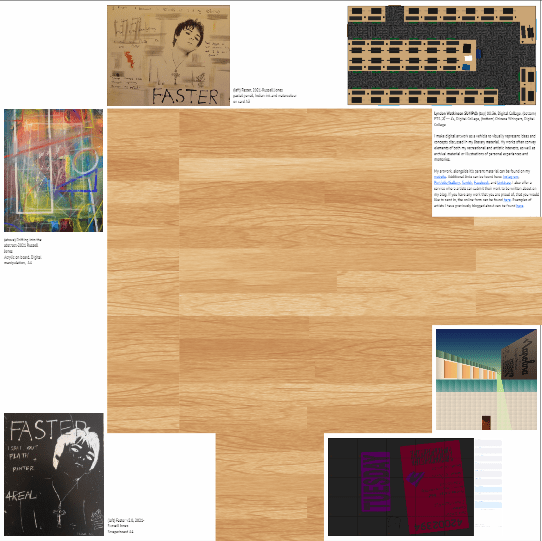
For my presentation I will display my triptych of scraperboard inspired by the Manic Street Preachers The Holy Bible album.
The triptych is apt because the front cover of the album is by Jenny Savile and presents a painting of an obese woman from three different angles as a triptych.

The Holy Bible was released in 1994 five months after Kurt Cobain’s death which shook the music world.
Richey Edwards the chief lyricist of this album and also rhythm guitarist was affected by this news. Richey’s health declined significantly during this year resulting in anorexia and self harm.
The album expresses this in its harrowing and bleak outlook on the decline of humanity in the 20th century through the lens of a religious text.
Unfortunately Richey’s health would decline and he went missing in February 1995 presumed dead.
I have chosen this album as a launchpad for ideas as it was an immensely personal album for me I was 15 when this album came out ready to be leaving school and all my heroes were dying off.


I have used the song titles as the basis for inspiration for my artwork. These are Faster, 4st 7lb and This is yesterday.
Faster is autobiographical and centres around Richey’s mindset and it feels like a defiant call to arms.
4st 7lbs is a descent into anorexia a condition Richey suffered from and puts you in the position of a girl’s viewpoint and the transcendence of bodily autonomy.
This is yesterday is a reflection on nostalgia and the yearning of childhood.
I want to mix the political and the personal which this album does and inflect my own experiences.
The album is rife with literary and artistic references such as Jenny Savile and Martin Kippenberger who have their artwork on the front covers.
The other artists of interest whilst doing my research is Raymond pettibon whose work on punk fanzines definitely has that punk DIY aesthetic of early Manics.
The album is a Pandora’s box of treasures where the more you explore the more you found out.
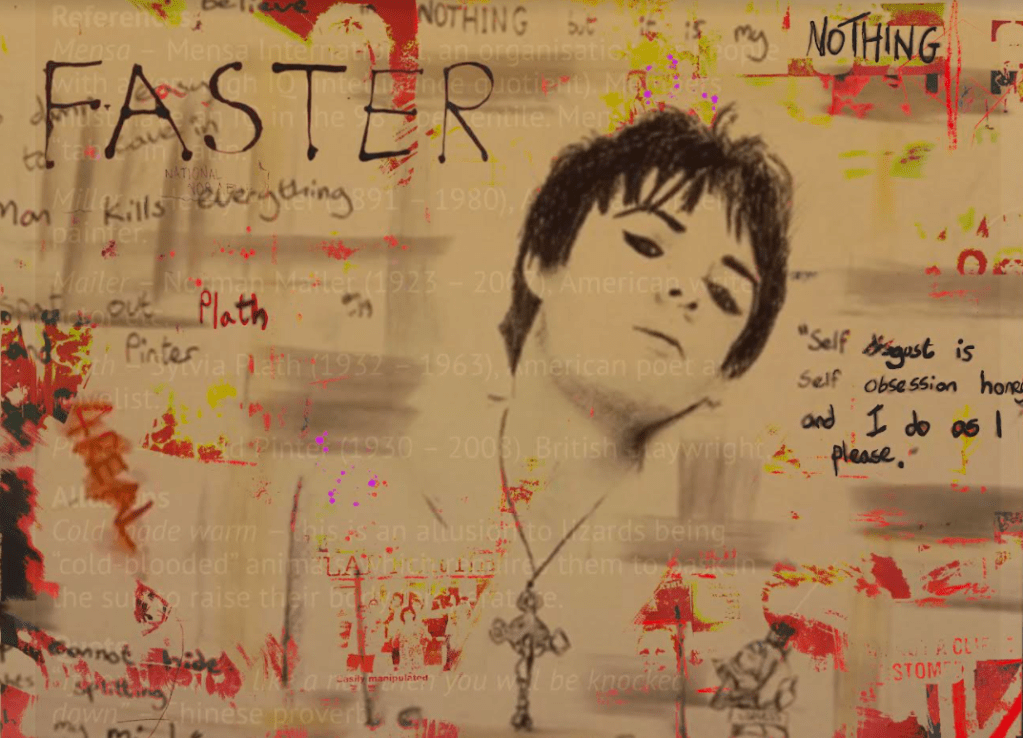
So the first picture I drew is Faster which I used pastel pencil on flesh coloured card, Indian ink and watercolour.
A simple picture with lyrics from the song around Richey James just to illustrate a kind of art associated with fandom.
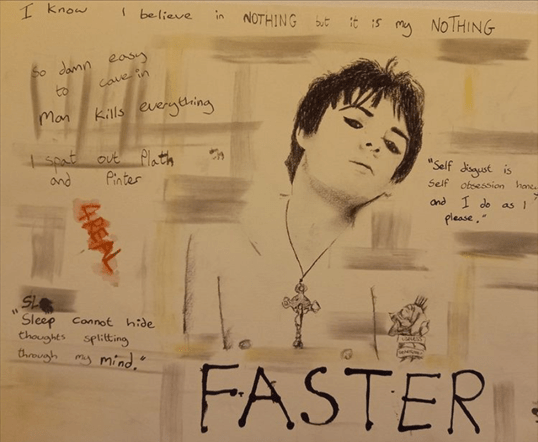
Pastel pencil, Indian ink and watercolour pencil.
Some aspects I like of this picture but overall I’m not happy with the fonts and it needs more work maybe digitally enhanced.
The next picture is 4st 7lb which I used velour paper and Indian ink to basically do the same thing as the Faster picture since the lyrics are so good I don’t think I could possibly add anything different.
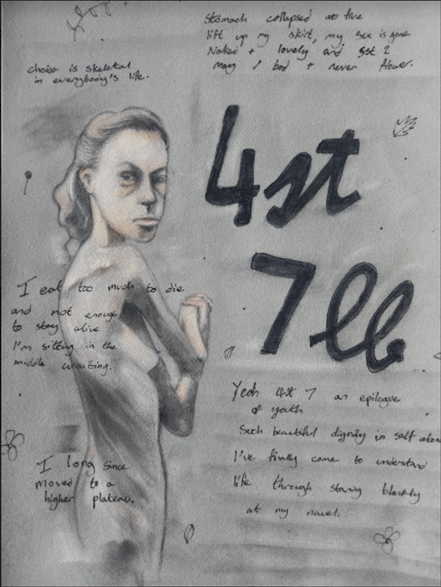
I wasn’t happy with this image for me it just didn’t convey what I wanted; in my mind I wanted something more gestural like a life drawing but I couldn’t get that across.
So I have settled for a triptych of scraperboard of the three titles Faster, 4st 7lb and This is yesterday.


Faster looks really good on scraperboard the image of Richey Edwards looking like the negative of a photo and also the front cover of a magazine.
In the bottom right hand of the corner is an issue number a nod to the punk zines of Raymond Pettibon.
I spat out Plath and Pinter a headline to catch the masses, a call to arms to reject the literary bourgeoisie.
4REAL etched into the scraperboard like the laceration of a blade on skin; Richey’s justification of sincerity to a blasé journalist.
This is yesterday a nod to nostalgia an excerpt from my mum’s memoirs, struggles of growing up. The personal being absorbed into the frame of a song reference.
Memories etched onto a surface become solidified become an object and not lost.
Scratches into the skin heal and maybe those memories that can be lost need some permanence. A nod to an archival process like a cave painting or even Moses’ tablet an urge to preserve beyond the ravages of time.
4st 7lbs counting the days down like the days spent in your personal hell starving yourself to achieve the goals of transcendence.
I think all these pieces benefit from using scraperboard and add a consistency and a mark making that is visceral, violent and of the punk ethic that ties in with the DIY aesthetic of Raymond Pettibon, Martin Kippenberger and I would like to think Jenny Savile who has an interest in the bodily form and violent provocative images.
Raymond Pettibon
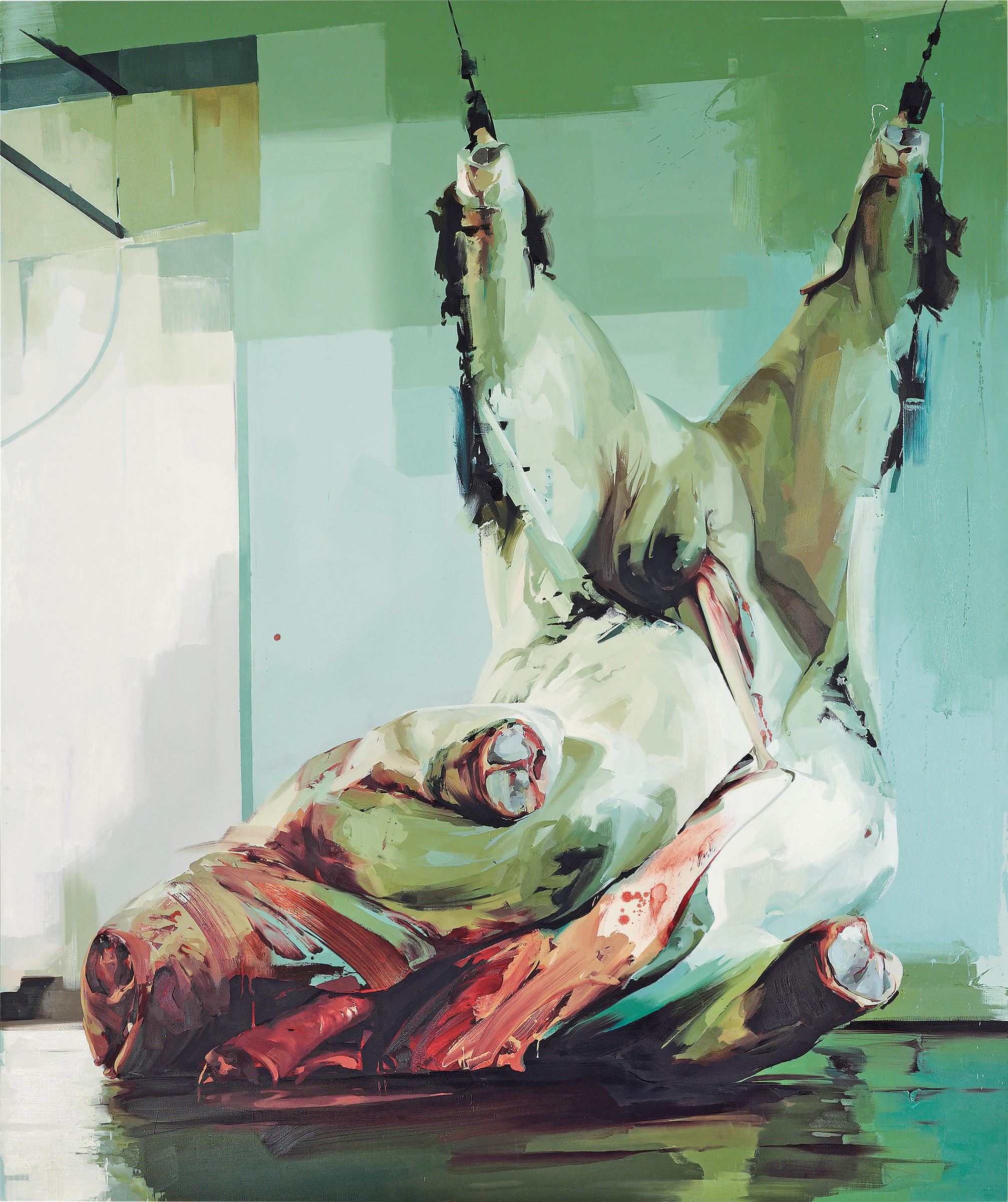
These artworks I have chosen are the kind of art I am drawn to whether it is a political statement, a montage of random ideas or a picture that is simply visceral.
The medium of scraperboard may not be the same but I hope the intent is.
I hope to continue in this vein mixing more personal with the political and following disparate strands to make some sense of what I am exploring.
Too many rabbit holes to go down and the undertow will pull me under and submerged I may find the inspiration; hopefully I will emerge with the work I want.
I may be spinning too many plates just to have them all smash but maybe that is the whole idea, the artwork in its creation.

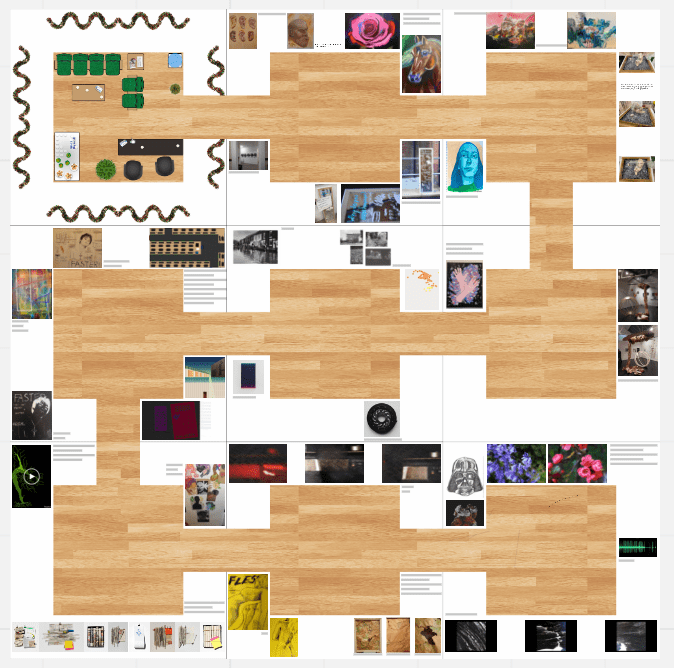
Lyndon curated the 9 sleeps online exhibition on Miro:
Martin Kippenberger
https://www.tate.org.uk/whats-on/tate-modern/exhibition/martin-kippenberger/martin-kippenberger-biography
Words in this article are taken from Yusef Sayed essay found in https://227lears.com/2021/02/10/unconventional-redemption
Martin Kippenberger (25 February 1953 – 7 March 1997) was a German artist and sculptor known for his extremely prolific output in a wide range of styles and media, superfiction as well as his provocative, jocular and hard-drinking public persona.
“Art is, in fact, always viewed after the fact, from outside, seldom at the moment it’s created – I’d say twenty years after. After that, one finally determines what effect the work and the artist had. How people then will talk about me, or won’t talk about me, that’s what will count.”
– Martin Kippenberger
Kippenberger’s reputation has only grown since his death in 1997 at the age of 44. Often overlooked for prestigious exhibitions that showcased the works of his peers both in Europe and America during his lifetime – and seen by some as more of a prankster than someone to be taken seriously – his work is now part of museum collections worldwide and the subject of hugely successful retrospectives, notably The Problem Perspective at the Museum of Contemporary Art, Los Angeles in 2009.
Through his use of caustic humour, wordplay, historical references, idiosyncratic recurring motifs, autobiographical elements and an enthusiasm for repurposing a vast array of media and everyday objects, Kippenberger left an enormous body of work – much of which was made with the help of assistants, students and friends, regularly turning out several paintings, or multiples each day.
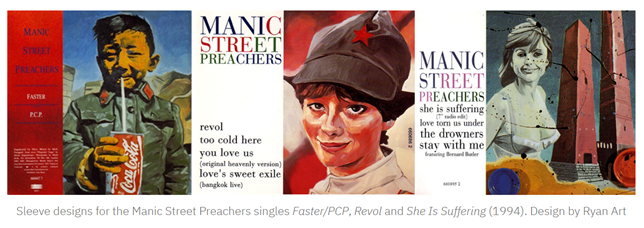
Yusef Sayed goes into further detail in his essay and he does an incredible job but I will say this about Martin Kippenberger is fantastic and an inspiration. I love his covers for the Manics singles and I remember owning them and the covers add a mythos to the band.
I love the fact Martin Kippenberger is controversial. I am an atheist and in my world there are no sacred cows, prophets or divine retribution I need to be afraid of just other human beings.
If there is one tenet of religious behaviour I will admit I have a liking for is the idea of Karma which everyone should adhere to.
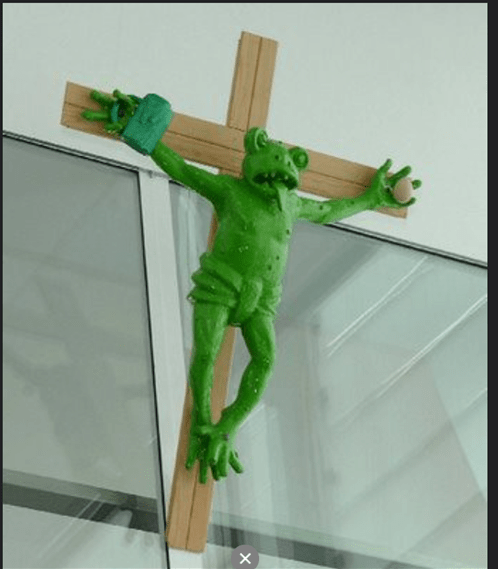
https://artoridiocy.blogspot.com/2008/08/jesus-frogging-christ.html
The crucified frog is right up my street.
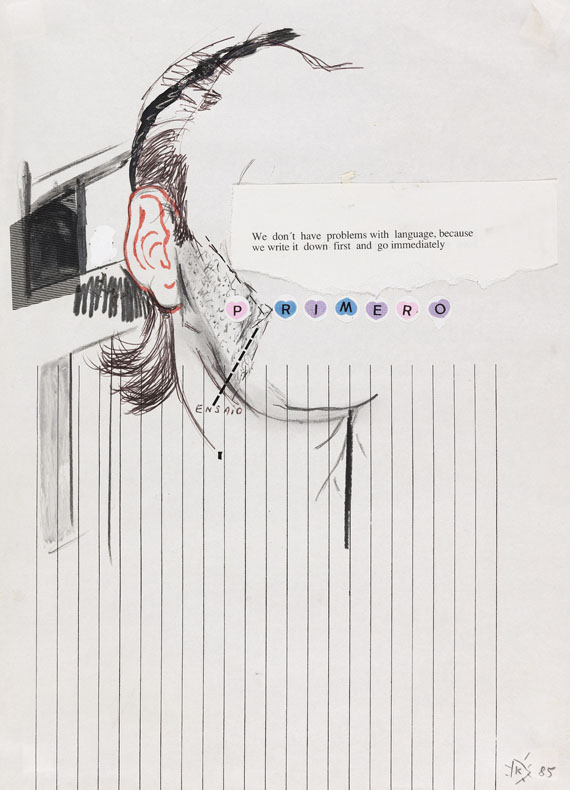
Mixed media with collaged text, letter sticker and adhesive stripes on partly ruled paper.
Bottom right monogrammed and dated. 30.5 x 22.5 cm (12 x 8.8 in), size of sheet.
I absolutely adore this piece of work and it is exactly the sort of approach I am looking for in my own work.
Manual for Practice 2021–2Art Practice 3, BA Fine Art, Level 6Seminars for ‘Performative Reflection’
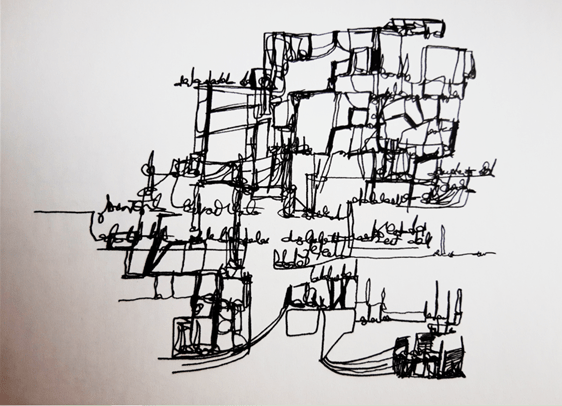
Except for a few identifiable syllables and words, [or] the
From John Vincler “Dwelling places: On Renee Gladman’s turn to drawing” in the Paris Review, 2018
beginning of a sentence or phrase, the drawings take the form of
stylized but illegible writing in lines that often cluster to suggest
architectural silhouettes or urban skylines. What would cause a
writer to turn to a mode of drawing that looks like writing? […] The
drawings share many of the same concerns and preoccupations
found in her prose but are addressed through line, gesture, and
space, rather than language. […] This is what I wanted to know:
What are we reading or seeing when moving through books of
writing containing only gesture and abstraction? What does it
mean to write free from language?
As artists, can we answer John Vincler’s question? We often think and make in ways that are outside of words, and so sometimes, when we are asked to write about our work, to find
words to reflect on our work either on the page or as speaking, we can struggle. We get afraid of words and worry that we are not using them properly. We get frustrated because some of what we do is not designed to fit into words—words can’t ‘capture’ it.
But maybe our artist skills are the very skills that can help us find ways of using words that do better ‘justice’ to our work. Maybe we can explain to John Vincler why an accomplished writer like Renee Gladman used drawing to help her develop her thinking?
‘It was a different terrain than writing, inciting new questions about space, gesture, and the accumulation of
experience’.Renee Gladman, from her introduction to Prose Architectures.
‘Through drawing I had discovered a new manner for thinking. It extended my being in time; it made things
slow. It quieted language’.
‘In contrast to writing this line moved in time with thought rather than chasing thought through syntax’
Exercise 1: Drawing as Writing as Drawing in the Dark
• Grab a drawing board and some paper.
• Get comfortable (whatever works for you).
While we watch these two short experimental films, in the dark draw and write in response to what you are seeing / experiencing. What emerges doesn’t matter, it’s the doing that counts. Pay attention to the sounds, shapes, and textures of what you are seeing, not just the content. Don’t worry that you can’t see the paper, or that your marks and lines and words are layering up on top of each other.
https://www.ubu.com/film/rhoades_dresden.html Film 2: Lis Rhodes, Dresden Dynamo, 1971-72
Exercise 2: Draw/Write Your Work Back to Life Part 1
Spend 10 minutes looking at and listening to your piece of work. Sit with it. Look at its surfaces, its movement, its textures, its colours, its shapes, its size, its sounds, its volume. Focus on detail, focus on the whole, pay attention to it, let it speak to you. What is it trying to say? How can you help it? Don’t worry if your mind goes blank. Don’t worry if it races
Do not take notes while you are doing this, even if you really, really want to. Now put the work out of sight, and as before
• Grab a drawing board and some paper.
• Get comfortable (whatever works for you).
Exercise 2 Part 2: Draw/Write Your Work Back to Life Part 2
Now put the work out of sight, and as before
• Grab a drawing board and some paper.
• Get comfortable (whatever works for you).
Use drawing and words to remember the work you were just looking at or listening to. You might try and represent the work, or you might try and remember it through shapes, marks and lines. On the same sheet of paper, jot down any thoughts that occur to you about the work. What was it? What is it? What could it be? What do you want to do? What happened?
What next…? Use as much paper as you want. Go for it.
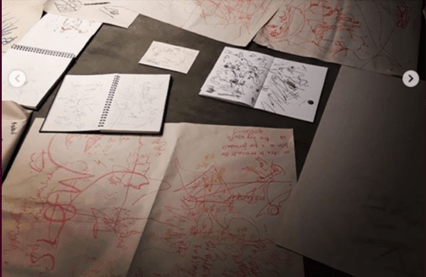
November 16th Holly Graham
Holly Graham is a South London-based artist, working with print and audio. Her work examines how memory and narrative shape collective histories. Bound up in this lies an interest in recording-mechanisms, documents, evidence and processes of editing – concerns rooted around a commitment to responsible story-telling and amplifying quiet histories. Recent exhibitions & projects include: ‘Within which all this is suspended: Acts of betrayal’, Contemporary Collaborations at Robert Young Antiques (2021); ‘What Looks to be a Piece of Fruit & Loose Teeth and Stinking Breath’, Southwark Park Galleries (2020–21); ‘No Winder You Canna Catch Fish’, Gaada, Shetland (2020); #FridayFact, Goldsmiths CCA, Online (2020). Graham’s talk will reflect on matters raised in her essay ‘Be/hold/en – A Duty of Care’, in ON CARE (London: MA BIBLIOTHEQUE, 2020). What of when representations of bodies inscribed with muddy and violent histories, racist histories and presents, are assembled and laid bare to testify, singularly or en masse; when they are duplicated, reprinted, replicated,
re-performed? Are the potentials of violence and/or agency embedded in the images also amplified? What are the responsibilities involved in their exposure and display? What protective measures are in place? And who cares anyway?
https://www.hollygraham.co.uk/
Holly Graham introduced the talk with her work Kodak https://www.hollygraham.co.uk/kodak
Holly Graham read from her essay Be/hold/en
https://www.hollygraham.co.uk/be-hold-en and talked about https://www.hollygraham.co.uk/sweet-swollen
A series of works that consider histories and legacies of sugar and slavery, taking as their starting point a pair of late 18th century ‘blackamoor’ sweetmeat bowls in Meissen porcelain, held within the Victoria and Albert Museum collection.
The works include a series of sugarlift etchings on steel, depicting the gesturing hands of these figurines and others similar in design, fabricated throughout Europe from 1765 onwards; alongside an audio piece of edited interviews with eight V&A African Heritage tour guides. These works were originally commissioned in 2018 for the Jerwood Visual Arts Project Space, located within the gallery café; and formed the starting point for an on-going body of work.
https://www.hollygraham.co.uk/green-fingers-ii After Harry Jacobs:
A body of work centred around studio images taken from the extensive archive of late South London-based photographer Harry Jacobs, now housed in the Lambeth Archives. The works in this series draw on an interest in how the studio, frequented largely by the Afro-Caribbean community from the 1950s through to the 1990s, acted throughout this period as a neutral flattened space, staging compressed narratives. In pulling backdrops and props to the foreground, the pieces seek to explore this notion of flattening and expansion both formally and thematically.
Holly Graham played the video of Green fingers 2.
A series of links posted throughout the lecture:
https://thenewinquiry.com/the-weather/
https://blogs.commons.georgetown.edu/engl-090-fall2018/files/2015/01/Sharpe_In-the-Wake.pdf
https://www.theguardian.com/books/2020/jun/21/reni-eddo-lodge-uk-book-charts-debate-racism-game-some-dont-want-to-play
https://www.e-flux.com/journal/10/61362/in-defense-of-the-poor-image/
https://www.stuarthallfoundation.org/projects/reconstructionwork/
http://www.caareviews.org/reviews/1974#.YZPnfJDP3OQ
https://badgirlsshortcourse.files.wordpress.com/2016/04/tina-campt-reading-complete.pdf
Conclusion: The lecture was very well received and Holly Graham emerged as a genuine talent who is putting forward a voice for people whose experiences have been marginalised in history and creating an archive for those experiences.
The uses of literacy
http://www.jeremydeller.org/TheUsesOfLiteracy/TheUsesOfLiteracy.php
The Uses of Literacy, 1997
This was an early curatorial project, an examination of a kind of folk or vernacular culture, so it was a lot of things at once. I handed out flyers inviting fans of the Manic Street Preachers to make art for an exhibition that was going to be staged for one day in Norwich. I was interested in the band because there was a great anti-intellectual drive in British music at the time, and this band actually wore their heart on their sleeves in terms of what they were interested in: art, literature and philosophy. I suspected that their fans would be interested in similar things. This was a pre-internet, fanzine era, but once the word got around, people started sending me all these artworks through the post. One fan who contributed was called Lotte Petersen. She lived on an island and would write me these long funny letters about how terrible her life was. The art in the show was made during a specific moment – before these young people might go to art college, where they’re basically discouraged from making this sort of work, as it is not important or significant. After that this material potentially becomes embarrassing, when it shouldn’t be. It is like catching these artists in their purest form.
Jeremy Deller


I am aware of Jeremy Deller’s work as it has come up before in lectures specifically the battle of Orgreave (which was a really good idea); I never knew he curated Manic Street preachers fan art.
I would love to have been a part of this. I consider myself a fan and Manics fans have an obsessiveness with not just the band but all their literary references and art.
Red hot chili peppers Can’t stop
This video which came out in 2002 was inspired by Erwin Wurm one minute sculpture.
RHCP have an artistic influence in their music.
Their cover for I’m with you was by Damien Hirst:


Monarchy of roses video has drawings by Raymond Pettibon the punk zine artist.
https://open.spotify.com/episode/13XY1lT1UPF9lkvFoXWRWy?si=aoAZNTnQQIell0NfLtFd5g
4st 7lb
Nothing else sounds quite like ‘4st 7lb’. Even in the context of an album on which each track is a significantly different, dark riff on the post-punk formula, this song is one of the most unique Manics efforts of its era. Bradfield’s superb guitars create much of the bleak but perversely exciting atmosphere, and Moore’s drums are constantly shifting and seldom sticking to one pattern for any length of time. The fairly protracted slow, hazy section at the end of the song is perhaps its masterstroke, build around Bradfield’s “underwater” guitar work and creating a sense of life slowly slipping away.
Life slipping away? Yes, ‘4st 7lb’ deals with a brush with death right at the mid-point of The Holy Bible, creating the (accurate) impression that things could actually get darker from here. The song is Edwards’ excellently-written musing on the subject of the eating disorder anorexia, which he himself had suffered. One of the things which makes the lyric particularly powerful is the treatment of anorexia not just as a tragic, shocking condition in terms of what it does to sufferers, but also as a kind of dysfunction of vanity in which the sufferer delights in abusing those around them (“just look at the fat scum who pamper me so”) – easy listening it is not. 4st 7lb is, of course, the weight below which death becomes medically unavoidable – the point of no return.
The song’s devastating chorus is one of the finest aspects, in which the song’s protagonist conjures up fantastic images of slimming into non-existence, romanticising the slow death she is inflicting upon herself. It is notable that Bradfield sings from an explicitly female perspective here – this is perhaps unique within the whole of the Manics discography, and perhaps shields Edwards from the significantly autobiographical nature of what he had written.
Undoubtedly one of the best songs Richey Edwards ever wrote, ‘4st 7lb’ is a devastating piece of work, even in the context of The Holy Bible. Songs like this would not come around again.
Choice Lyric
“and I don’t mind the horror that surrounds me”References
Karen – Karen Krizanovich, formerly of Sky Magazine, agony aunt, journalist.Kate – Kate Moss (1974 -) English model known for her waifish figure, drug-taking, and association with “heroin chic”.
Emma – Emma Balfour (1970 -), Australian model.
Kristin – Kristin McMenamy (1966 -), American model.
Ryvita – a rye-based crispbread product commonly eaten by people trying to slim.
Kit Kat – chocolate bar made by Nestlé.
Twiggy – Lesley Lawson (née Hornby) (1949 -) English model, particularly famous in the 1960s.
Andy Johnson https://manicsdiscog.wordpress.com/2013/03/02/t64-4st-7lb/
4st 7lbs Full lyrics
“I eat too much to die and not enough to stay alive. I’m sitting in the middle waiting.”
The song begins with dialogue from from the 1994 documentary about anorexia, Caraline’s Story, which centres on the troubles of Caraline Neville-Lister. She describes how she eats “too much”, but basically a meagre amount of food. She is eating enough food to keep you alive but not enough to maintain a healthy lifestyle. Caraline died months after the filming of the documentary.
Days since I last pissed, Cheeks sunken and despaired.
So gorgeous sunk to six stone, lose my only remaining home.
See my third rib appear, a week later all my flesh disappears.
Stretching taut, cling-film on bone, I’m getting better.
Karen says I’ve reached my target weight, Kate and Emma and Kristin know it’s fake.
Problem is diet’s not a big enough word.
I wanna be so skinny that I rot from view, I want to walk in the snow and not leave a footprint.
I want to walk in the snow and not soil its purity.
Stomach collapsed at five, lift up my skirt my sex is gone.
Naked and lovely and 5st. 2, may I bud and never flower.
My vision’s getting blurred but I can see my ribs and I feel fine.
My hands are trembling stalks and I can feel my breasts are sinking.
Mother tries to choke me with roast beef and sits savouring her sole Ryvita.
That’s the way you’re built my father said, but I can change, my cocoon shedding.
I want to walk in the snow and not leave a footprint.
I want to walk in the snow and not soil its purity.
Kate and Kristin and Kit Kat all things I like looking at.
Too weak to fuss, too weak to die, Choice is skeletal in everybody’s life.
I choose my choice, I starve to frenzy.
Hunger soon passes and sickness soon tires.
Legs bend, stockinged I am Twiggy and I don’t mind the horror that surrounds me.
Self-worth scatters, self-esteem’s a bore, I long since moved to a higher plateau.
This discipline is so rare so please applaud, Just look at the fat scum who pamper me so.
Yeah four stone seven, an epilogue of youth.
Such beautiful dignity in self abuse.
I’ve finally come to understand life through staring blankly at my navel.
I remember hearing this song back in 1994 reading the lyric sheet and thinking wow Richey has managed to get into the headspace of someone who has an eating disorder (apparently he suffered from anorexia nervosa) and not only that but from the perspective of a young female who suffer mostly from this condition.
The song explores the idea of bodily autonomy and elements of control which result in this self destructive behaviour.
The song is totally empathic and makes the listener walk in that persons shoes no matter how uncomfortable that feels.
A very important song in that context to understand the condition and the causal effects behind that.
It happens to be a great song despite the harrowing subject which pretty much sums up the album too.
Only recently Nikki from Big Brother passed away from this awful illness just recently.
In creating a panel for this song I am careful in how I present it as it is a delicate subject which needs tact.
I have some ideas of the anorexic woman which I have drawn to be surrounded by either artists in a life drawing class where her suffering has become gestural.
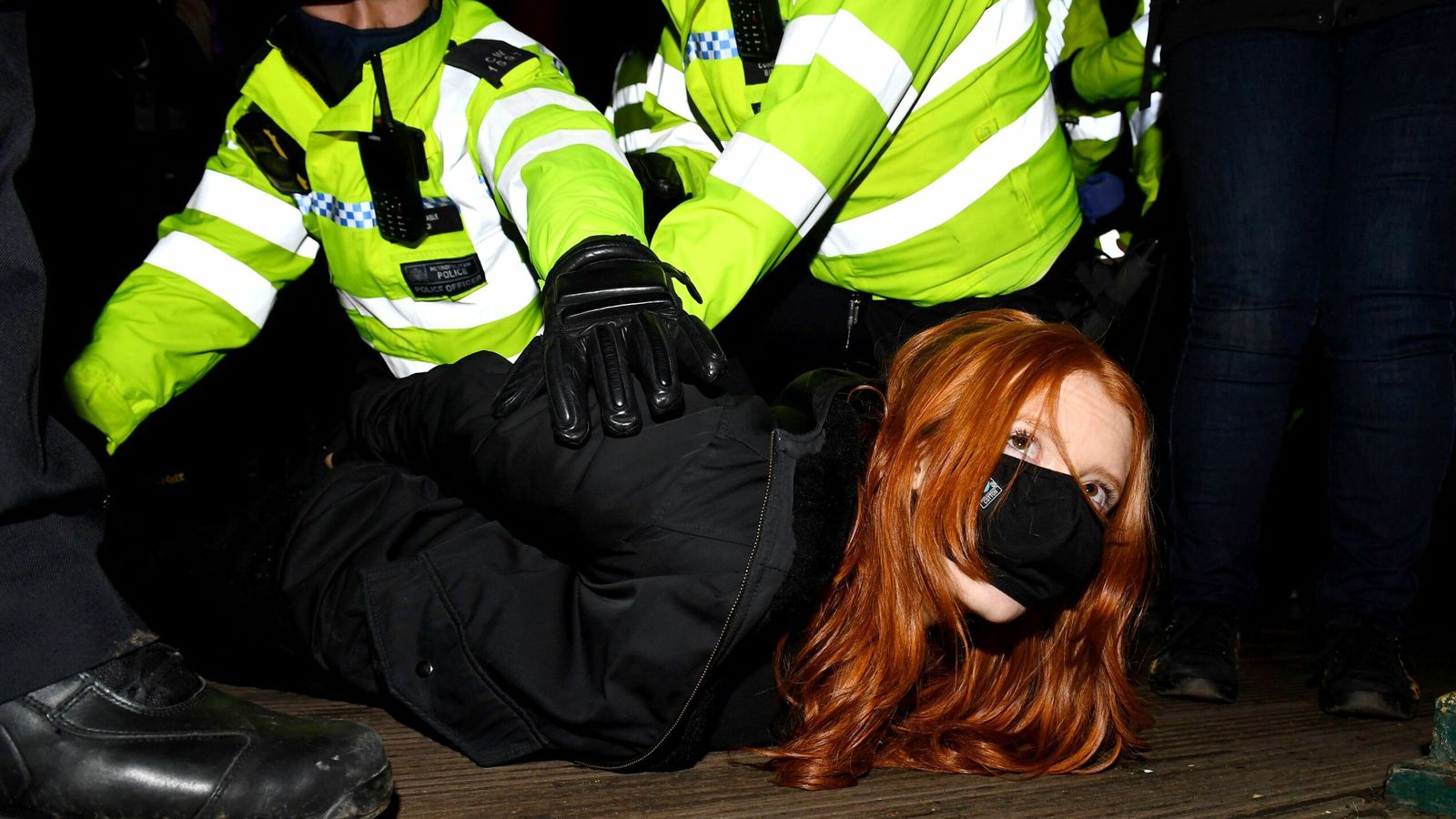
The other was surrounded by men in riot gear which was inspired by the heavy-handed approach to the Sarah Everard vigil.
A comment on the fear of a woman’s sexuality and vulnerability which ties in with the Manics sense of feminity being exploited.
I decided to draw my image of an emaciated female with lyrics from the song to kind of get the ball rolling.
As opposed to the Faster picture this time I used velour paper and I like the drawing I’m not too keen on the title but the writing looks okay.
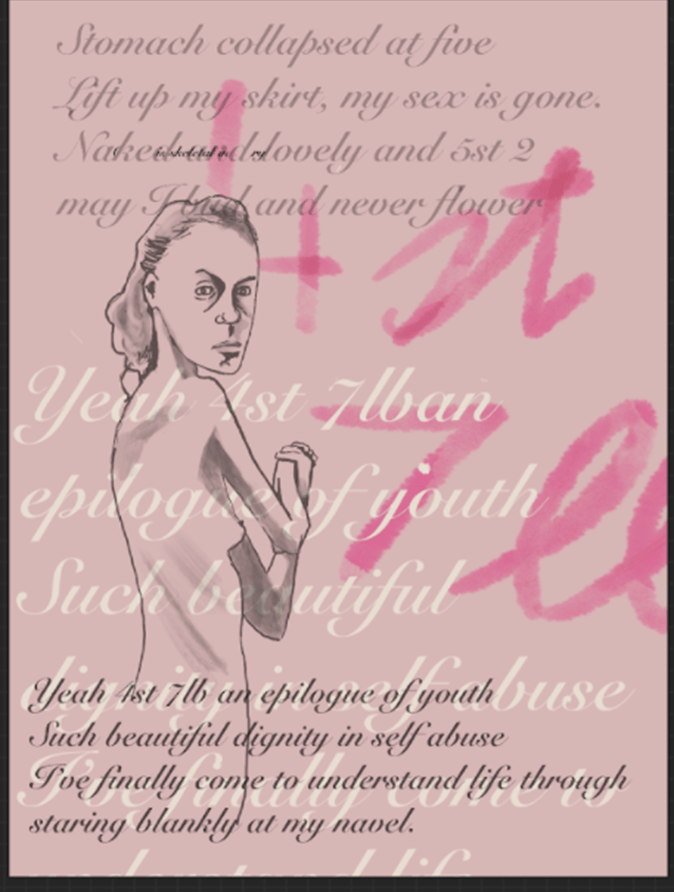
I have scanned it in to Procreate so I have more freedom to change things digitally.
I am new to procreate so I am trying to find my feet but the technology is astounding.
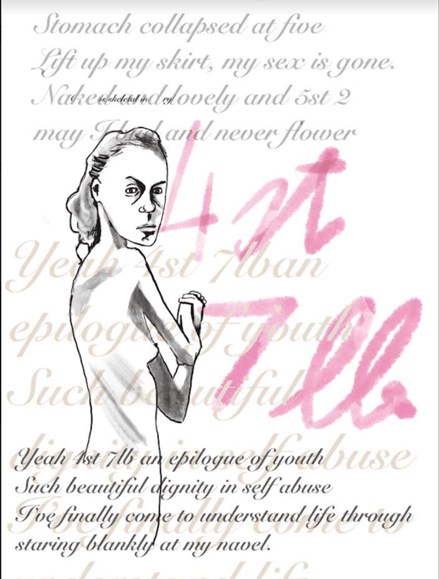
Much more happier with this and now I have this template I can experiment and create the pieces of work I mentioned before a lot easier.
I think this picture has a greeting card aesthetic to the card but the image of the girl looking back is haunting and almost accusatory.
Faster

For most Manic Street Preachers listeners, ‘Faster’ should need no introduction. Ranked by the band as their finest ever single, centrepiece of their most acclaimed album The Holy Bible, focus of the most controversial Top of the Pops appearance ever, and described by NME as “one of the most exhilarating pop singles of all time”, the song is always preceded by its immense reputation.
It is easy to forget, especially given the relatively uncommercial nature of the song, that it was also released as part of a single and as such was the first chance anyone had to hear something from The Holy Bible, the record which was to become widely regarded as the band’s best and certainly the most harrowing. Preceded only by the fairly scattershot Life Becoming a Landslide EP released in February 1994 (which contained only one song which hinted at what was to come), the Faster/P.C.P. double A-side single represented a huge shift from the band’s previously stadium-ready sound. Going “under the corporate wing” was out; scathing, self-lacerating lyrics and incendiary, back-to-basics post-punk was in. It surely cannot have been lost on the band that the date of the single’s release – June 6th, 1994 – was the fiftieth anniversary of the allied invasion of Normandy during World War II. For the band, who had switched their laid-back hard rock clothes for a rag-tag military aesthetic Keith Cameron described as “underdog spirit, individual ego subservient to the collective good”, it was their own D-Day.
Opening with a quote spoken by John Hurt in the film version of Orwell’s Nineteen Eighty-Four (the single of course being released ten years after the year in which Orwell set his dystopian novel), ‘Faster’ immediately makes apparent the dark subject matter that will haunt the whole of its parent album. The furious and explosive intro that follows is the first salvo of an era in Manics history that is both heavier and simultaneously more stripped-back than ever before – the glam-inspired piano of Generation Terrorists and the elegiac organs and strings that softened Gold Against the Soul have no place in the brutal new reality of ‘Faster’. The intensity and fearsome simplicity of guitars, drums and unhinged-sounding vocals persist for the whole of the song, leading up to the electrifying conclusion which has Bradfield repeatedly shout “so damn easy to cave in / man kills everything”. The Holy Bible would put human nature under the microscope, and the prognosis would not be good.
Although it was described by NME’s Keith Cameron as “the definitive Richey-era Manics song”, ‘Faster’ actually had notable contributions made to it by Wire. In the single-ranking session the Manics did for NME in 2011, Wire claimed responsibility for both the song’s title (which can be interpreted as either a person choosing not to eat or what Bradfield described as Richey’s prophetic vision of “the acceleration of everything – joy, pain, death, consumerism”) and the “man kills everything” outro section. The rest of the lyrics are Edwards’ work – work Wire described as “confusing”, even as early as 1994.
Arguably, the song is as much an explosion of ideas as it is an explosion of sound. Wire recalled that Edwards told him the song was about self-abuse, and for his own part Edwards listed the ideas behind the song as
“Strength through weakness. All morality sown in the soil of the ruling caste. Self-abuse is anti-social, aggression still natural. Society speeding up – finds worth in failure.“
The song’s famous chorus, which has Bradfield’s character – The Holy Bible is all about singing in character – proclaim his superiority to Mensa, (Henry) Miller, (Norman) Mailer, (Sylvia) Plath and (Harold) Pinter was described by Wire as an example of “almost heroic self-indulgence”, but is also an early (chronologically, as opposed to within the album) example of the immense range of cultural references and allusions The Holy Bible would make.
The Manics provoked 25,000 complaints to the BBC after their performance on Top of the Pops to perform ‘Faster’. This stemmed purely from Bradfield’s wearing of a balaclava with his first name written on it; in a laughable example of cultural short-sightedness, viewers interpreted the item of clothing as a gesture of support for the Provisional IRA. This would the first of two main occasions on which the Manics would provoke misplaced reactions, the second being the incident in which the cover to 2009’s Journal for Plague Lovers was considered obscene and covered up by supermarkets (the cover being a painting by Jenny Savile, who also painted the picture used as the cover of The Holy Bible).
The video for ‘Faster’ is a simple but classic one featuring the band playing in an overexposed white room while portions of the lyrics occasionally pop up as full screen captions. In the finest moment, Bradfield is seen playing the blistering solo (once again in his balaclava) while the lyric “I know I believe in nothing / but it is my nothing” appears on screen.
As with all tracks from The Holy Bible, a US mix by Tom Lord-Alge exists and was released on the tenth anniversary edition. This is often thought of as the weakest of Lord-Alge’s efforts, described by Cameron as having been “defeated” by the song. Hardly surprising – such a singular, incredible effort by the band was always going to rebuff modifications by anyone else.
Choice Lyric
“the first time yourself / naked you cry”References
Mensa – Mensa International, an organisation for people with a very high IQ (intelligence quotient). Members must have an IQ in the 98th percentile. Mensa means “table” in Latin.Miller – Henry Miller (1891 – 1980), American writer and painter.
Mailer – Norman Mailer (1923 – 2007), American writer, actor etc.
Plath – Sylvia Plath (1932 – 1963), American poet and novelist.
Pinter – Harold Pinter (1930 – 2008), British playwright.
Allusions
Cold made warm – this is an allusion to lizards being “cold-blooded” animals, which requires them to bask in the sun to raise their body temperature.Quote
“If you stand up like a nail then you will be knocked down” – Chinese proverb.Opening Quote
Andy Johnson https://manicsdiscog.wordpress.com/2013/02/25/a59-faster/
“I hate purity, I hate goodness. I don’t want virtue to exist anywhere. I want everyone corrupt” – spoken by the character Winston Smith, played by John Hurt in the 1984 film version of Orwell’s dystopian novel Nineteen Eighty-Four.
Full lyrics to Faster
“I hate purity, I hate goodness / I don’t want virtue to exist anywhere / I want everyone corrupt” Introduction by John Hurt sampled from 1984
I AM AN ARCHITECT, THEY CALL ME A BUTCHER
I AM A PIONEER, THEY CALL ME PRIMITIVE
I AM PURITY, THEY CALL ME PERVERTED
HOLDING YOU BUT I ONLY MISS THESE THINGS WHEN THEY LEAVE
I AM AN IDIOT DRUG HIVE, THE VIRGIN, THE TATTERED AND THE TORN
LIFE IS FOR THE COLD MADE WARM AND THEY ARE JUST LIZARDS
SELF DISGUST IS SELF OBSESSION HONEY AND I DO AS I PLEASE
A MORALITY OBEDIENT ONLY TO BE CLEANSED REPENTED
I AM STRONGER THAN MENSA, MILLER AND MAILER
I SPAT OUT PLATH AND PINTER
I AM ALL THE THINGS THAT YOU REGRET
A TRUTH THAT WASHES THAT LEARNT HOW TO SPELL
THE FIRST TIME YOU SEE YOURSELF NAKED YOU CRY
SOFT SKIN NOW ACNE, FOUL BREATH, SO BROKEN
HE LOVES ME TRULY THIS MUTE SOLITUDE I’M DRAINING
I KNOW I BELIEVE IN NOTHING BUT IT IS MY NOTHING
SLEEP CAN’T HIDE THE THOUGHTS SPLITTING THROUGH MY MIND
SHADOWS AREN’T CLEAN, FALSE MIRRORS, TOO MANY PEOPLE AWAKE
IF YOU STAND UP LIKE A NAIL THEN YOU WILL BE KNOCKED DOWN
I’VE BEEN TO HONEST WITH MYSELF I SHOULD HAVE LIED LIKE EVERYBODY ELSE
I AM STRONGER THAN MENSA, MILLER AND MAILER
I SPAT OUT PLATH AND PINTER
I AM ALL THE THINGS THAT YOU REGRET
A TRUTH THAT WASHES THAT LEARNT HOW TO SPELL, LEARNT TO SPELL
SO DAMN EASY TO CAVE IN, MAN KILLS EVERYTHING
SO DAMN EASY TO CAVE IN, MAN KILLS EVERYTHING
SO DAMN EASY TO CAVE IN, MAN KILLS EVERYTHING
The album cover is by Martin kippenberger
http://www.artnet.com/artists/martin-kippenberger/
Pastel pencil, Indian ink and watercolour pencil.
My idea is to represent The Holy Bible in a series of panels that look like fan art or an inlay for a CD booklet with Raymond Pettibon as reference with that whole DIY aesthetic in mind.
I usually use pastel pencil with velour paper but used card instead with a slight flesh tone to it.
Problem is that there was no room for error whilst drawing Richey but luckily I managed it.
My writing isn’t great I wanted it to look like the writings in a diary as Richey wrote his lyrics in a diary. His lyrics here are open, confessional and show his strength in being vulnerable.
I think the font would look better type written I like the unintentional mistakes here.
The 4real was painted in red watercolour and is there to illustrate the time when Richey carved 4real into his arm to demonstrate to a journalist their sincerity as a band.
I wanted this picture to be a tribute and a shrine to Richey Edwards.
I am not totally happy with this picture I am going to upload it to Procreate and tamper with it digitally as digital I feel is the way forward certainly when using text.
This is the one picture I didn’t want to deviate from as a portrait of the artist so that’s why I have chosen it first.
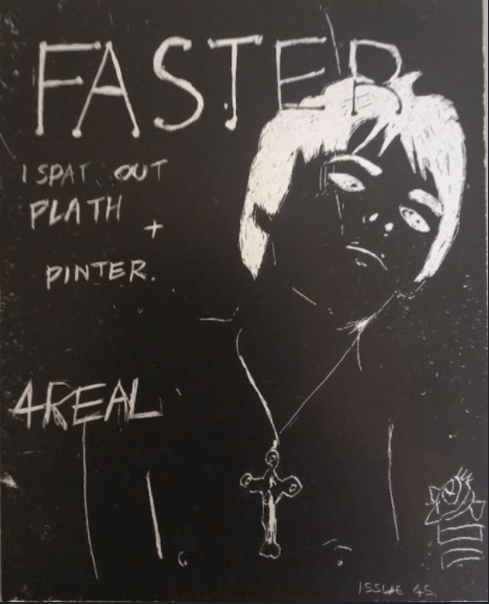
I quite like the feel of scraperboard to get the feeling of the scratches associated with self-harming and how the image looks like a negative transfer of Richey as a cover of a magazine.
Michelle Williams Gamaker 09/11/2021
Michelle Williams Gamaker works with moving image, performance, and installation. Her practice is often in dialogue with film history, particularly Hollywood and British studio films. Restaging scenes to reveal their politically problematic, imperialist roots, her work is a form of fictional activism to recast characters originally played by white actors with people of colour. She combines scriptwriting, workshopping with actors, revisiting analogue SFX, and producing props to create intricately staged films. Williams Gamaker is joint-winner of the Film London Jarman Award 2020 and is also recipient of the Stuart Croft Moving Image Award 2020 for ‘The Bang Straws’ (2021). This film will premiere at BFI’s London Film Festival (2021) and is selected for the Short Film Award. It will also feature at Aesthetica Short Film Festival in addition to Winterthur, Switzerland. Williams Gamaker is a Senior Lecturer in BA Fine Art, and is a Decolonising the Archive research resident, developed by UAL Decolonising Arts Institute.
http://www.michellewilliamsgamaker.com/biocontact.html
Michelle is introduced to the lecture by Michelle Atherton. Michelle Atherton talks about her experiences at University and how paying for fees came in just in her second year and didn’t encounter any Poc teachers apart from Steve McQueen.
Michelle started off with documentary films and started to move into fictional films.
Michelle studied in the Netherlands and returning to London.
http://www.michellewilliamsgamaker.com/houseofwomen.html Michelle talks about this video she created.
In 1946, auditions were held for the character of the silent dancing girl Kanchi in Black Narcissus (1947), the upcoming film by venerated British directors Michael Powell and Emeric Pressburger. In a nationwide search close to 1000 hopefuls applied, with over 200 girls tested and interviewed. The coveted role finally went to seventeen-year-old Jean Simmons, who had recently won worldwide acclaim for her performance as Estella in David Lean’s Great Expectations. To fulfil the role, the white English actor had to wear dark Panstick make-up and a jewel in her nose to become the “exotic temptress” of Rumer Godden’s novel of the same name.
https://www.bfi.org.uk/features/where-begin-with-powell-pressburger
House of Women recasts the role, auditioning only Indian ex-pat or first-generation British Asian women and non-binary individuals living in London. Unlike in the original role, for House of Women the re-cast Kanchi of the 21st Century speaks. Shot on 16mm film, the four candidates, Jasdeep Kandola, Arunima Rajkumar, Tina Mander and Krishna Istha, introduce themselves to an anonymous reader (voiced by Kelly Hunter) and recite a personalised alphabet including references to the history of photography and gender politics.
https://www.mattflix.video/williams-gamaker-trilogy-1
http://www.michellewilliamsgamaker.com/the-bang-straws.html The bang Straws considers the violent mechanisms of 20th century studio films and takes Anna May Wong as its starting point to revisit the casting discrimination that she experienced.
https://jupiterwoods.com/research/research-and-development-projects/herstories-feminisms/the-bang-straws
https://www.sitegallery.org/event/site-salons-alison-j-carr-and-michelle-williams-gamaker/
 Rusty'sArtWerk