12 October Transmission

NKISI (aka Melika Ngombe Kolongo)
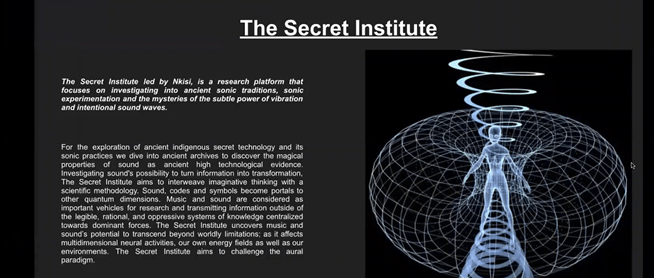
Nkisi is the alias of Melika Ngombe Kolongo, a musician, artist, DJ, and producer born in the Democratic Republic of Congo and raised in Belgium. Musically, her performances are composed of a captivating cross-talk of African rhythms, uncompromising European hard dance tropes, dark synthesizer melodies and relentless and electrifying energy. She is a co-founder of NON Worldwide, a collective of African and African diaspora musicians, and leads the research platform The Secret Institute focusing on investigating ancient sonic
traditions, sonic experimentation, and the mysteries of the subtle power of vibration and intentional sound waves. Her recorded work includes ‘Axis Arkestra’ (2020), ‘Subjective Engine’, R&S Compilation (2020), and ‘Destruction of power’, Collapsing Market (2019). Selected sound design includes the soundtrack for Slim Soledad’s performance ‘Another Map to Nevada’, Performance Agency, Berlin (2020); ‘Sensa’, with Paul Maheke and Ariel Ashbel, performed at Block Universe London UK; ‘Performa19’ at Abrons Art Centre NYC;
Ludwig Museum Cologne; Venice Biennial (2019). Nkisi has performed live in venues including Tate Modern, Berlin Atonal, HAU2, and Palais de Tokyo. She curated the Wysing Festival, UK (2017) and a series of events for the Biennale de l’Image en Mouvementin (2018). She is a Resident on NTS Radio.

Melika was introduced by Michelle Atherton I will post this link which I think explains Melika's approach and her usage of the name Nkisi also.
https://djmag.com/content/nkisi-genre-defying-artist-fusing-trance-inducing-rhythms-african-cosmology
Melika introduces the concept of her secret studies of ancient practices connected to trends.
Research is rooted into sound as a vibrational device which is labelled as cymatics:
https://www.thesecretinstitute.space/bio
“The power of sound as an invisible and critical component in our perception of reality through the ancient archives of indigenous technology; a way to critically engage with paradigm and dominant systems of knowledge. Sounds seem to be a better tool to critique our materiality sometimes dominated society based on compartmentalisation, thinking about race, gender, sexuality, ableism and how this influenced social relations and social violence. At the moment my work focuses on alternative forms of knowledge production using sound as an embodied way of exchange.
I’m particularly interested in a change in our own paradigm in how we can interact with sounds not merely for entertainment purposes, but also as a multidimensional tool to retune our holographic reality.
In ancient Conga traditions the invisible worlds are the real worlds, the physical worlds only acting as polygraphic representations of the vibrations emitted.
The Conga traditions unlock mysteries of collective meta-experience and how directional sounds generate energy.
We are worlds, we are doors and windows into other worlds as we exist at the intersections between the subtle and dense dimensions, what we see is only a fraction of what is, it is through the energetic fields that we exchange information with the subtle dimensions.
These fields are all sound, sound holds enormous amounts of data and the super imposition of different frequencies and waves creates a web of energetic fields that connects all of us.
Animated and inanimated beings. If we are all music, what music do you project? What music do we project collectively? So the idea of Cymatics would be that it is kind of like a study of visible sound and vibration.”
Melika describes how forms get more complex higher the frequency and how this can relate to patterns in nature and Maths. Melika’s album in 2019 Seven directions https://uiqmusic.bandcamp.com/album/7-directions-uiqlp002 explores this.
‘7 Directions’ – is rooted firmly in the African Cosmology of the Bantu-Kongo and in particular the writings of Kongo scholar Dr Kimbwandende Kia Bunseki Fu-Kiau.
Musically we think it’s Nkisi’s most singular record to date – explicitly exploring – via 7 hyper-focused hyper-modern tracks – the incredible polyrhythms of congolese percussion music.
UIQ
“When we hear before we see, voice and sound waves interplay between
– Nkisi
consciousness and hallucinations. Allowing the rhythmic to experiment with conditions of perception, disrupting predetermined expectations…Through manipulating rhythm, we create movements of energy… this energy determines collective behaviour and allows for new ways of producing knowledge…when we hear before we see, we can think about predicting the future and the manipulation of imagery that happens. through visionary possession we are renewed from within, in a system of systems… the pattern of patterns in being, it reaches and remains
forever incomplete”
Melika then states that everything is energy, always moving, always in vibration at the molecular level and beyond sound functions as a collective energy between beings and dimensions.
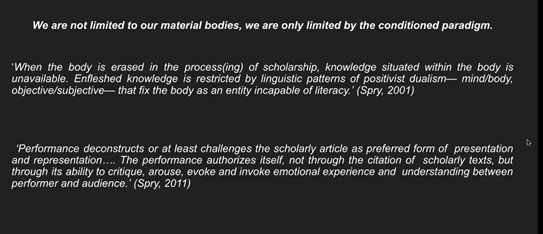
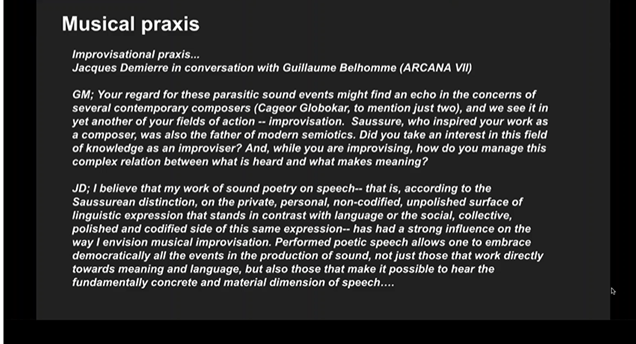
This one conversation, one of my favourite books about music from basically musicians writing music. It’s called Arcana and it’s a book that was started by a really amazing artist, John Zorn. So I think it kind of started with this group of experimental improvisational free jazz musicians from New York.
Nkisi

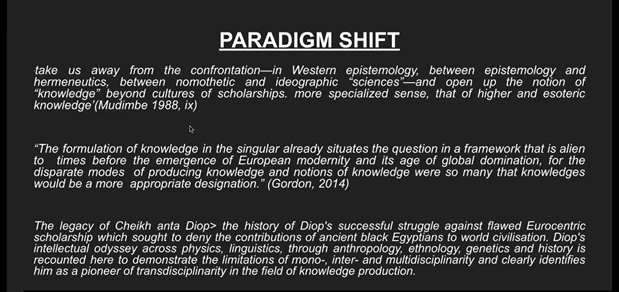
Melika then talked about decolonizing the senses and sound as embodied systems of knowledge.
Conclusion:
I found this a fascinating talk and I am massively into music so it was quite refreshing to listen to.
It would be interesting to know as the conversations were tending towards the spiritual and how sound affects that; if taking chemicals at dance events is a form of euphoria an atheist can achieve without the posit of religion but I wasn’t going to bring that one up in a public forum.
 Rusty'sArtWerk