Mark Titmarsh is a visual artist working in painting, video and writing. His current work executed under the rubric of ‘expanded painting’ is painting about painting or painting that dissimulates into objects, videos and texts. Recent work has included paintings on industrial materials, environments of fluorescent string and video works for mobile phones. His book on Expanded Painting is published by Bloomsbury. Titmarsh co-founded Sydney-based artists’ group Art Hotline, which exhibited ephemeral works in everyday non-gallery sites and co-edited the visual arts journal On The Beach. He is a lecturer in Design Studies at the University of Technology, Sydney (UTS) in Australia. http://www.marktitmarsh.com.au/
Jo and Hester Reeve introduces Mark and talks about art and philosophy and Mark’s oeuvre including his book “expanded painting”.
I am watching a recording of this lecture.
Mark introduces the title which is (not) stupid as a painter contemporary art in the vicinity of philosophy.
Nobody can say who coined the term stupid as a painter but it’s often attributed to Marcel Duchamp to indicate painters weren’t entirely dumb but produced their work through their heart but not through their mind/brain.
Mark is not philosophy trained but treats philosophy as a ready-made tool or a found object.
Most of us will brush up against philosophy in our works. Michael Corris sees art and philosophy as mediums that can overlap and create a third space.
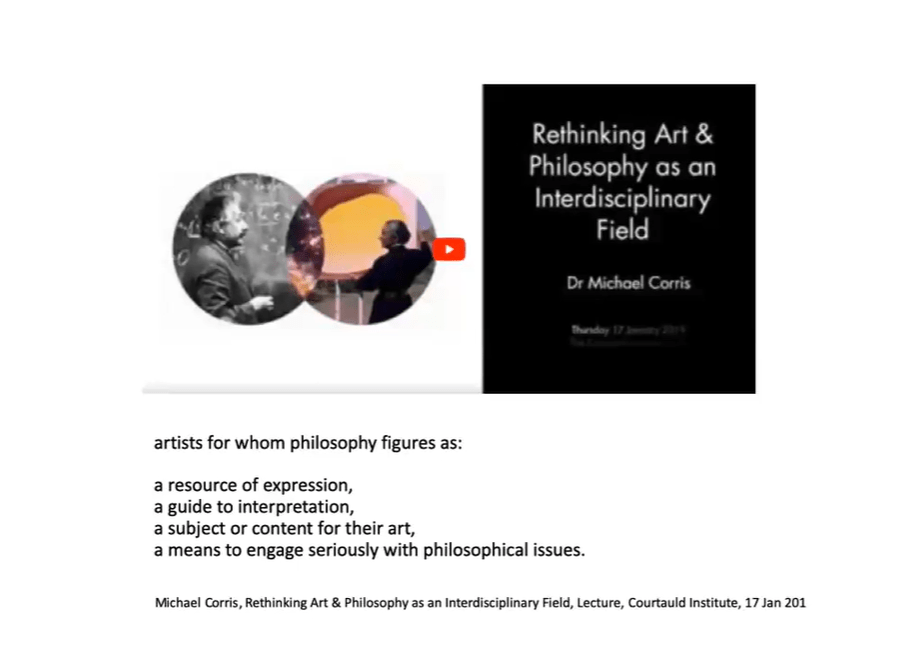
Philosophy starts as a riposte to religion asking existential questions of what it means to be human and what is the meaning of life and art.
All of these questions are subconsciously behind your art and your intention to create.
Mark gives us an example of an artist whose gender and race becomes a part of this philosophical question of who we are, our identity and how we represent that with Adrian Piper a female artist of African-American descent.
Rising to prominence as a pioneering Conceptual, Minimalist and Feminist artist in the New York art scene during the early 1970s, Piper’s work raises often uncomfortable questions about racial politics and identity, engages in social critique and deploys concepts from her parallel career as a philosopher.
Art is a philosophy in the sense of how an artist takes decisions in reflecting the world through their senses and representing them in a manifested form.
Mark gives examples of writers who expand on the notion of art and philosophy:
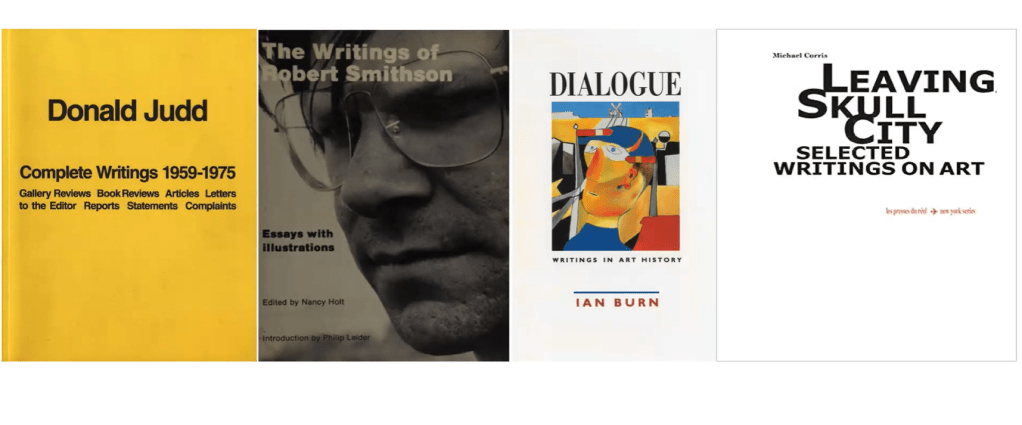
Clement Greenberg is mentioned in reference to American artists of the 40s, 50s and 60s primarily in the area of Abstract Expressionism.
Clement Greenberg was arguably the most influential American art critic of the second half of the twentieth century. Greenberg explained his concept of formalism–arguably what he is most famous for apart from being the primary champion of Jackson Pollock–in his 1960 essay “Modernist Painting.”
Mark goes onto explain how Formalism originated from the literary world and progressed into the art arena.
Russian formalism is a school of literary theory and criticism that flourished in Russia around 1915. It emerged in opposition to abstract literary theories with the goal to develop a scientific basis for the study of literature, especially poetry.

Jasper Johns’s playful, enigmatic paintings interrogate the very ways in which we see and interpret the world. Beginning in the mid-1950s, Johns deliberately avoided art cut off from everyday life and made common signs, such as flags and targets, the subject of his work. Riffing on the divergent examples of Dada and Abstract Expressionism, b Johns, along with his Neo-Dada collaborator Robert Rauschenberg, created a nuanced art that spoke to notions of autobiography, irreverence, and philosophical engagement.
The work measures 42.2 inches (107.3 cm) by 60.6 inches (153.8 cm). It is made using encaustic, oil paint, and newsprint collage on three separate canvases, mounted on a plywood board. The painting reflects the three colors of the US flag: red, white and blue; the flag is depicted in the form it took between 1912 and 1959, with 48 white stars on a blue canton representing the then-US states (excluding Alaska and Hawaii), and with thirteen red and white stripes. Newsprint is visible under the stripes. Reading the texts, it is clear that the newsprint was not selected at random: Johns steered clear of headlines, or national or political news, and used inconsequential articles or adverts. The painting has a rough-textured surface, and the 48 stars are not identical. It is dated 1954 on its reverse.
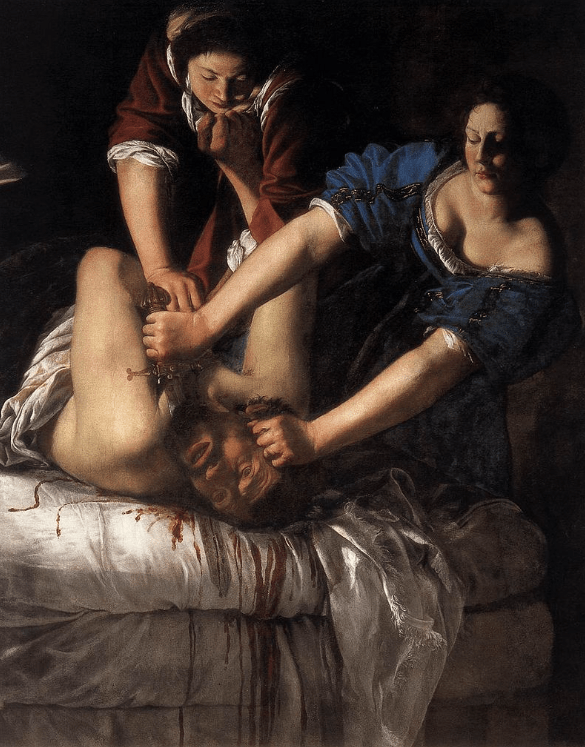
Artemisia Gentileschi, Judith Slaying Holofernes, 1620–21, oil on canvas, 162.5 x 199 cm (Uffizi Gallery, Florence; photo: Steven Zucker, CC BY-NC-SA 2.0)
“Lord God, to whom all strength belongs, prosper what my hands are now to do for the greater glory of Jerusalem; for now is the time to recover your heritage and to further my plans to crush the enemies arrayed against us.”
Judith’s prayer before beheading Holofernes (Judith 13:4-5)
The story of Judith
Rivulets of blood run down the white sheets, as Judith, a pious young widow from the Jewish city of Bethulia, beheads Holofernes, general of the Assyrian army that had besieged her city. Moved by the plight of her people and filled with trust in God, Judith took matters into her own hands. She coiffed her hair, donned her finest garments and entered the enemy camp under the pretense of bringing Holofernes information that would ensure his victory. Struck by her beauty, he invited her to dine, planning later to seduce her. As the biblical text recounts, “Holofernes was so enchanted with her that he drank far more wine than he had drunk on any other day in his life” (Judith 12:20). Judith saw her opportunity; with a prayer on her lips and a sword in her hand, she saved her people from destruction.
This type of renaissance art dominated for about 500 years until conceptual art and minimalist art in the 60s using Picasso as an example.
An example of conceptual art without the process of making or painting is one and three chairs.

Joseph Kosuth
One and Three Chairs 1965
A chair sits alongside a photograph of a chair and a dictionary definition of the word chair. Perhaps all three are chairs, or codes for one: a visual code, a verbal code, and a code in the language of objects, that is, a chair of wood. But isn’t this last chair simply . . . a chair? Or, as Marcel Duchamp asked in his Bicycle Wheel of 1913, does the inclusion of an object in an artwork somehow change it? If both photograph and words describe a chair, how is their functioning different from that of the real chair, and what is Kosuth’s artwork doing by adding these functions together? Prodded to ask such questions, the viewer embarks on the basic processes demanded by Conceptual art.
“The art I call conceptual is such because it is based on an inquiry into the nature of art,” Kosuth has written. “Thus, it is . . . a working out, a thinking out, of all the implications of all aspects of the concept ‘art,’ . . . Fundamental to this idea of art is the understanding of the linguistic nature of all art propositions, be they past or present, and regardless of the elements used in their construction.” Chasing a chair through three different registers, Kosuth asks us to try to decipher the subliminal sentences in which we phrase our experience of art.
Publication excerpt from The Museum of Modern Art,
MoMA Highlights, New York: The Museum of Modern
Art, revised 2004, originally published 1999, p. 257.
Other examples are air conditioning show with just an air conditioner in the corner of an exhibition space affecting the air immediately around the object.
A room full of radio waves, a steam sculpture, a vial of Parisian air are all unquantifiable and turned around the art market but the ideas became as valuable as a material object.
An artist choosing something as art becomes an art object challenging what an art object can be.
Ian Burn (29 December 1939 – 29 September 1993) was an Australian conceptual artist. He was a member of the Art and Language group that flourished in the 1970s. Ian Burn was also an art writer, curator, and scholar.
Mark goes into the idea of what is conceptual art in the modern world is it post-conceptual etc.
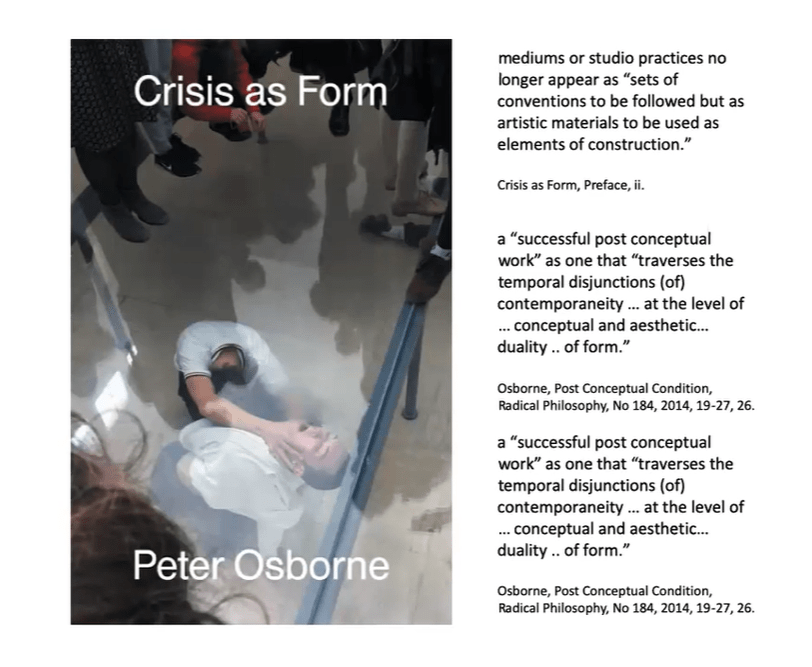
Mark explores the form of music and how it parallels art with the form of experimentation for expression for example the jazz improvisations.
Mark then mentions https://originforwardslash.com/
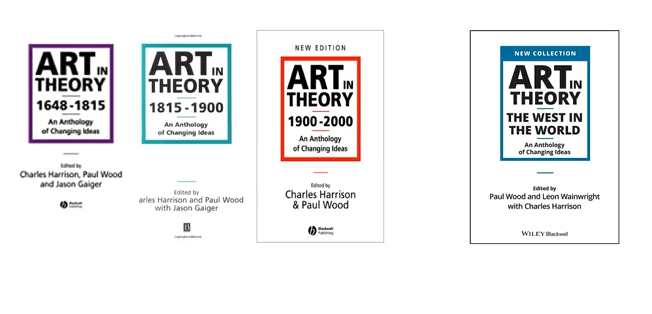
and the teaching tools which are the books on Art and philosophy
Mark mentions the post-colonial location of Australia and how that can affect his work, A.I., fashion as theatre and how the pandemic changed the face of the world and how we view ourselves as a collective.
As a summation of the talk I found it illuminating and enlightening and interesting how language and world events affect our appreciation and perception of our artistic vision.
The talk then goes into discussion of how the future can encapsulate the inclusivity and diversity of the world.
For example gender fluidity, East and the West, different beliefs and dialogues.
Artists to claim agency when they may have been marginalised or felt invisible.
For artists to challenge the status quo alongside the evolution of art and artists/philosophers that confront issues.
Philosophy helps us to deconstruct art and language and allows society to move forward and to question our society and mores.
 Rusty'sArtWerk