Larry Achiampong and David Blandy 8 June -11 February 2024
‘Genetic Automata’ is an ongoing body of video works by artists Larry Achiampong and David Blandy exploring race and identity in an age of avatars, videogames and DNA ancestry. The four films in the series investigate where deeply ingrained ideas about race come from and the role that science has played in shaping these perceptions. The exhibition premieres ‘_GOD_MODE_’, the newest film in the series, commissioned by Wellcome Collection, Black Cultural Archives and Wellcome Connecting Science.
https://wellcomecollection.org/exhibitions/ZAW0PxQAACcG-pX8 and here is a pdf of the exhibition plan https://wellcomecollection.cdn.prismic.io/wellcomecollection/8f466a20-62dd-4d47-ab66-7a0c0473ce92_WellcomeCollection-GeneticAutomata-VisualStory.pdf
On 24th of October 2023 I boarded the train from Sheffield train station en route to London St Pancras. With me were 22 fellow students of Fine Art ready to traverse round the busy London streets with the sole reason of visiting the galleries.
The first port of call is the Wellcome Collection on Euston Rd and is the exhibition from Larry Achiampong and David Blandy entitled Genetic Automata.
I am familiar with these two artists as they both conducted a talk during my undergraduate degree.
Larry Achiampong is a working-class Black man of Ghanian heritage from east London and Blandy from west London. Together they collaborate on art that explores their friendship, love of popular culture and shared interest in the postcolonial condition.
In Genetic Automatica we are asked the question of what is the role of science in shaping how we think about race.
A four-part series of video installations explores understandings of race and identity in the age of avatars, videogames and DNA ancestry.
Genetic Automata explores scientific racism: the false belief there are innate differences and abilities between races.
The human genome was decoded in 2003 which proves that there is no biological basis for race but systemic racism is so embedded in society that ideas about racial difference persist.
The first room I walked in was the Legacies of Eugenics with an array of cultural artifacts used to measure and categorise people.
Eugenics movement was started by Francis Galton at University College London in the early 1900s. “Eugenics” comes form the Ancient Greek for “good in birth”.
Galton coined the term to refer to his idea that selective breeding could improve humans.
Eugenicists created a hierarchy of people based on race, character and health.
They aimed ultimately to rid society of those they deemed unfit by encouraging only those they considered to have desirable traits to have children.
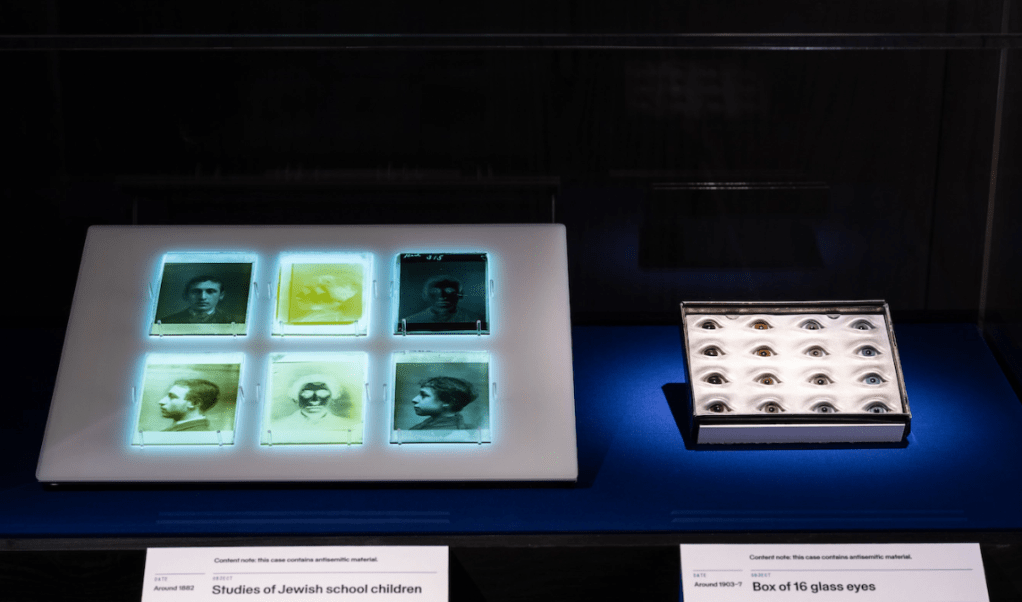
These photographs and glass eyes were used to study small groups of Jewish schoolchildren living in the East End of London in the 1920s and measure their eugenic worth. Conclusions based on these studies’ racist assumptions were presented as “objective science” to support eugenic beliefs. They fueled antisemitic immigration policies.
Other items on display are head callipers amongst other artifacts used to determine the intelligence of a race from physical characteristics.
Phrenology is the false belief that skull shape determines personality and intellect. Phrenologist Robert Noel collected these busts to analyse the difference between criminals’ and intellectuals’ heads.
This room is very interesting and presents you with unsettling evidence of the bigotry that has been the basis for the worst atrocities of the 20th century.
I am reading the Zone of interest by Martin Amis at the time of the exhibition which delves into the banality and complicity of evil when racial superiority is inferred.
Although it wasn’t mentioned in this exhibition Churchill was an advocate of Eugenics https://winstonchurchill.org/publications/finest-hour-extras/churchill-and-eugenics-1/
Films
The first of the films is ‘_GOD_MODE_’ : 11 minutes 41 seconds 2023
‘_GOD_MODE_’ considers the roots and implications of scientific racism. It explores how eugenic practices have left traces across society today, from education to medicine and politics.
This film was situated next to the Legacies of Eugenics room.
A Lament For Power
2020
13 minutes, 15 seconds
The second film in the ‘Genetic Automata’ series questions the ethics behind advances in biological science and medicine.
It is told from the fictionalised viewpoint of Henrietta Lacks, a Black American woman whose cancer cells were taken without her or her family’s knowledge in 1951. Her cells became known anonymously as HeLa cells. They are considered to be immortal because they can replicate endlessly. Lacks’ cells have been used in some of the world’s most significant biomedical developments, including the polio and COVID-19 vaccines and decoding the human genome.
Dust to Data
2021
15 minutes, 25 seconds
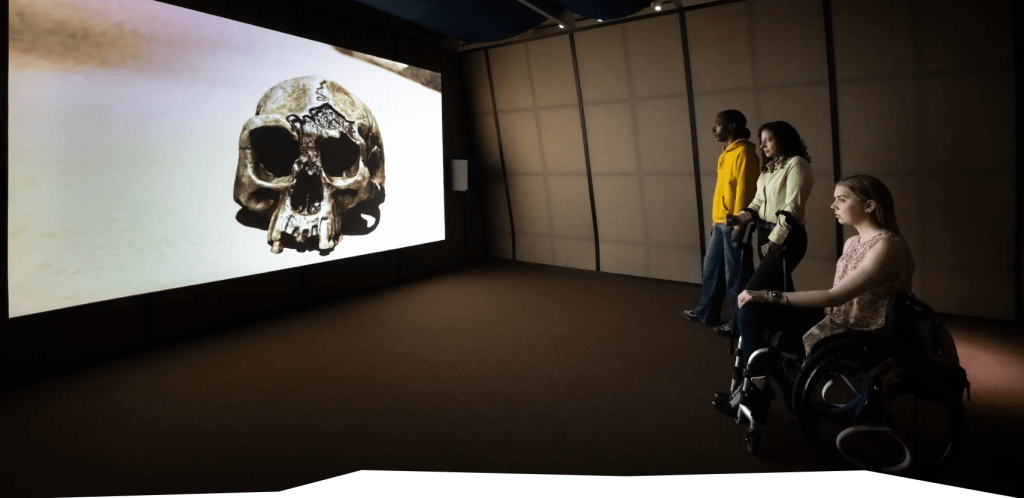
The third instalment of the series examines the tangled histories of archaeology, colonialism and eugenics.
A Terrible Fiction
2019
11 minutes 51 seconds
The initial chapter in Larry Achiampong and David Blandy’s ‘Genetic Automata’ series investigates classification, categorisation and ordering of the natural world.
It highlights John Edmonstone, a formerly enslaved Black man living in Edinburgh, who taught taxidermy to Charles Darwin. Edmonstone gave Darwin the skills to preserve and study chaffinches from the Galapagos. This enabled Darwin to formulate the theory of natural selection. Edmonstone’s significance remains largely unacknowledged.
Each video was installed and exhibited in a separate room. I really enjoyed this exhibition and how it was presented.
I feel it complimented the other exhibition of being human.
I wish I had more time to really digest all the information presented but unfortunately we were on a tight schedule with our itinerary.
I love all the references to popular culture such as Metal Gear Solid, Resident Evil and the nod to their influences such as comics like Maus written by Art Spiegelman about the holocaust using mice and rats as an analogy for human behaviour.
 Rusty'sArtWerk