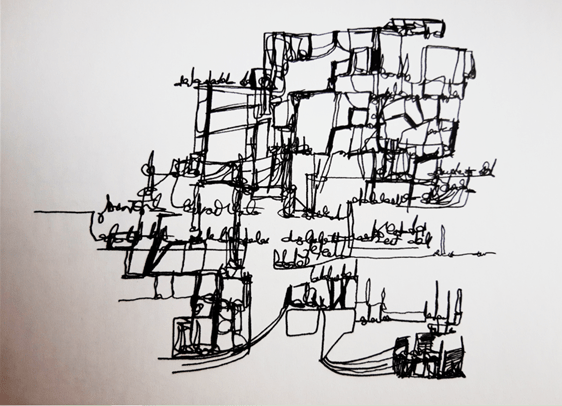
Except for a few identifiable syllables and words, [or] the
From John Vincler “Dwelling places: On Renee Gladman’s turn to drawing” in the Paris Review, 2018
beginning of a sentence or phrase, the drawings take the form of
stylized but illegible writing in lines that often cluster to suggest
architectural silhouettes or urban skylines. What would cause a
writer to turn to a mode of drawing that looks like writing? […] The
drawings share many of the same concerns and preoccupations
found in her prose but are addressed through line, gesture, and
space, rather than language. […] This is what I wanted to know:
What are we reading or seeing when moving through books of
writing containing only gesture and abstraction? What does it
mean to write free from language?
As artists, can we answer John Vincler’s question? We often think and make in ways that are outside of words, and so sometimes, when we are asked to write about our work, to find
words to reflect on our work either on the page or as speaking, we can struggle. We get afraid of words and worry that we are not using them properly. We get frustrated because some of what we do is not designed to fit into words—words can’t ‘capture’ it.
But maybe our artist skills are the very skills that can help us find ways of using words that do better ‘justice’ to our work. Maybe we can explain to John Vincler why an accomplished writer like Renee Gladman used drawing to help her develop her thinking?
‘It was a different terrain than writing, inciting new questions about space, gesture, and the accumulation of
experience’.Renee Gladman, from her introduction to Prose Architectures.
‘Through drawing I had discovered a new manner for thinking. It extended my being in time; it made things
slow. It quieted language’.
‘In contrast to writing this line moved in time with thought rather than chasing thought through syntax’
Exercise 1: Drawing as Writing as Drawing in the Dark
• Grab a drawing board and some paper.
• Get comfortable (whatever works for you).
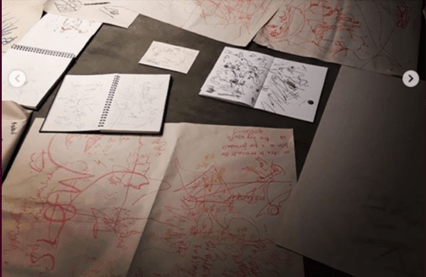
While we watch these two short experimental films, in the dark draw and write in response to what you are seeing / experiencing. What emerges doesn’t matter, it’s the doing that counts. Pay attention to the sounds, shapes, and textures of what you are seeing, not just the content. Don’t worry that you can’t see the paper, or that your marks and lines and words are layering up on top of each other.
https://www.ubu.com/film/rhoades_dresden.html Film 2: Lis Rhodes, Dresden Dynamo, 1971-72
Exercise 2: Draw/Write Your Work Back to Life Part 1
Spend 10 minutes looking at and listening to your piece of work. Sit with it. Look at its surfaces, its movement, its textures, its colours, its shapes, its size, its sounds, its volume. Focus on detail, focus on the whole, pay attention to it, let it speak to you. What is it trying to say? How can you help it? Don’t worry if your mind goes blank. Don’t worry if it races
Do not take notes while you are doing this, even if you really, really want to. Now put the work out of sight, and as before
• Grab a drawing board and some paper.
• Get comfortable (whatever works for you).
Exercise 2 Part 2: Draw/Write Your Work Back to Life Part 2
Now put the work out of sight, and as before
• Grab a drawing board and some paper.
• Get comfortable (whatever works for you).
Use drawing and words to remember the work you were just looking at or listening to. You might try and represent the work, or you might try and remember it through shapes, marks and lines. On the same sheet of paper, jot down any thoughts that occur to you about the work. What was it? What is it? What could it be? What do you want to do? What happened?
What next…? Use as much paper as you want. Go for it.
 Rusty'sArtWerk