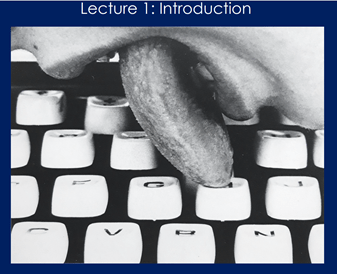
The word metaphor is made up from two parts: meta (over, across), and pherein (to carry, or to bear). Metaphor, ‘a transfer, especially of the sense of the transfer of meaning from one word to a different word, literally a carrying over’.
‘Hope’ is the thing with feathers / That perches in the soul / And sings the tune without the words / And never stops – at all.
Emily Dickinson
Using metaphor to translate our ideas concerning art when it is a visual medium; examples are above.
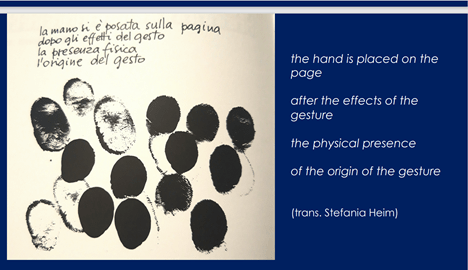
and fingerprints on paper, Liliana Landi, 1974
‘In the creative act, the artist goes from intention to
The transcript of a talk, The Creative Act, given by Marcel Duchamp in the
realisation through a chain of totally subjective
reactions. His struggle towards the realisation is a series
of efforts, pains, satisfactions, refusals, decisions, which
also cannot and must not be fully conscious, at least on
the aesthetic plane. The result of this is a difference
between the intention and it’s realisation, a difference
which the artists is not aware of.
USA in 1957.
The tutor went on to discuss that she had a couple of issues with the quotation primarily the subjectivity which in this case it is possible to be objective. The space between intention and realisation is where the manual for practice lies within.
The Manual for Practice task will be supported through a range of group and individual taught sessions designed to support the stages of it’s development through the year.
Lecture Programme — to give an outline of the task, explain some of the concepts and approaches to research and writing, and assessment procedures.
Group Seminars — to guide you through more focussed support
towards the module task. These will be a variety of workshop-based
exercises and focus group work.
1-2-1 Tutorials with your CRIT TUTOR — to guide you in specific areas of
content in your field of study, arranged at a convenient point in your
development.
Super Crit Presentation Exercise — with two Crit Groups, presenting
work in progress, alongside some critical reflection, in written form and
oral presentation.
• ARTISTIC STATEMENT – approx. 250 words: a short and focused
artistic statement (I will give the detail of this in a separate lecture)
• STUDIO REPORT – approx. 3750 words, illustrated: a critical
reflective report of your practice, related to your wider concerns
via your contextual research.
↕ Supported by ↕
Super-Crit Presentation Exercise 600-1200 words
(end of semester 1: see your schedule and your
crit-tutors for dates of your super-crit)
MANUAL FOR PRACTICE – SUPER CRIT PRESENTATION EXERCISE
600-1200 words in total
This exercise will help you start to think through your developing final submission.
This is the document that your crit-group tutors can use to see where you are at
with the M4P, and use to plan further support and guidance.
• Describe the artwork, the idea and concept, your aims,
and any discoveries during the making.
• How does the artwork relate to other existing artist’s
artworks? Make a direct comparison?
• What are the wider ideas and concerns in the artwork?
Consider the key concepts or theories that support this.
What to do now?
• Start experimenting with ways to make notes and document and
reflect on your progress—find out what will work for you.
• Start finding out about contemporary artists and events that will
enrich and inform your practice. (Go to exhibitions in Sheffield—there
are loads).
• Start doing some reading!
• Remember, a marathon is made up of small steps
 Rusty'sArtWerk